
Cycling Helmet Market Size, Trends and Insights By Category (Conventional Helmet, Smart Helmet), By Sales Channel (Online Retail, Specialty & Sports Shops, Department & Discount Stores), and By Region - Global Industry Overview, Statistical Data, Competitive Analysis, Share, Outlook, and Forecast 2026 – 2035
Report Snapshot
CAGR: 3.8%
| Study Period: | 2026-2035 |
| Fastest Growing Market: | Asia Pacific |
| Largest Market: | North America |
Major Players
- SCOTT Sports SA
- Uvex Sports
- MET-Helmets
- POC Sports
- Others
Reports Description
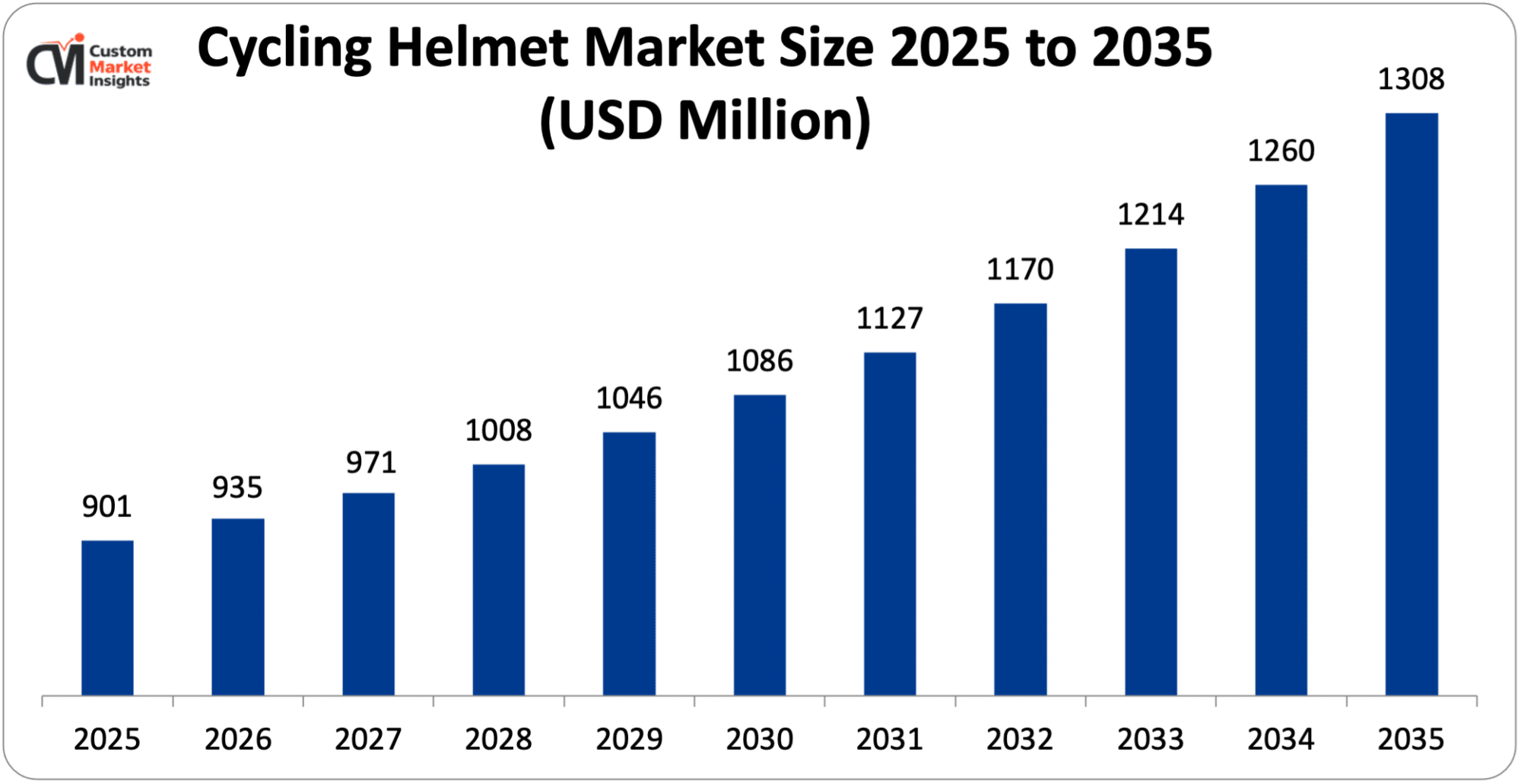
The market size of global cycling helmets will be estimated at USD 901 million in 2025 and is expected to grow to between USD 935 million in 2026 and about USD 1308 million by 2035, with a current CAGR (compound annual growth rate) of 3.8% during the period of 2026 to 2035. A cycling helmet is a protective helmet intended to protect the head of a person during the activity of cycling. The purpose of a cycling helmet is to minimize the risk of suffering injury, such as a head fracture or brain damage from a crash or fall. The typical cycling helmet consists of a shell that is comprised of a hard material—generally made from polycarbonate—and an impact-absorbing layer usually consisting of expanded polystyrene (EPS).
The impact-absorbing layer compresses under load, absorbing some of the impact energy and reducing the force to be transmitted to the skull and brain. The intention of modern cycling helmet construction is to produce an effective strap-on helmet that is airflow friendly while remaining lightweight, aerodynamic, and user-friendly. Many design concessions are made to add extra features to the helmet, such as rotational impact absorption features (like the MIPS) and fit adjustment features. Most modern bicycle helmets also have features such as a clip for a visor or headlight or even a communication system. Cycling helmets are commonly used by commuters, recreational riders, and professional cyclists. They are mandated by law in many locations to make cycling safer.
Market Highlight
- In 2025, North America will dominate the global market with an estimated market share of 42%. Increasing government initiatives and product launches drive the regional expansion.
- The Asia Pacific is growing at the highest CAGR over the analysis period. The increasing health awareness drives the industry growth.
- By category, the conventional helmet segment dominated the industry in 2025 with more than 70%.
- By sales channel, the specialty & sports shops segment would have the highest share of the market in 2025 of over 45%.
Significant Growth Factors
The cycling helmet market trends present significant growth opportunities due to several factors:
- Rising Safety Awareness & Regulations: The safety consciousness and strict government regulations are two primary driving forces for the growth of the market for cycling helmets. The increasing number of road accidents involving cyclists has increased safety concerns for the people. Thus, most of them have taken safety precautions in the form of helmets to prevent injuries. The mandatory helmet regulations by regional governments and regulation bodies have caused a rise in the penetration of helmets. These guidelines have affected raising awareness among the public about the importance of wearing a helmet. Accordingly, many safety agencies and cycling community organizations have run campaign programs to educate the consumers about the benefits of wearing helmets. This has prompted the customers to adopt the helmets on a larger scale.
- Expansion of e-commerce & Retail Channels: The growth of e-commerce and organized retail formats is a key factor driving the cycling helmet industry. Increased product accessibility, visibility, and customer convenience through organized retail channels are aiding a marked growth in demand. Online sale channels enable end-user customers to virtually view an assortment of varied product specifications, brands, and prices, facilitating the right purchase decisions. Further, direct-to-customer channel growth, chiefly driven by online sales routes and supported by a strong scope for end customer feedback and brand visibility, has resulted in increased purchase potential for brands through online direct sales channels. Organized retail channels, including specialty sports stores, hypermarkets, and supermarket channels, are also witnessing increased penetration, reported by increased spatial presence of helmets, improved product visibility, and overall acceptance.
What are the Major Advances Changing the Cycling Helmet Market Today?
- Advanced Impact Protection Technologies (MIPS & Beyond):
Advanced technologies in the protection against impacts, as offered by MIPS AB, have been an important breakthrough in the development and improvement of the cycling helmet market, offering a new level of protection to the consumers using the product, considering the linear and rotational force impacts while the helmet is in contact with the user’s head. Unlike other helmet technologies, MIPS AB offered a new level of protection through the implementation of the low-friction layer inside the helmet, allowing the head and helmet to have a slight degree of movement, thus reducing the rotational force, which is considered the main cause of brain injury in case of an accident. However, the implementation of new technologies is also offering a new level of innovation in the development and improvement of the cycling helmet market, as offered by Lazer Sport through the implementation of its new KinetiCore technology, as offered in its new line of helmets, such as the Vento, the Strada, and its latest introduction, the Sphere, offering a new level of protection through the implementation of the crumple zones inside the helmet, thus avoiding the need to add a new layer inside the helmet.
The implementation of new technologies, such as the Release Layer System (RLS), as offered through the company’s new product introductions, such as the Canyon Deflectr helmet, continues to play an important role in the improvement and development of the cycling helmet market, offering a new level of protection through its ability to protect against rotational impacts. The product launch and improvement play an important role in offering a new level of protection, innovation, and advancement in the development and improvement of the cycling helmet market, ensuring the importance of the impact protection technology in the evolution and improvement of the product.
- Smart Helmets & Connected Features:
Smart helmets with connected features have been recognized as one of the greatest innovations in the cycling helmet industry. Smart helmets are no longer just ordinary helmets but have transformed into intelligent, multi-functional wearables. These smart helmets are embedded with technology, including Bluetooth connectivity, LED light systems, GPS navigation, crash detection, and smartphone integration. These smart helmets have been found to provide greater safety and convenience compared to traditional helmets. Unlike traditional helmets, smart helmets allow for real-time communication and provide greater visibility. These smart helmets are extremely useful for commuters and athletes.
The increasing need for smart features is due to the rising number of vehicles on the road. The increasing number of vehicles on the road has resulted in greater traffic density. Therefore, smart helmets with connected features have been found to provide greater convenience. Some of the latest innovations in smart helmets include the Lumos Ultra and Ultra E-Bike smart helmets launched by Lumos. These smart helmets are designed to provide greater convenience to the rider.
The smart helmets enable the rider to communicate with other drivers on the road. With the help of smart helmets, the rider is able to communicate with other drivers on the road. Sena Technologies is another leading firm that has been at the forefront of developing smart helmets with connected features. Sena Technologies has developed smart helmets with Bluetooth connectivity, built-in speakers and microphones, and intercom connectivity.
The smart helmets enable the rider to communicate with other riders. Sena Technologies has developed smart helmets with Bluetooth connectivity, built-in speakers and microphones, and intercom connectivity. These smart helmets are designed to provide greater convenience to the rider. Sena Technologies has developed smart helmets with Bluetooth connectivity, built-in speakers and microphones, and intercom connectivity. These smart helmets are designed to provide greater convenience to the rider. LIVALL is another leading firm that has been at the forefront of developing smart helmets with connected features. LIVALL has developed smart helmets with features such as fall detection, SOS alerts, and light systems. These smart helmets are designed to provide greater convenience to the rider. LIVALL has developed smart helmets with features such as fall detection, SOS alerts, and light systems. These smart helmets are designed to provide greater convenience to the rider.
Category Wise Insights
By Category
Why Conventional Helmet Hold a Prominent Position in the Market?
The conventional helmet segment dominated the industry in 2025 with more than 70%. Traditional helmets tend to be much cheaper relative to other helmets equipped with more advanced technology or smart features. As a result, they are usually reasonably priced for most consumers, including casual riders and beginners. These types of helmets are also easily found at all sporting good shops, department stores, and online shops.
The smart helmet segment is growing at the highest CAGR during the forecast period. Smart helmets can be linked to a mobile phone and cycling apps in many ways, so they offer, among others, GPS, performance, and communication facilities elements that could enhance the cycling experience. This can appeal to the group who are riding a bike as part of a fitness routine or for transportation purposes. Several have been developed already with LED lights incorporated so that cyclists are more visible in the dark, as well as the integration of turn signals.
By Sales Channel
Why Specialty & Sports Shops Capture the Highest Market Share in the Cycling Helmet Market?
The specialty & sports shops segment would have the highest share of the market in 2025 of over 45%. Specialized shops usually stock a very comprehensive selection of helmets and are often able to advise on the technical aspect of the models. An understanding of the advantages of MIPS technology or better venting can often be the difference when a customer makes the decision to buy. Retail outlets are unlikely to stock an extensive range of high-end helmets, as most specialist or sport shops will ensure they stock only the best brands.
The online retail segment is growing at a rapid rate over the projected period. The increasing penetration of smartphones as well as the convenience offered by the online retail platform drives the industry growth.
Report Scope
| Feature of the Report | Details |
| Market Size in 2026 | USD 935 million |
| Projected Market Size in 2035 | USD 1308 million |
| Market Size in 2025 | USD 901 million |
| CAGR Growth Rate | 3.8% CAGR |
| Base Year | 2025 |
| Forecast Period | 2026-2035 |
| Key Segment | By Category, Sales Channel and Region |
| Report Coverage | Revenue Estimation and Forecast, Company Profile, Competitive Landscape, Growth Factors and Recent Trends |
| Regional Scope | North America, Europe, Asia Pacific, Middle East & Africa, and South & Central America |
| Buying Options | Request tailored purchasing options to fulfil your requirements for research. |
Regional Analysis
How Big is North America Cycling Helmet Market Size?
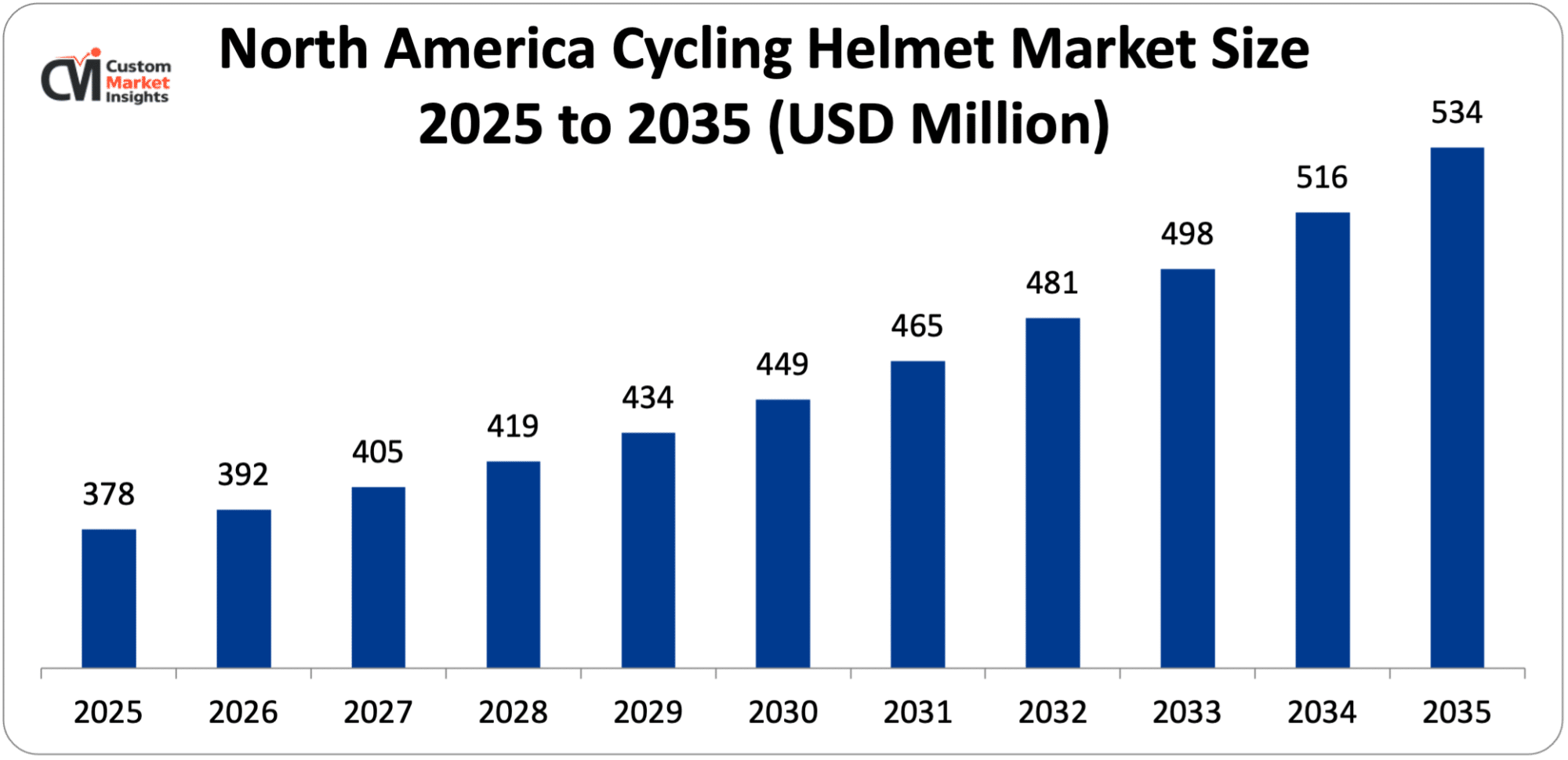
Its market size, in terms of North America Cycling Helmet, is projected to be USD 378 million in 2025 with a growth of about USD 534 million in 2035 with a CAGR of 3.5% between 2026 and 2035.
Why did North America Dominate the Cycling Helmet Market in 2025?
In 2025, North America will dominate the global market with an estimated market share of 35%. There’s a great deal of focus on safety in North America, and there are numerous campaigns and regulations encouraging riding with helmets. Many states and municipalities have legislation against riding without a helmet, and many require children to wear helmets, encouraging sales. Cycling as a leisure activity and mode of transport is increasing in North America, especially in urban centers, and the trend is stimulating demand for helmets.
US Cycling Helmet Market Trends
In the North American region, the US is growing at a significant rate over the projected period. Cycling infrastructure investment (bike lanes and bike-sharing programs) is leading to increased riding in the US and therefore increasing sales of cycling helmets. The market has seen an influx of technology-led helmets, with many smart helmet products (covering Bluetooth hearing and integrated lights, crash detection, and more).
Why is Europe Experiencing a Significant Growth in the Cycling Helmet Market?
Europe holds a significant market share in 2025. European cities are currently going through a boom in urban cycling, as its usage is expanding at a fast rate, notably in the Netherlands, Denmark, or Germany. Urban cycle-specific infrastructure is becoming more and more common in order to stimulate sustainable urban travel and make cycling safer and more comfortable. As a result of this current boom, an increasing proportion of the population in European countries has started to incorporate cycling, even as a leisure and health activity (more specifically in the UK, France, and Italy).
UK Cycling Helmet Market Trends
The UK held the dominant position in the market in 2025. The increasing health awareness related to riding a cycle drives the industry growth.
Why is the Asia Pacific Growing at the Highest CAGR in the Cycling Helmet Market?
The Asia Pacific is expected to grow at the Highest CAGR over the projected period. Cycling as a form of recreation and competition is gaining popularity quickly within the Asia Pacific region in various countries, such as Japan, South Korea, and Australia. As a result, there is a greater focus on safety equipment, such as helmets, among recreational as well as professional cyclists. Several governments within the Asia Pacific region are actively promoting cycling as an alternative healthy form of travel and at the same time conducting campaigns to enhance awareness of cycling safety issues and the need for helmets within the region.
Japan Cycling Helmet Market Trends
Japan holds the prominent market share in the industry due to the growing popularity of lightweight, comfortable bike helmets for Electric Transport, like in Tokyo, Osaka, and other large cities, more safety accessories are needed, and e-bikes and other alternative means of commute grow in demand.
Why is the Middle East & Africa Region is growing rapidly in the Cycling Helmet?
The MEA region is growing at a steady rate over the projected period. Through boosting retail distribution and expanding e-commerce sites, cycling helmets are becoming more widely available throughout the region.
UAE Cycling Helmet Market Trends
The UAE is growing at the highest CAGR during the forecast period. The rising penetration of e-bikes and bike-sharing programs in urban centers is supporting market expansion.
Top Players in the Cycling Helmet Market and Their Offerings
- Vista Outdoor Operations LLC
- Dorel Sports (Cannondale Schwinn helmets)
- Trek Bicycle Corporation
- Specialized Bicycle Components Inc.
- SCOTT Sports SA
- KASK S.p.A.
- Uvex Sports
- MET-Helmets
- POC Sports
- ABUS August Bremicker Söhne KG
- Limar Srl
- Orbea
- Giant Bicycles
- Fox Racing
- Bern Unlimited
- Lazer Sport (Lazersport)
- Moon Helmet
- Merida Industry Co. Ltd.
- Boardman Bikes
- Louis Garneau
- Others
Key Developments
Cycling helmet market has experienced considerable changes in the last two years as the market players are trying to diversify their technological aspects and develop product portfolios using strategic approaches.
- In August 2024, VAN RYSEL introduced a new lineup of road cycling helmets, featuring three distinct models tailored to meet the needs of cyclists at every level, from enthusiasts to professionals: the RCR, the FCR, and the XCR. (https://www.vanryselcycling.com/new-van-rysel-helmets)
These strategic measures have enabled the companies to reinforce their competitive positions, increase the product line, boost their technological competencies, and also seize growth opportunities in the fast-growing Cycling Helmet market.
The Cycling Helmet Market is segmented as follows:
By Category
- Conventional Helmet
- Smart Helmet
By Sales Channel
- Online Retail
- Specialty & Sports Shops
- Department & Discount Stores
Regional Coverage:
North America
- U.S.
- Canada
- Mexico
- Rest of North America
Europe
- Germany
- France
- U.K.
- Russia
- Italy
- Spain
- Netherlands
- Rest of Europe
Asia Pacific
- China
- Japan
- India
- New Zealand
- Australia
- South Korea
- Taiwan
- Rest of Asia Pacific
The Middle East & Africa
- Saudi Arabia
- UAE
- Egypt
- Kuwait
- South Africa
- Rest of the Middle East & Africa
Latin America
- Brazil
- Argentina
- Rest of Latin America
Table of Contents
- Chapter 1. Report Introduction
- 1.1. Report Description
- 1.1.1. Purpose of the Report
- 1.1.2. USP & Key Offerings
- 1.2. Key Benefits For Stakeholders
- 1.3. Target Audience
- 1.4. Report Scope
- 1.1. Report Description
- Chapter 2. Market Overview
- 2.1. Report Scope (Segments And Key Players)
- 2.1.1. Cycling Helmet by Segments
- 2.1.2. Cycling Helmet by Region
- 2.2. Executive Summary
- 2.2.1. Market Size & Forecast
- 2.2.2. Cycling Helmet Market Attractiveness Analysis, By Category
- 2.2.3. Cycling Helmet Market Attractiveness Analysis, By Sales Channel
- 2.1. Report Scope (Segments And Key Players)
- Chapter 3. Market Dynamics (DRO)
- 3.1. Market Drivers
- 3.1.1. Rising Safety Awareness & Regulations
- 3.1.2. Expansion of e-commerce & Retail Channels
- 3.2. Market Restraints
- 3.3. Market Opportunities
- 3.5. Pestle Analysis
- 3.6. Porter Forces Analysis
- 3.7. Technology Roadmap
- 3.8. Value Chain Analysis
- 3.9. Government Policy Impact Analysis
- 3.10. Pricing Analysis
- 3.1. Market Drivers
- Chapter 4. Cycling Helmet Market – By Category
- 4.1. Category Market Overview, By Category Segment
- 4.1.1. Cycling Helmet Market Revenue Share, By Category, 2025 & 2035
- 4.1.2. Conventional Helmet
- 4.1.3. Cycling Helmet Share Forecast, By Region (USD Million)
- 4.1.4. Comparative Revenue Analysis, By Country, 2025 & 2035
- 4.1.5. Key Market Trends, Growth Factors, & Opportunities
- 4.1.6. Smart Helmet
- 4.1.7. Cycling Helmet Share Forecast, By Region (USD Million)
- 4.1.8. Comparative Revenue Analysis, By Country, 2025 & 2035
- 4.1.9. Key Market Trends, Growth Factors, & Opportunities
- 4.1. Category Market Overview, By Category Segment
- Chapter 5. Cycling Helmet Market – By Sales Channel
- 5.1. Sales Channel Market Overview, By Sales Channel Segment
- 5.1.1. Cycling Helmet Market Revenue Share, By Sales Channel, 2025 & 2035
- 5.1.2. Online Retail
- 5.1.3. Cycling Helmet Share Forecast, By Region (USD Million)
- 5.1.4. Comparative Revenue Analysis, By Country, 2025 & 2035
- 5.1.5. Key Market Trends, Growth Factors, & Opportunities
- 5.1.6. Specialty & Sports Shops
- 5.1.7. Cycling Helmet Share Forecast, By Region (USD Million)
- 5.1.8. Comparative Revenue Analysis, By Country, 2025 & 2035
- 5.1.9. Key Market Trends, Growth Factors, & Opportunities
- 5.1.10. Department & Discount Stores
- 5.1.11. Cycling Helmet Share Forecast, By Region (USD Million)
- 5.1.12. Comparative Revenue Analysis, By Country, 2025 & 2035
- 5.1.13. Key Market Trends, Growth Factors, & Opportunities
- 5.1. Sales Channel Market Overview, By Sales Channel Segment
- Chapter 6. Cycling Helmet Market – Regional Analysis
- 6.1. Cycling Helmet Market Overview, By Region Segment
- 6.1.1. Global Cycling Helmet Market Revenue Share, By Region, 2025 & 2035
- 6.1.2. Global Cycling Helmet Market Revenue, By Region, 2026 – 2035 (USD Million)
- 6.1.3. Global Cycling Helmet Market Revenue, By Category, 2026 – 2035
- 6.1.4. Global Cycling Helmet Market Revenue, By Sales Channel, 2026 – 2035
- 6.2. North America
- 6.2.1. North America Cycling Helmet Market Revenue, By Country, 2026 – 2035 (USD Million)
- 6.2.2. North America Cycling Helmet Market Revenue, By Category, 2026 – 2035
- 6.2.3. North America Cycling Helmet Market Revenue, By Sales Channel, 2026 – 2035
- 6.2.4. U.S. Cycling Helmet Market Revenue, 2026 – 2035 (USD Million)
- 6.2.5. Canada Cycling Helmet Market Revenue, 2026 – 2035 (USD Million)
- 6.2.6. Mexico Cycling Helmet Market Revenue, 2026 – 2035 (USD Million)
- 6.2.7. Rest of North America Cycling Helmet Market Revenue, 2026 – 2035 (USD Million)
- 6.3. Europe
- 6.3.1. Europe Cycling Helmet Market Revenue, By Country, 2026 – 2035 (USD Million)
- 6.3.2. Europe Cycling Helmet Market Revenue, By Category, 2026 – 2035
- 6.3.3. Europe Cycling Helmet Market Revenue, By Sales Channel, 2026 – 2035
- 6.3.4. Germany Cycling Helmet Market Revenue, 2026 – 2035 (USD Million)
- 6.3.5. France Cycling Helmet Market Revenue, 2026 – 2035 (USD Million)
- 6.3.6. U.K. Cycling Helmet Market Revenue, 2026 – 2035 (USD Million)
- 6.3.7. Russia Cycling Helmet Market Revenue, 2026 – 2035 (USD Million)
- 6.3.8. Italy Cycling Helmet Market Revenue, 2026 – 2035 (USD Million)
- 6.3.9. Spain Cycling Helmet Market Revenue, 2026 – 2035 (USD Million)
- 6.3.10. Netherlands Cycling Helmet Market Revenue, 2026 – 2035 (USD Million)
- 6.3.11. Rest of Europe Cycling Helmet Market Revenue, 2026 – 2035 (USD Million)
- 6.4. Asia Pacific
- 6.4.1. Asia Pacific Cycling Helmet Market Revenue, By Country, 2026 – 2035 (USD Million)
- 6.4.2. Asia Pacific Cycling Helmet Market Revenue, By Category, 2026 – 2035
- 6.4.3. Asia Pacific Cycling Helmet Market Revenue, By Sales Channel, 2026 – 2035
- 6.4.4. China Cycling Helmet Market Revenue, 2026 – 2035 (USD Million)
- 6.4.5. Japan Cycling Helmet Market Revenue, 2026 – 2035 (USD Million)
- 6.4.6. India Cycling Helmet Market Revenue, 2026 – 2035 (USD Million)
- 6.4.7. New Zealand Cycling Helmet Market Revenue, 2026 – 2035 (USD Million)
- 6.4.8. Australia Cycling Helmet Market Revenue, 2026 – 2035 (USD Million)
- 6.4.9. South Korea Cycling Helmet Market Revenue, 2026 – 2035 (USD Million)
- 6.4.10. Taiwan Cycling Helmet Market Revenue, 2026 – 2035 (USD Million)
- 6.4.11. Rest of Asia Pacific Cycling Helmet Market Revenue, 2026 – 2035 (USD Million)
- 6.5. The Middle-East and Africa
- 6.5.1. The Middle-East and Africa Cycling Helmet Market Revenue, By Country, 2026 – 2035 (USD Million)
- 6.5.2. The Middle-East and Africa Cycling Helmet Market Revenue, By Category, 2026 – 2035
- 6.5.3. The Middle-East and Africa Cycling Helmet Market Revenue, By Sales Channel, 2026 – 2035
- 6.5.4. Saudi Arabia Cycling Helmet Market Revenue, 2026 – 2035 (USD Million)
- 6.5.5. UAE Cycling Helmet Market Revenue, 2026 – 2035 (USD Million)
- 6.5.6. Egypt Cycling Helmet Market Revenue, 2026 – 2035 (USD Million)
- 6.5.7. Kuwait Cycling Helmet Market Revenue, 2026 – 2035 (USD Million)
- 6.5.8. South Africa Cycling Helmet Market Revenue, 2026 – 2035 (USD Million)
- 6.5.9. Rest of the Middle East & Africa Cycling Helmet Market Revenue, 2026 – 2035 (USD Million)
- 6.6. Latin America
- 6.6.1. Latin America Cycling Helmet Market Revenue, By Country, 2026 – 2035 (USD Million)
- 6.6.2. Latin America Cycling Helmet Market Revenue, By Category, 2026 – 2035
- 6.6.3. Latin America Cycling Helmet Market Revenue, By Sales Channel, 2026 – 2035
- 6.6.4. Brazil Cycling Helmet Market Revenue, 2026 – 2035 (USD Million)
- 6.6.5. Argentina Cycling Helmet Market Revenue, 2026 – 2035 (USD Million)
- 6.6.6. Rest of Latin America Cycling Helmet Market Revenue, 2026 – 2035 (USD Million)
- 6.1. Cycling Helmet Market Overview, By Region Segment
- Chapter 7. Competitive Landscape
- 7.1. Company Market Share Analysis – 2025
- 7.1.1. Global Cycling Helmet Market: Company Market Share, 2025
- 7.2. Global Cycling Helmet Market Company Market Share, 2024
- 7.1. Company Market Share Analysis – 2025
- Chapter 8. Company Profiles
- 8.1. Vista Outdoor Operations LLC
- 8.1.1. Company Overview
- 8.1.2. Key Executives
- 8.1.3. Product Portfolio
- 8.1.4. Financial Overview
- 8.1.5. Operating Business Segments
- 8.1.6. Business Performance
- 8.1.7. Recent Developments
- 8.2. Dorel Sports (Cannondale Schwinn helmets)
- 8.3. Trek Bicycle Corporation
- 8.4. Specialized Bicycle Components Inc.
- 8.5. SCOTT Sports SA
- 8.6. KASK S.p.A.
- 8.7. Uvex Sports
- 8.8. MET-Helmets
- 8.9. POC Sports
- 8.10. ABUS August Bremicker Söhne KG
- 8.11. Limar Srl
- 8.12. Orbea
- 8.13. Giant Bicycles
- 8.14. Fox Racing
- 8.15. Bern Unlimited
- 8.16. Lazer Sport (Lazersport)
- 8.17. Moon Helmet
- 8.18. Merida Industry Co. Ltd.
- 8.19. Boardman Bikes
- 8.20. Louis Garneau
- 8.21. Others.
- 8.1. Vista Outdoor Operations LLC
- Chapter 9. Research Methodology
- 9.1. Research Methodology
- 9.2. Secondary Research
- 9.3. Primary Research
- 9.3.1. Analyst Tools and Models
- 9.4. Research Limitations
- 9.5. Assumptions
- 9.6. Insights From Primary Respondents
- 9.7. Why Custom Market Insights
- Chapter 10. Standard Report Commercials & Add-Ons
- 10.1. Customization Options
- 10.2. Subscription Module For Market Research Reports
- 10.3. Client Testimonials
List Of Figures
Figures No 1 to 19
List Of Tables
Tables No 1 to 41
Prominent Player
- Vista Outdoor Operations LLC
- Dorel Sports (Cannondale Schwinn helmets)
- Trek Bicycle Corporation
- Specialized Bicycle Components Inc.
- SCOTT Sports SA
- KASK S.p.A.
- Uvex Sports
- MET-Helmets
- POC Sports
- ABUS August Bremicker Söhne KG
- Limar Srl
- Orbea
- Giant Bicycles
- Fox Racing
- Bern Unlimited
- Lazer Sport (Lazersport)
- Moon Helmet
- Merida Industry Co. Ltd.
- Boardman Bikes
- Louis Garneau
- Others
FAQs
The key players in the market are Vista Outdoor Operations LLC, Dorel Sports (Cannondale Schwinn helmets), Trek Bicycle Corporation, Specialized Bicycle Components Inc., SCOTT Sports SA, KASK S.p.A., Uvex Sports, MET-Helmets, POC Sports, ABUS August Bremicker Söhne KG, Limar Srl, Orbea, Giant Bicycles, Fox Racing, Bern Unlimited, Lazer Sport (Lazersport), Moon Helmet, Merida Industry Co. Ltd., Boardman Bikes, Louis Garneau, Others.
Government regulations play a crucial role in shaping the cycling helmet market by mandating helmet usage, enforcing safety standards, and promoting awareness, which collectively drive higher adoption rates and stimulate market growth.
Price point directly impacts market growth and adoption by balancing affordability and perceived value, where lower prices drive mass adoption while premium pricing supports innovation-led demand but limits accessibility.
According to the present analysis and forecast modeling, the market of Cycling Helmet will witness a significant growth of about USD 1308 million in the year 2035 with the growing innovative product launch, increasing collaboration, and rising government initiatives, with a CAGR of 3.8% between the years 2026 and 2035.
It is projected that North America will hold the largest market share in the cycling helmet market in the forecast period, with a share of about 42% of the global market share, which is attributed to the increasing government initiatives for smart technology.
The Asia Pacific is expected to grow at the highest rate during the forecast period. The growth in the region is owing to the increasing awareness regarding health.
The key factors driving the market are the growing trend in bicycle tourism, growing adoption of cycling as a recreational activity for physical and mental well-being, and the rising number of cycling tournaments.