Valued at USD 9.7 Bn in 2026, the market is projected to reach USD 18.2 Bn by 2035, growing at a 7.2% CAGR. North America holds the largest share, while Asia-Pacific grows fastest. The report profiles 18 companies.
The global hearing aids market was valued at USD 9.7 Bn in 2026 and is projected to reach USD 18.2 Bn by 2035, growing at a CAGR of 7.2%. North America is the largest regional market and Asia-Pacific is growing fastest.
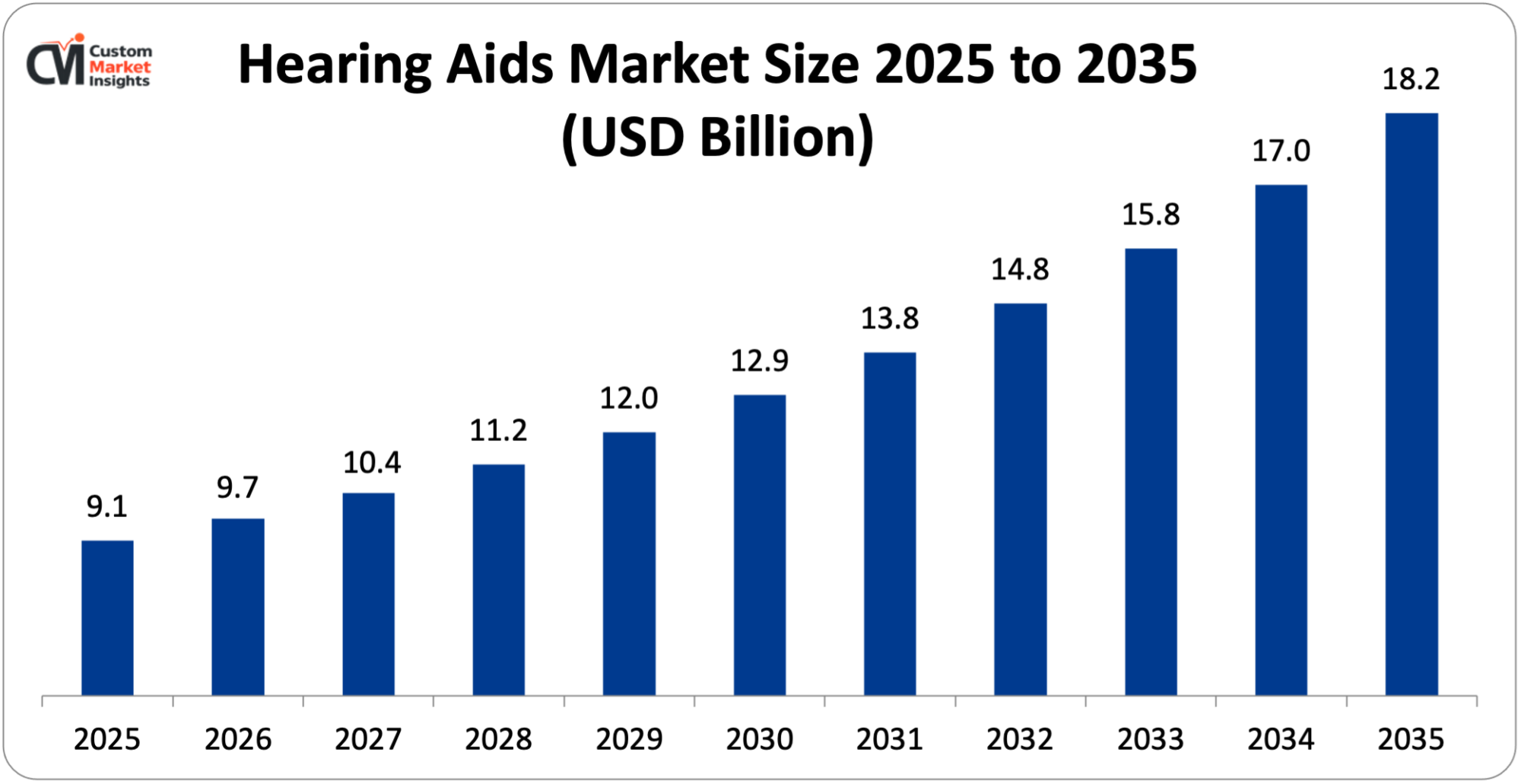
Global Hearing Aids Market 2025 – 2034 (By Billion)
The market size of global hearing aids will be estimated at USD 9.1 billion in 2025 and is expected to grow to between USD 9.7 billion in 2026 and about USD 18.2 billion by 2035, with a current CAGR (compound annual growth rate) of 7.2% during the period of 2026 to 2035. Hearing aids are small electronic medical devices that help people who experience hearing loss to hear better.
Nowadays, they consist of a microphone, an amplifier, a speaker, and a small battery. As they help people who experience hearing loss due to aging, prolonged exposure to loud noise, a genetic disorder, or a medical problem, hearing aids are very useful. New modern technology in hearing aids, such as digital signal processing, wireless streaming, and automated program control, helps sound and voice whisper. Hearing aids help people who experience hearing loss to communicate with each other more efficiently and to have a better quality of life.
In 2025, North America will dominate the global market with an estimated market share of 39%. The rising innovative product launch and the increasing aging population.
The Asia Pacific is growing at the highest CAGR over the analysis period. The presence of major players drives the regional market.
By product type, the receiver-in-the-ear hearing aid product dominated the market in 2025 with a revenue share of over 60%.
By technology, the digital hearing aids segment captures the largest market share of over 90% in 2025.
Significant Growth Factors
The hearing aids market trends present significant growth opportunities due to several factors:
Rising prevalence of hearing loss: Market growth is also fueled by an ever-growing incidence of hearing loss. The increasing number of people experiencing hearing decline is driven by factors such as an aging world population, extended exposure to loud sounds including industrial noise and music, genetic conditions, various types of infections, and medical disorders. A change in lifestyle and greater urban noise levels are also factors leading to an increased prevalence of noise-induced hearing loss among the population. With a growing number of mild-to-severe hearing impairment sufferers, additional digital hearing aids will be needed to meet the demand, along with various other types of hearing aids. Market is also expanding due to early diagnosis projects and increasing acceptance of treatment methods. For instance, according to the World Health Organization, the prevalence worldwide is that 1.5 billion people have some degree of hearing impairment, which is expected to increase to 2.5 billion by 2050. There are more than 430 million people with disabling hearing loss, with a predicted 1 in 4 people having hearing problems by 2050.
Rising innovative product launch: The growth opportunities of the hearing aids market are further complemented by the increasing innovative hearing aid product launches. Hearing technology is experiencing innovations that include features such as artificial intelligence-based sound processing, Bluetooth-enabled hearing aids, rechargeable batteries, synchronization with smartphones, and hearing aids that can adjust environmental sounds. The advancement of the hearing aid features allows a consumer to personalize the hearing aid's listening experience, increase speech intelligibility in noisy environments, and link with other digital devices. In anticipation of research & development efforts to design smaller, powerful, multi-tasking hearing aids, the hearing aids market will see a number of product launches that will potentially encourage existing users to upgrade as well as new users to explore hearing aids. Therefore, innovative hearing aid launches will be widely seen to create significant growth opportunities for the industry. For instance, in October 2025, Oticon announced a newsworthy development in hearing aid technology. The world ‘s first hearing aids with Google Fast Pair and new innovative connectivity technologies. Introducing Oticon Intent and Oticon Zeal. Oticon made a new world benchmark for hearing aid connectivity by allowing users to easily connect their hearing aids directly to Android (™) OS devices that support Bluetooth (™) LE Audio. The Oticon Intent devices were designed with user comfort and technology in mind. Oticon Intent devices are the first hearing aids with second-generation AI (artificial intelligence) and 4D Sensor technology, which recognizes what users need in their listening experience and automatically adapts to their listening intentions. They come in the new, innovative hearing aid style Oticon Zeal, the most discreet all-in-one hearing aid on the market, so you don't have to settle.
What are the Major Advances Changing the Hearing Aids Market Today
Artificial Intelligence (AI) and machine learning: Artificial Intelligence and Machine Learning are some of the most significant technological advances to have been introduced into the hearing aid market recently and have facilitated advancements in hearing aids to make them available to a great number of users due to the lifespan and maturity of this technology. Hearing aids that implement AI systems are capable of analyzing, understanding, and categorizing different sound environments, including speech, noise, and music, and adapting their amplification in response accordingly, enabling a much more natural listening experience. Machine learning enables the hearing aid to constantly monitor the changing sound environment and adapt to the individual user's preferences and routine, allowing a more tailored service. These features allow for faster and easier communication in more complex situations in busy public places. For instance, in February 2025, GN, the world's leading innovator for hearing aids, revealed the launch of ReSound Vivia, the world's smallest AI powered hearing aid, and ReSound Savi, an essentials range equipped with Bluetooth LE Audio and Auracast broadcast audio. The new ReSound Vivia hearing aids offer the most comprehensive sound class yet, offering fantastic speech recognition and a natural listening experience in even the most difficult situations, such as a busy restaurant or concert. This technology is driven by GN's human approach to AI, which takes the brain's natural process of sound to develop a program that generates crystal-clear speech in even the busiest setting. GN's new "Intelligent Focus" feature is the only AI capable of adapting to an individual's eye movements, so the hearing aids automatically send the right sounds based on the person's natural response. These are fantastic results, creating a natural, effortless listening experience that simply could not be achieved in a traditional setting, giving even more bespoke solutions for its users. Driven by a new dedicated DNN chip, the AI hearing aids provide the best ever listening experience. This DNN-powered approach will be up to 17 times more effective than competing DNN-enabled hearing aids when working with directionality and noise reduction, dramatically improving speech clarity. Trained on 13.5 million spoken utterances in multiple languages, with varying vocal effort and 3.9 million optimized audio settings, the DNN can perform 4.9 trillion operations per day to identify speech and suppress background noise.
Rechargeable battery technology: Rechargeable battery technology represents one of the most important innovations in the hearing aid market by significantly improving ease of use and user-friendliness in hearing aid devices. As the conventional hearing aids were powered by small batteries, many users found the small disposable battery inconvenient for regular usage, and there were many issues experienced by deaf and elderly users who had difficulty in managing the battery change or the physical manipulation of the battery holder. The rechargeable batteries are now increasingly used for providing energy to hearing aids, most modern hearing aids can simply be plugged into a charging station, which is much like a phone or wireless earbuds station, providing a day ‘s power supply on a single charge while the device delivers the audio stream to the hearing device at the same time. Advances in battery technology above conversions provide benefits in terms of reducing consumables and upkeep and disposal costs as well as environmentally friendly benefits. Thus, the use of rechargeable batteries is helping promote the wide usage of hearing aids in the world.
Category Wise Insights
By Product Type
Why Receiver-In-The-Ear Hearing Aids Hold a Prominent Position in the Market?
The receiver-in-the-ear hearing aids product dominated the market in 2025 with a revenue share of over 60%. Many of the reasons these hearing aids are favored include their small and lightweight design, which allows them to sit more comfortably in smaller, softer ears, such as those found in pediatric fittings. In addition to being a great fit, these hearing aids are effective at improving speech in noise, and with the added digital wireless technology, they have been shown to have the possibility to actually allow the patient to experience better speech in noise than a person with normal hearing.
The behind-the-ear hearing aids segment is expected to grow at a rapid rate during the analysis period. This is primarily due to technological developments in BTE hearing aids. BTE ‘s with more than one microphone have used sounding source separation to enhance intelligibility over Single-Mic BTE ‘s; this is very effective in the presence of excessive noise, and can significantly enhance hearing aid user ‘s report of clarity due to the sophisticated beamforming programs that BTE ‘s employ. ReSound, for example, has greatly enhanced the experience of users of its BTE hearing aid products with a DNR enhancement to their range in February 2024, offering rechargeable BTE and custom in-ear hearing aids with Bluetooth LE and Auracast to improve noise environments.
By Technology
Why Digital Hearing Aids Dominates the Hearing Aids Market?
The digital hearing aids segment captures the largest market share of over 90% in 2025. Digital hearing aids digitally signal to the hearing aid based on the external environment to amplify sound and lessen the noise. The technologically advanced hearing aids can eliminate noise from the background and provide comfort, whispering, and a more advanced hearing experience. Besides, companies are claiming a new generation of digital hearing aids, digital technology, and easier smartphone compatibility are driving segment growth. Additionally, awareness about digital devices and their usage is anticipated to drive segment growth in the U.S., particularly as more consumers recognize the benefits of these advanced hearing aids in improving their quality of life.
The analog hearing aids segment is growing moderately. Analog hearing aids work by increasing the amplitude of continuous sound waves. As all sound (including noise & speech) is amplified equally by an analog hearing aid, some analog devices carry a microchip within the device to enable the user to program various settings for different listening environments, such as reducing background noise in crowded places or enhancing speech clarity in one-on-one conversations.
Report Scope
Feature of the Report
Details
Market Size in 2026
USD 9.7 billion
Projected Market Size in 2035
USD 18.2 billion
Market Size in 2025
USD 9.1 billion
CAGR Growth Rate
7.2% CAGR
Base Year
2025
Forecast Period
2026-2035
Key Segment
By Product Type, Technology, Sales Channel and Region
Report Coverage
Revenue Estimation and Forecast, Company Profile, Competitive Landscape, Growth Factors and Recent Trends
Regional Scope
North America, Europe, Asia Pacific, Middle East & Africa, and South & Central America
Buying Options
Request tailored purchasing options to fulfil your requirements for research.
Regional Analysis
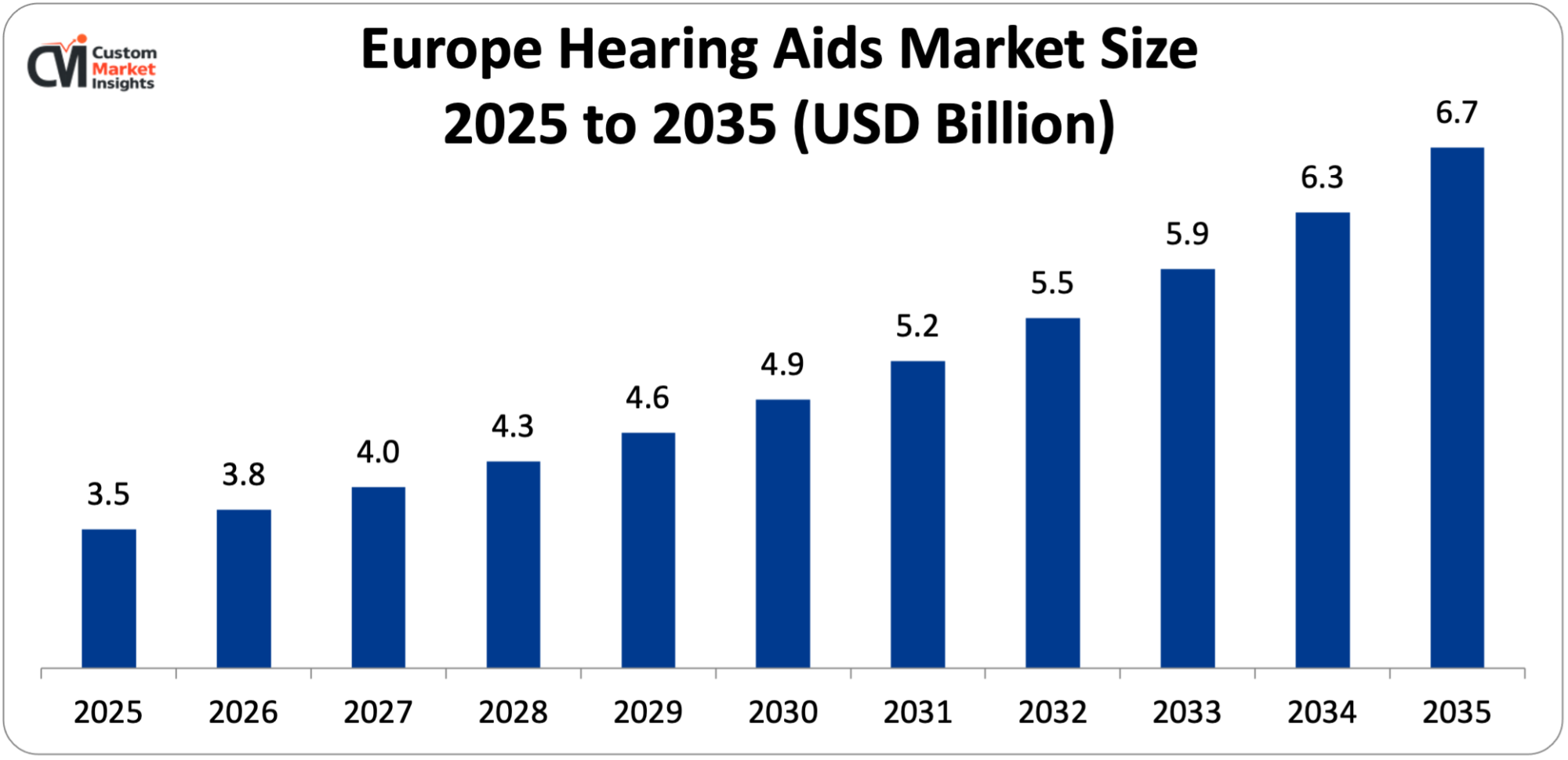
How Big is Europe Hearing Aids Market Size?
Its market size, in terms of Europe hearing aids, is projected to be USD 3.5 billion in 2025 with a growth of about USD 6.6 billion in 2035 with a CAGR of 6.5% between 2026 and 2035.
Why did Europe Dominate the Hearing Aids Market in 2025?
In 2025, Europe will dominate the global market with an estimated market share of 39%. Regional growth is the result of the growing number of hearing losses across Europe. WHO states that in 2023 about 190 million people across the WHO European region were suffering from some degree of hearing impairment and deafness, representing 20% of the European population. WHO also states that 236 million people across Europe will suffer from hearing loss by 2050.
UK Hearing Aids Market Trends
In the Europe region, the UK leads the industry expansion over the projected period. The UK hearing aids market is developing through new initiatives that prove that hearing healthcare solutions are more accessible, affordable, and innovative. One such initiative is the hearing therapeutics initiative (HTI) summit planned to take place in 2024 by the Royal National Institute for Deaf People (RNID), where the hearing research community will come together to discuss new concepts and connect with one another to make progress on new treatments for hearing loss and tinnitus. Major objectives of the summit would be to hasten the development of therapies for hearing loss by strengthening collaborations and intellectual connections and offering mentoring and communication opportunities for people working in this area between researchers, which would open up new markets in the UK by supporting novel ideas in hearing loss therapies and gaining improved patient access to new drugs.
Why is North America Experiencing a Significant Growth in the Hearing Aids Market?
North America holds a significant market share. The market is going up because more hospitals are utilizing hearing aids that are better than the ones they have now. Additionally, the country's healthcare sector is expected to grow over the next few years due to advancements in technology, such as improved sound processing and connectivity features. The hearing aid market is also affected by changing customer tastes and the rising desire for personalized and customized healthcare. People seek hearing aids that fit their needs and wants. The presence of prominent players in the area, such as Demant A/S, Sonova Holdings, WS Audiology, and Starkey Laboratories Inc., drives the industry growth. All of these top organizations spend more money on introducing new goods, making strategic partnerships, and working together to find new methods to grow and innovate in the market. For instance, in August 2024, Sonova Holding AG came up with two new hearing aid platforms under the Phonak brand: Audeo Infinio and Audeo Sphere Infinio. It starts a new chapter in hearing aids that are based on AI and employ AI in real time.
US Hearing Aids Market Trends
The US held the dominant position in the market. The region has the largest share mainly due to new product launches, very high demand for hearing aids, and the presence of important manufacturers. It is expected that the market will be driven by the favorable government policies and the rising incidences of the hearing disorder due to the increasing population. As per the articles published by the National Institute on Deafness and Other Communication Disorders in March 2024, there is a high incidence of speech frequency hearing loss in one or both ears in the age group of 20-69. There are more than 28 million clients in the U.S. who could require hearing aids and who could potentially use hearing aids.
Why is the Asia Pacific is growing at a rapid rate in the Hearing Aids Market?
The Asia Pacific is expected to grow at a rapid rate over the projected period. This growth is attributed to the presence of a large number of major players in the region and the huge geriatric population. The China hearing aids market is expected to grow at the fastest rate in the Asian pacific region during the forecast period, with South Korea and India being some of the emerging nations. Moreover, the rise in the incidence of hearing loss, particularly in the geriatric population, along with advancements in the distribution network of leading players across the globe, will propel the hearing aids market. Major key players in the industry are constantly innovating and bringing out improved hearing aid applications for hearing-impaired users, fueling demand for hearing aid applications in this region, particularly through the development of features such as Bluetooth connectivity, noise reduction technology, and personalized sound settings that enhance user experience.
China Hearing Aids Market Trends
China led the Asia Pacific market. Hearing loss is also prevalent among the population of China. Looking at a study done by NIH in Zhejiang involving 3754 adults from 18 to 98 years of age, there was found to be a 27.9% and 42.9% prevalence of speech frequency and high-frequency hearing loss. The rate of benefit from hearing aids in China is relatively low (<5%), the degree of hearing aid adoption remains very low, and the age at hearing aid adoption is extremely delayed. In evidence of this, the ChinaTrak 2023 survey shows a low rate of hearing aid adoption (only 9.3% of those with hearing impairments use hearing aids, estimated to be only 0.4% of the population), but a high level of satisfaction when using hearing aids (95% of hearing aid users in 2023 were satisfied, up from 92% in 2020).
Why is the Middle East & Africa Region is growing rapidly in the Hearing Aids?
The MEA region is growing at a steady rate over the projected period. The market is also driven by a higher prevalence rate of hearing impairment, a rapidly aging population, and greater demand for more sophisticated devices. According to the World Bank, the reported number of people aged 65 or older was approximately 26.9 million as of 2022. The elderly are more prone to hearing loss, leading to higher demand for hearing aids in the region. The UAE and South Africa are the two largest and fastest-growing markets in the MEA region with the support from the government and outbreaks of awareness for hearing problems.
UAE Hearing Aids Market Trends
The UAE is growing at the highest CAGR during the forecast period. The increasing healthcare expenditure in the area drives the market growth.
Top Players in the Hearing Aids Market and Their Offerings
Amplifon SpA
Arphi Electronics Private Limited
Audicus Inc.
audifon GmbH & Co. KG by KIND Group
Audina Hearing Instruments Inc.
Aurica LLC
Austar Hearing Science and Technology (Xiamen) Co. Ltd. by Merry Group
Cochlear Limited
Demant A/S
Earlens Corporation
GN Store Nord A/S
Great Earsmate Technology Group Ltd.
Horentek S.r.l.
JINGHAO MEDICAL
LUCID HEARING HOLDING COMPANY LLC
LXE Hearing
MDHearingAid Inc.
Medtronic PLC
Others
Key Developments
Hearing aids market has experienced considerable changes in the last two years as the market players are trying to diversify their technological aspects and develop product portfolios using strategic approaches.
In October 2025, Widex, one of WSA’s leading brands, announced it has been honored with two wins in the Sixth Annual Hearing Technology Innovator Awards. The Widex Allure App won in the Best Hearing Device: Mobile App (Assistive Technology & Software) category, while Widex Compass Cloud earned the award for Best Clinical Product (Service Delivery). The annual award program, hosted by Hearing Health & Technology Matters, celebrates the most forward-thinking solutions in the global hearing industry. (https://www.wsa.com/press-release/widex-allure-app-and-compass-cloud-named-winners-in-2025-hearing-technology-innovator-awards/)
In April 2025, building on the significant success of the industry’s flagship product, Edge AI, Starkey continues to push the edge of what is possible in hearing technology. For over 50 years, Starkey has been driven by a singular goal: to be the best. This relentless pursuit of excellence propels us into the next era of innovation—an era defined by groundbreaking innovations, exceptional quality, and superior service. The next generation of Bluetooth is here with LE Audio, delivering higher fidelity, fewer drop rates, and increased range. A highly anticipated breakthrough, LE Audio introduces broadcast audio capability through Auracast™. Edge AI is fully LE Audio compatible and Auracast-ready, setting the stage for seamless connectivity. (https://www.starkey.com/press/press-releases/2025/04/starkey-introduces-all-new-accessories-building-on-the-success-of-edge-ai)
These strategic measures have enabled the companies to reinforce their competitive positions, increase the product line, boost their technological competencies and also seize growth opportunities in the fast-growing hearing aids market.
Who are the key players in the Hearing Aids market?
The key players in the market are Amplifon SpA, Arphi Electronics Private Limited, Audicus, Inc., audifon GmbH & Co. KG by KIND Group, Audina Hearing Instruments Inc., Aurica LLC, Austar Hearing Science and Technology (Xiamen) Co. Ltd. by Merry Group, Cochlear Limited, Demant A/S, Earlens Corporation, GN Store Nord A/S, Great Earsmate Technology Group Ltd., Horentek S.r.l., JINGHAO MEDICAL, LUCID HEARING HOLDING COMPANY LLC, LXE Hearing, MDHearingAid Inc., Medtronic PLC, and Others.
What role do government regulations play in shaping this market's development?
Government regulations play an important role in shaping the development of the hearing aids market by ensuring product safety, quality standards, and accessibility for patients. Regulatory bodies set rules for device approval, manufacturing standards, and clinical performance. These rules help keep devices reliable and protect consumers. In addition, supportive policies such as reimbursement programs, hearing health initiatives, and the approval of over-the-counter hearing aids in some regions have improved accessibility and affordability. These regulations encourage innovation while ensuring compliance with medical standards, thereby supporting the overall growth and structured development of the hearing aids market.
How does the price point impact market growth and adoption?
A factor that influences the growth of the hearing aid market is the price range of hearing aids, as the price of the device can be a barrier to the accessibility of the hearing aids to the population. Low-priced hearing aids, including those available over the counter and those with primitive technology, increase adoption by making them more accessible and therefore more popular.
What is the projected market size by the end of the forecast period?
According to the present analysis and forecast modeling, the market of hearing aids will witness a significant growth of about USD 18.2 billion in the year 2035 with the growing aging population, increased investment in advanced technology, and increasing patient of hearing loss with a CAGR of 7.2% between the years 2026 and 2035.
Which region is anticipated to dominate the market during the forecast period?
It is projected that North America will hold the largest market share in the hearing aids market in the forecast period, with a share of about 39% of the global market share, which is attributed to the presence of major players and an increasing aging population.
Which region is expected to grow at the fastest CAGR in this market?
The Asia Pacific is expected to grow at the highest CAGR during the forecast period. The growth in the region is owing to the presence of major players and rising vehicle ownership.
What are the key driving factors influencing the growth of the Hearing Aids market?
Hearing aid market growth is expected to increase on the back of increasing incidence of hearing loss worldwide across the age groups, particularly in older patients. The boom in the older population would result in increased incidence of age-related hearing loss.
Ayush Kadam is a Senior Market Research Analyst at Custom Market Insights, with over seven years of experience in syndicated and custom market research. He specializes in market sizing, competitive intelligence, industry trends, forecasting, and strategic insights, helping clients turn complex data into actionable business decisions.