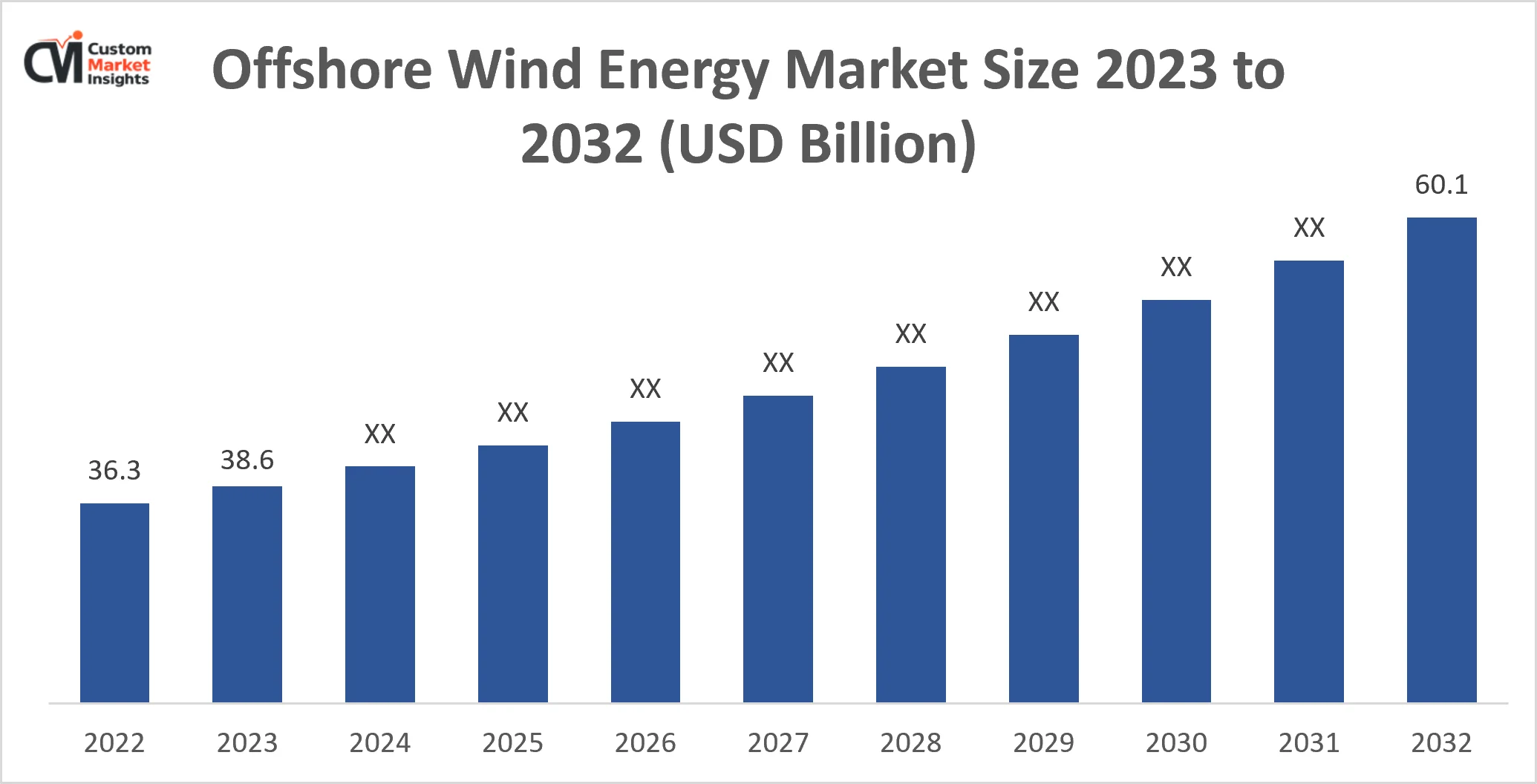
The global offshore wind energy market is projected to grow from USD 38.6 Bn in 2023 to USD 60.1 Bn by 2032, a 12.1% CAGR. Europe leads; Asia-Pacific grows fastest. The report is segmented by component and location.
The global offshore wind energy market was valued at USD 38.6 Bn in 2023 and is projected to reach USD 60.1 Bn by 2032, growing at a CAGR of 12.1%. Europe is the largest regional market and Asia-Pacific is growing fastest.
Global Offshore Wind Energy Market 2023–2032 (By Billion)
As per the current market research conducted by CMI Team, the global Offshore WindEnergyMarket is expected to record a CAGR of 12.1% from 2023 to 2032. In 2022, the market size is projected to reach a valuation of USD 36.3 billion. By 2032, the valuation is anticipated to reach USD 60.1 billion.
Evolution of the largest commercially available wind turbines
Year
Meter
MW
2010
90
3
2013
151
6
2016
164
8
2021
220
12
2030
245
18
Source: Offshore Wind Outlook 2019 by iea.org
The offshore wind energy market involves capturing wind energy from offshore areas using wind turbines and related infrastructure. It covers the entire process, from project development and construction to the operation and maintenance of offshore wind farms that generate renewable electricity for the grid.
This market is rapidly evolving due to technological advancements, cost reduction efforts, and supportive government policies worldwide. The trend includes larger and more efficient turbines, energy storage and grid integration, sustainability focus, and rising demand for clean energy to combat climate change and lower carbon emissions. International collaborations and investments contribute to its global growth.
Offshore Wind Energy Market - Significant Growth Factors
The Offshore Wind Energy Market presents significant growth opportunities due to several factors:
Synergy with Other Sectors: Offshore wind projects can create synergies with other sectors, such as aquaculture and marine conservation. By integrating wind farms with aquaculture facilities or protected marine areas, there is potential for sustainable coexistence and additional economic benefits.
Job Creation and Local Development: Offshore wind projects offer opportunities for job creation and local economic development. Building and maintaining offshore wind farms require a skilled workforce, supporting employment in areas near the project sites. Additionally, investments in local infrastructure and supply chains contribute to the growth of coastal communities.
Innovation and Research: Continued investment in research and development presents opportunities to enhance offshore wind technology, reduce costs, and increase energy yields. Innovations in floating turbines, deeper water installations, and advanced materials can further boost the market's competitiveness.
Advancements in Technology: Technological innovations in offshore wind turbine design, floating platforms, and grid integration have significantly increased the efficiency and feasibility of offshore wind projects. These advancements have made offshore wind more competitive with traditional energy sources.
Supportive Government Policies: Favorable government policies, incentives, and renewable energy targets have created a conducive environment for offshore wind development. Governments worldwide offer financial support, feed-in tariffs, and streamlined permitting processes to encourage investments in offshore wind projects.
Global Market Expansion: The offshore wind energy market offers vast opportunities for expansion globally, particularly in regions with favourable wind resources and coastal areas. Emerging markets in Asia-Pacific, North America, and Latin America present significant growth potential for offshore wind development.
Offshore Wind Energy Market - Mergers and Acquisitions
The Offshore Wind Energy Market has seen several mergers and acquisitions in recent years, with companies seeking to expand their market presence and leverage synergies to improve their product offerings and profitability. Some notable examples of mergers and acquisitions in the Offshore Wind Energy Market include:
Equinor ASA and BP: In 2020, Equinor ASA and BP collaborated to jointly develop offshore wind projects in the United States. The partnership aimed to combine Equinor's offshore wind experience with BP's energy expertise to accelerate the growth of renewable energy in the region.
Shell Global acquire Daystar Power Group: In 2022, Shell completes the acquisition of solar solutions provider Daystar Power Group. As a provider of integrated solar power solutions, Daystar brings reliable energy to businesses in West Africa, helping customers reduce power costs and pollution.
Ørsted A/S's Acquisition of Deepwater Wind: In 2018, Ørsted A/S acquired Deepwater Wind, a leading developer of offshore wind projects in the United States. The acquisition strengthened Ørsted's position in the US offshore wind energy market, providing access to key projects and expertise in the region.
Shell New Energies' Acquisition of EOLFI: In 2019, Shell New Energies acquired EOLFI, a French renewable energy developer with experience in offshore wind projects. The acquisition expanded Shell's renewable energy portfolio, including offshore wind assets in France and other markets.
These mergers and acquisitions have helped companies expand their product offerings, improve their market presence, and capitalize on growth opportunities in the Offshore Wind Energy Market. The trend is expected to continue as companies seek to gain a competitive edge in the market.
The Offshore Wind Energy Market faces several significant threats that could impact its growth and profitability in the future. Some of these threats include:
Regulatory and Permitting Challenges: Lengthy and complex regulatory processes and permitting requirements can pose significant obstacles to offshore wind projects. Delays in obtaining necessary approvals may increase project costs and deter potential investors.
Environmental Impact and Stakeholder Concerns: Offshore wind projects may face opposition from environmental groups and local communities due to concerns about potential impacts on marine ecosystems, wildlife, and coastal aesthetics. Addressing these concerns and ensuring sustainable project development is crucial for market growth.
Grid Integration and Infrastructure Limitations: Integrating offshore wind energy into existing power grids can be challenging, particularly when projects are located far from onshore infrastructure. Inadequate grid infrastructure may limit the capacity to transmit electricity efficiently, hindering the growth of offshore wind installations.
Competition with Other Energy Sources: Offshore wind faces competition from other renewable and conventional energy sources. The relative cost and availability of alternatives like solar, onshore wind, and natural gas can impact investment decisions and market growth for offshore wind projects. Ensuring cost-effectiveness and continued technological advancements is essential to maintain competitiveness.
Report Scope
Feature of the Report
Details
Market Size in 2023
USD 38.6 Billion
Projected Market Size in 2032
USD 60.1 Billion
Market Size in 2022
USD 36.3 Billion
CAGR Growth Rate
12.1% CAGR
Base Year
2023
Forecast Period
2024-2033
Key Segment
By Component, Location and Region
Report Coverage
Revenue Estimation and Forecast, Company Profile, Competitive Landscape, Growth Factors and Recent Trends
Regional Scope
North America, Europe, Asia Pacific, Middle East & Africa, and South & Central America
Buying Options
Request tailored purchasing options to fulfil your requirements for research.
Category-Wise Insights
By Event Type :
Turbines: Turbines serve as the core components of offshore wind farms, converting wind energy into electricity. Recent advancements in turbine technology have resulted in larger and more efficient turbines, significantly boosting energy output while reducing overall costs. The trend in turbine development includes innovations in blade design, gearbox improvements, and the use of direct-drive technology, resulting in higher capacity factors and enhanced performance of offshore wind farms.
Electrical Infrastructure: This includes subsea cables, substations, and grid connections, which play a vital role in transmitting electricity from offshore wind farms to onshore grids. Innovations aim to improve grid integration and enhance transmission capacity. The trend in electrical infrastructure focuses on high-voltage direct current (HVDC) technology for long-distance transmission, smart grid solutions for grid stability, and advanced subsea cable systems to reduce power losses and improve efficiency.
Substructure: Substructures provide the foundation and support for offshore wind turbines. Innovations in floating and fixed substructures have enabled the deployment of wind farms in deeper waters and challenging environments. The trend in substructure design includes the development of innovative floating platforms, such as semi-submersible and tension leg platforms, to tap into abundant wind resources in deeper seas, and the use of innovative materials and construction techniques for cost-effective fixed foundations.
Others: This category encompasses various components such as offshore wind farm installation vessels, operations and maintenance equipment, and safety systems, contributing to the overall efficiency and sustainability of offshore wind projects. The trend in this segment focuses on automation and digitization of maintenance processes, advancements in vessel designs for efficient installation and maintenance operations, and the development of advanced safety systems to ensure the well-being of personnel and equipment during offshore operations.
By Location
Shallow Water: Offshore wind projects located in shallow water regions typically have water depths up to 30 meters. These sites are close to the shoreline, allowing for fixed-bottom foundation installation. Shallow water locations are attractive due to lower installation costs and ease of access for maintenance.
Transitional Water: Transitional water sites have water depths ranging from 30 to 60 meters. Projects in these areas often use fixed-bottom foundations or innovative floating platforms, offering a balance between shallow and deep-water advantages.
Deep Water: Offshore wind farms situated in deep water have water depths exceeding 60 meters. These locations typically require floating platforms, enabling access to wind resources far from the shoreline and unlocking potential in previously untapped areas.
Offshore Wind Energy Market - Regional Analysis
The Offshore Wind Energy Market is segmented into various regions, including North America, Europe, Asia-Pacific, and LAMEA. Here is a brief overview of each region:
North America: North America is witnessing a surge in offshore wind development, driven by increased government support for renewable energy and growing environmental consciousness. The region is experiencing a trend of collaboration between state governments, utilities, and private companies to expedite project approvals and create a conducive regulatory environment. Key players in North America's offshore wind energy market include Ørsted A/S, Equinor ASA, and Avangrid Renewables, which have established a strong presence through strategic partnerships and project acquisitions.
Europe: Europe remains a global leader in offshore wind, with a trend of continuous expansion and technology advancements. The region is witnessing a growing number of large-scale projects in deep waters and a focus on research and development to improve turbine efficiency and grid integration. Europe's offshore wind energy market is dominated by companies like Orsted A/S, Vattenfall AB, and Siemens Gamesa Renewable Energy, known for their extensive experience and contributions to the growth of the industry.
Asia-Pacific: Asia-Pacific is experiencing rapid growth in offshore wind projects, with countries like China and Taiwan leading the way. The region's trend involves investments in large-scale floating offshore wind farms and technological collaborations to harness wind resources in challenging deep-water locations. Key players in the Asia-Pacific offshore wind energy market include China General Nuclear Power Corporation (CGN), Taiwan Power Company (Taipower), and China Three Gorges Corporation (CTG), who have significant contributions to the region's increasing installed capacity.
LAMEA (Latin America, Middle East, and Africa): LAMEA is an emerging region for offshore wind, with countries like Brazil, South Africa, and Egypt exploring potential projects. The trend in LAMEA involves pilot projects to assess wind resources, environmental impacts, and regulatory frameworks to lay the foundation for future market growth. The offshore wind energy market in LAMEA is still in its nascent stage, with a limited number of players dominating. Notable participants include Equinor ASA and Vestas Wind Systems A/S, who are actively exploring opportunities in the region.
Competitive Landscape – Offshore Wind Energy Market
The Offshore Wind Energy Market is highly competitive, with a large number of manufacturers and retailers operating globally. Some of the key players in the market include:
Siemens Gamesa Renewable Energy S.A.
Vestas Wind Systems A/S
Iberdrola S.A.
Ørsted A/S
Equinor ASA
EDP Renováveis S.A.
Northland Power Inc.
MingYang Smart Energy Group Co. Ltd.
GE Renewable Energy
Others
These companies operate in the market through various strategies such as product innovation, mergers and acquisitions, and partnerships.
New players entering the offshore wind energy market are embracing innovation and development to establish their presence. Companies such as RWE Renewables, Shell New Energies, and TotalEnergies are investing in offshore wind projects, leveraging their expertise in renewable energy and oil and gas industries to expand into the growing offshore wind sector.
These new entrants bring substantial financial resources and technical capabilities to drive market competition. Dominating the offshore wind energy market are established players like Ørsted A/S, Equinor ASA, and Siemens Gamesa Renewable Energy. With a track record of successful project developments, these companies have secured a significant market share and global presence.
They continue to lead through consistent investments in research, technology, and strategic partnerships, driving the advancement of offshore wind technology and market expansion.
Regional Coverage
North America
U.S.
Canada
Mexico
Rest of North America
Europe
Germany
France
U.K.
Italy
Spain
Rest of Europe
Asia Pacific
China
Japan
India
New Zealand
Australia
South Korea
Rest of Asia Pacific
The Middle East & Africa
Saudi Arabia
UAE
Egypt
Kuwait
South Africa
Rest of the Middle East & Africa
Latin America
Brazil
Argentina
Rest of Latin America
CMI.Market Research Report2023-2032
Global Offshore Wind Energy Market 2024–2033
Updated: September 2026 · Formats: PDF, Excel, PPT
Which are the driving factors of the Offshore Wind Market?
The key factors driving the Market are Synergy with Other Sectors, Job Creation and Local Development, Innovation and Research, Advancements in Technology, Supportive Government Policies And Global Market Expansion.
Which type led the Offshore Wind market?
The "Component" category dominated the market in 2022.
Who are the key players in the Offshore Wind market?
The key players in the market are Siemens Gamesa Renewable Energy S.A., Vestas Wind Systems A/S, Iberdrola S.A., Ørsted A/S, Equinor ASA, EDP Renováveis S.A., Northland Power Inc., MingYang Smart Energy Group Co. Ltd., GE Renewable Energy, Others.
Which region held the largest market share in the Offshore Wind market?
"Europe" had the largest share in the Offshore Wind Market.
What is the growth rate of the Offshore Wind market?
The global market is projected to grow at a CAGR of 12.1% during the forecast period, 2023-2032.
How much is the Offshore Wind market?
The Offshore Wind Market size was valued at USD 36.3 Billion in 2022.
Ayush Kadam is a Senior Market Research Analyst at Custom Market Insights, with over seven years of experience in syndicated and custom market research. He specializes in market sizing, competitive intelligence, industry trends, forecasting, and strategic insights, helping clients turn complex data into actionable business decisions.