
Global Smart Eyewear Technology Market Size Likely to Grow at a CAGR of 22.5% By 2035
Key highlights
- What are the Factors That Have a Significant Contribution to the Growth of the Smart Eyewear Technology Market?
- North America held the highest market share in 2025.
- Canada Mexico Rest of North America Europe Germany France U.
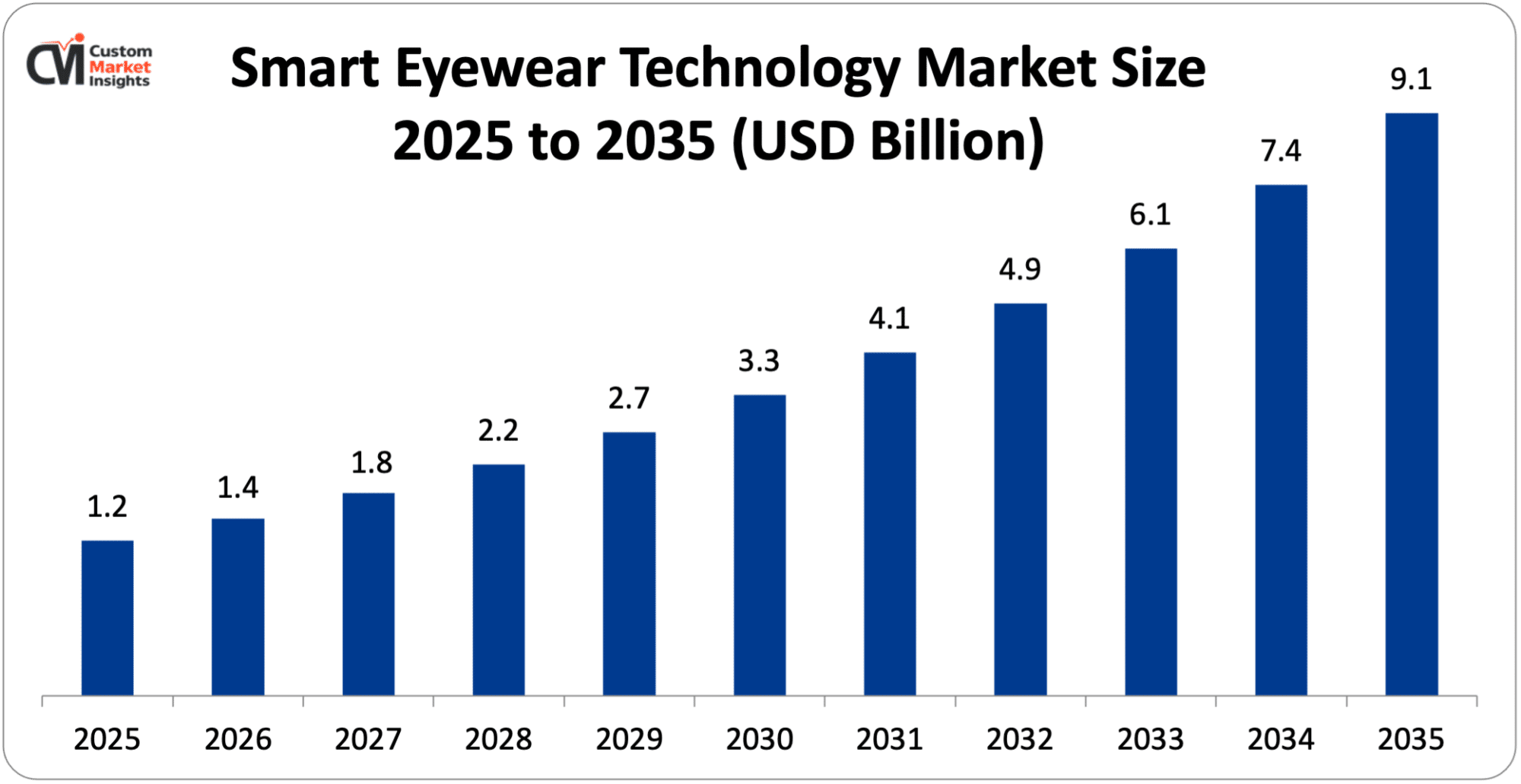
The market size of global smart eyewear technology will be estimated at USD 1.2 billion in 2025 and is expected to grow to between USD 1.4 billion in 2026 and about USD 9.1 billion by 2035, with a current CAGR (compound annual growth rate) of 22.5% during the period of 2026 to 2035.
To learn more about this report - request a sample report PDF
Smart Eyewear Technology Market Revenue and Trends
“Smart eyewear” a generic term used for relatively any wearable computing device which is designed, to look like regular eye-wear (spectacles or sunglasses), but with the integration of state-of-the-art digital, visual, and audio technologies into the spectacle frame. Such devices are often marketed as ‘smart glasses,' which include a variety of digital components such as micro-displays, miniature cameras, multiple sensors, and microphones to enable interaction with augmented reality (AR), notifications, and AI assistants in the user‘s direct line of vision. Smart eyewear eliminates the need to view a monitor and is meant to be used daily in a hands-free manner that gives users awareness of their environment while viewing digital output. Until recently, smart eyewear was both scruffy and specially utilized in industrial contexts, but today these devices are becoming more stylish and consumer friendly, are AI equipped, and include integration of translation, object identification, and virtual mapping. Innovative digital features are made possible by waveguides, integrated processors, and Bluetooth/Wi-Fi connections to smartphones.
What are the Factors That Have a Significant Contribution to the Growth of the Smart Eyewear Technology Market?
The expanding business and industrial applications are also highly contributing to the market growth of the smart eyewear technology. Various companies are adopting smart eyewear to improve efficiency, productivity, and safety at work. They can also provide workers with any relevant data, digital instructions, and remote expert assistance while keeping their hands free. Sectors such as manufacturing, logistics, healthcare, construction, field services, and many others are implementing smart eyewear for training, maintenance assistance, inspection, and workflow management. This trend is likely to be enhanced in the coming future by Industry 4.0 investments into technology and digitization.
Also, the smart eyeglasses technology market is largely fueled by increased investments and product launches by technology companies. Major technological firms and startups are significantly investing in research and development of features in smart eyeglasses such as augmented reality, artificial intelligence etc. These investments are leading to launching of more features in smart eyeglasses such as better visual display, voice control, lightweight eyeglasses, connecting features etc. Increasing product launches and innovations in this field, along with growing partnerships between eyewear manufacturers and technology firms, are expected to increase the availability of smart eyewear and the rise in the number of applications, resulting in increased adoption in the upcoming years. For instance, in April 2025, Apple launched its own smart glasses in 2025, positioning the device as a more premium alternative to Meta's Ray-Ban smart glasses.
Regional Insights
North America held the highest market share in 2025. Advanced technology infrastructure exists in the region to facilitate ongoing development of innovation for smart glasses and other connected devices.
Besides, the Asia Pacific market has the highest rate of growth in the smart eyewear technology market. The rising adoption in healthcare and growth of 5G and edge computing drives the regional market growth.
Report Scope
| Feature of the Report | Details |
| Market Size in 2026 | USD 1.4 billion |
| Projected Market Size in 2035 | USD 9.1 billion |
| Market Size in 2025 | USD 1.2 billion |
| CAGR Growth Rate | 22.5% CAGR |
| Base Year | 2025 |
| Forecast Period | 2026-2035 |
| Key Segment | By Technology, Product, End User and Region |
| Report Coverage | Revenue Estimation and Forecast, Company Profile, Competitive Landscape, Growth Factors and Recent Trends |
| Regional Scope | North America, Europe, Asia Pacific, Middle East & Africa, and South & Central America |
| Buying Options | Request tailored purchasing options to fulfil your requirements for research. |
Recent Developments
- In November 2025, Uvex safety group Germany—one of the world‘s largest professional safety eyewear and personal protective equipment companies—and Solos—one of the world‘s most advanced new smart glasses companies—have announced a strategic partnership to take smart technology into the Health and Safety marketplace. Combining uvex‘s extensive experience in ergonomically designed, industrial safety-tested eyewear with the groundbreaking advances in AI, camera, and voice-interaction technologies pioneered by Solos, the two companies are investigating the future of intelligent eyewear to improve worker safety, communication, and efficiency in industrial environments. (https://www.uvex-safety.com/en/media/press-releases/uvex-and-solos-announce-partnership/)
List of the prominent players in the Smart Eyewear Technology Market:
- Meta Company
- Sony Corporation
- Microsoft Corporation
- Epson America Inc
- Lumus Ltd
- Vuzix Corporation
- Google Inc
- Optinvent SA
- Osterhout Design Group
- Kopin Corporation
- Lenovo
- Samsung Electronics Co Ltd
- Recon Instruments
- EssilorLuxottica
- Ricoh
- Others
The Smart Eyewear Technology Market is segmented as follows:
By Technology
- Virtual Reality
- Augmented Reality
By Product
- Head Mounted Display
- Assisted Reality Glasses
- Mixed Reality Holographic Displays
By End User
- Manufacturing
- Transportation & Logistics
- Military & Defense
- Healthcare
- Gaming Industry
- Construction & Architecture
- Others
Regional Coverage:
North America
- U.S.
- Canada
- Mexico
- Rest of North America
Europe
- Germany
- France
- U.K.
- Russia
- Italy
- Spain
- Netherlands
- Rest of Europe
Asia Pacific
- China
- Japan
- India
- New Zealand
- Australia
- South Korea
- Taiwan
- Rest of Asia Pacific
The Middle East & Africa
- Saudi Arabia
- UAE
- Egypt
- Kuwait
- South Africa
- Rest of the Middle East & Africa
Latin America
- Brazil
- Argentina
- Rest of Latin America
Rushikesh Dorge
View profile and reportsAbout Custom Market Insights
Custom Market Insights is a market research and advisory company. It publishes syndicated reports across 18+ industries and delivers custom research, feasibility studies and market entry strategy for companies, investors and consultancies.
###