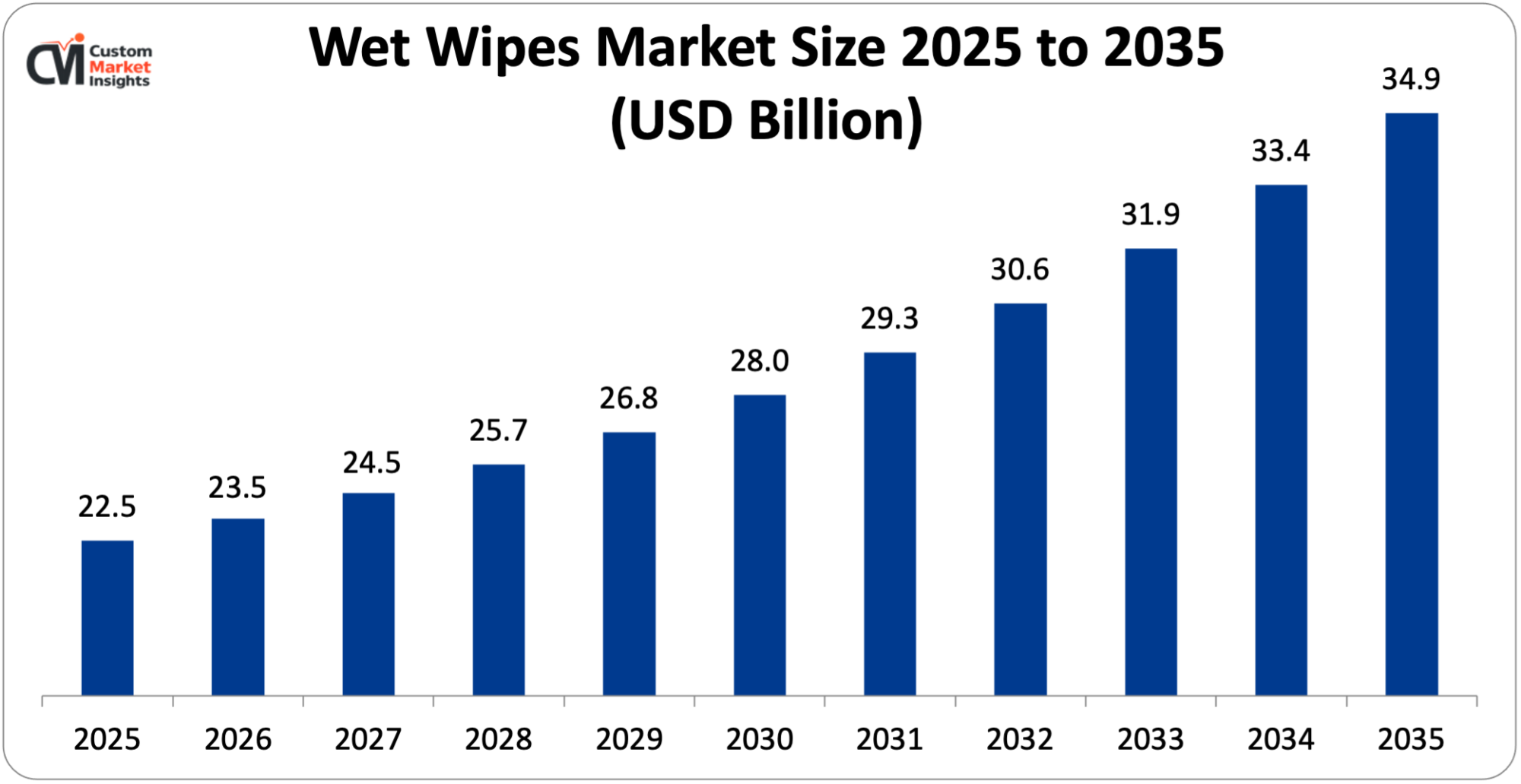
The global wet wipes market was valued at USD 23.5 Bn in 2026 and is projected to reach USD 34.9 Bn by 2035, growing at a CAGR of 4.5%. North America is the largest regional market and Asia-Pacific is growing fastest.
The market size of global wet wipes will be estimated at USD 22.5 billion in 2025 and is expected to grow to between USD 23.5 billion in 2026 and about USD 34.9 billion by 2035, with a current CAGR (compound annual growth rate) of 4.5% during the period of 2026 to 2035. Wet wipes are pre-wet disposable material sheets manufactured using various paper, nonwoven, and blended fabric materials. These are pre-wetted substrates mainly to provide cleaning, disinfecting, and moistening properties for hygiene and cleaning purposes. Wet wipes are also used in various personal, baby, household, health care, and cosmetic applications, which are expected to show increased market growth due to existing consumer demand.
Wet wipes are available in the market in various brands that contain ingredients like preservatives, water, skin conditioning agents, mild cleaning agents, and fragrances, mainly with pre-moistened nonwoven and fabric sheets. Wet wipes are replacing traditional cleaning methods, including cloth, water, and soap, and requiring no additional products or tools for cleaning due to their portability, ease of use, and disposal advantage. The global market of wet wipes includes various categories such as baby wipes, household disinfecting wipes, facial wipes, and antibacterial wipes.
In 2025, North America will dominate the global market with an estimated market share of 38%. The rising innovative product launch and the increasing health & hygiene awareness.
The Asia Pacific is growing at the highest CAGR of 5.6% over the analysis period. The presence of major players drives the regional market.
By product, the household/disinfectant/cleaning wipes held the largest market share of 30% in 2025.
By distribution channel, the supermarkets & hypermarkets segment captures the largest market share of over 35% in 2025.
Significant Growth Factors
The wet wipes market trends present significant growth opportunities due to several factors:
Rising awareness of personal hygiene and sanitation: The rise in awareness over personal hygiene and sanitation is one of the key drivers of growth for the wet wipes market. As society becomes more educated about the benefits of hygiene and avoiding the spread of bacteria, there has been a greater demand for quick, convenient hygiene solutions. Wet wipes provide a quick, simple way to clean faces, hands, and surfaces without the use of water or cleaning products. People often find them easier to carry and quicker to use when out and about than traditional alternatives, and these perks will continue to benefit the consumer, whether in a public forum, when travelling, at work, or in a hospital. As the world deals with the aftermath of recent outbreaks of disease, both the public and the health industry will be more inclined to make use of disposable cleaning products, and this trend will help to drive the wet wipes forward.
Growth in disposable income and urbanization: Rise in disposable income coupled with a fast urbanization trend can be relied upon to boost the growth of this market. With the increase in disposable incomes in developing countries and metropolitan areas in particular, consumers become more willing to invest in hassle-free and superior-quality hygiene products for better everyday comfort and cleanliness. Coupled with the hectic lifestyle, urbanization reduces the time and convenience of carrying bulky hygiene products, such as towels, leading to customers opting for portable hygiene products, such as wet wipes. Furthermore, vast urbanization and the growing modern retailing channels, such as exclusive outlets, supermarkets, e-commerce, and others, have enhanced product availability, hence boosting the prospects of market growth. For instance, according to the United Nations, the rate of urbanization on a global level is steadily increasing, and presently 55% of the world's population resides in urban areas (expected to increase to 68% in 2050).
What are the Major Advances Changing the Wet Wipes Market Today?
Development of biodegradable and sustainable wipes: Innovations in biodegradable and eco-friendly wipes are a promising area of development for the wet wipes industry. Presently most upmarket brands employ synthetic fibers such as polyester and polypropylene that are not degradable and give rise to disposal issues. As consumers become more conscious of the ecological repercussions in the future, the trend will shift towards using organic cottons, bamboo fibers, or naturally degradable plant-based cellulosic raw materials for wet wipe applications. The environmental impact can be brought to a minimum if the wipes packaging used is recyclable or home compostable. The multitude of eco brands investing heavily in steps like the creation of environmentally friendly products and more eco production techniques to emerge new opportunities to grow the industry are evident.
Growth of flushable wet wipes technology: The development of flushable wet wipes is a common noticeable achievement in the wet wipes market of recent years. The product not only has commercial benefits to the consumer but also has environmental implications in the wet wipes industry. Unlike many traditional wet wipes that include nylon and polyester to give strength and have a negative impact on the environment through blocking sewage pipes, the flushable product is produced with a viable flushable design and is expected to biodegrade and disperse after being flushed away. They are designed with the use of natural fibers, mainly cellulose, and employ a manufacturing process that has strength during use and disintegrability once flushed.
Category Wise Insights
By Product
Why Household/Disinfectant/Cleaning Wipes Hold a Prominent Position in the Market?
The household/disinfectant/cleaning wipes held the largest market share of 30% in 2025. The disinfectant/cleaning wet wipe industry has developed several innovative products to overcome manufacturing difficulties and to improve product performance, reduce expensive chemical usage, and promote environmentally friendly disposal. For example, Sichuan Huanlong New Material Co. Ltd., from China, developed an antibacterial tissue from 100% bamboo fiber and essential oils with a simple and effective, environmentally friendly process, which is still mild and antibacterial.
The intimate wipes segment is growing at the highest CAGR of 5.8% over the analysis period. The growing product launch drives the industry growth. For instance, in April 2025, Niches & Nooks is a new, playful take on personal cleanliness. It has launched with an eclectic, pH-balanced range of products in groundbreaking formats and microbiome-friendly scents—meant to refresh, cleanse, and care for the nooks most often ignored. It’s raising the profile of intimate care with a playful tone and humorous take on a subject—long considered taboo. Incubated by Maesa, the leading disruptor in the beauty and wellness spaces, this collection is the group's first entry into the intimate care space.
By Distribution Channel
Why Supermarkets & Hypermarkets Dominates the Wet Wipes Market?
The supermarkets &; hypermarkets segment captures the largest market share of over 35% in 2025. The market growth is related to the ubiquitous presence of the products, the visibility of the brand, and the easy purchase experiences offered through those outlets. Large retail stores stock a range of wet wipes, baby wipes, disinfectant and facial wipes, and personal hygiene wipes with the convenience of giving their customers the opportunity of retail shopping with the comparison of many different brands, prices, and varieties of parameters available for the customers to choose from and also making the decision easier for them. Also, supermarkets and hypermarkets often offer marketing and distribution incentives such as discounted prices, two-for-one deals, and in-store advertisements, which prompt buying in bulk and on impulse. Moreover, with the increasing number of large retail chains and the growing organized retail infrastructure, especially in developing economies, the enhanced availability and visibility of the product increases consumer buying. Thus, supermarkets and hypermarkets continue to be the major contributors to the significant revenue growth for manufacturers of wet wipe products.
The e-commerce segment is growing at the highest CAGR of over 36% over the projected period. This boom can be explained by easy access due to online shopping and its benefits for the customers. Online websites give a broad picture of all wet wipe products, prices, and reviews in no time. Customers find it easier to go through the variety of products, choose the one they need, and browse for the best offers, discounts, subscription-based buying, and home delivery all in one place.
Report Scope
Feature of the Report
Details
Market Size in 2026
USD 23.5 billion
Projected Market Size in 2035
USD 34.9 billion
Market Size in 2025
USD 22.5 billion
CAGR Growth Rate
4.5% CAGR
Base Year
2025
Forecast Period
2026-2035
Key Segment
By Product, Material, Distribution Channel and Region
Report Coverage
Revenue Estimation and Forecast, Company Profile, Competitive Landscape, Growth Factors and Recent Trends
Regional Scope
North America, Europe, Asia Pacific, Middle East & Africa, and South & Central America
Buying Options
Request tailored purchasing options to fulfil your requirements for research.
Regional Analysis
How Big is North America Wet Wipes Market Size?
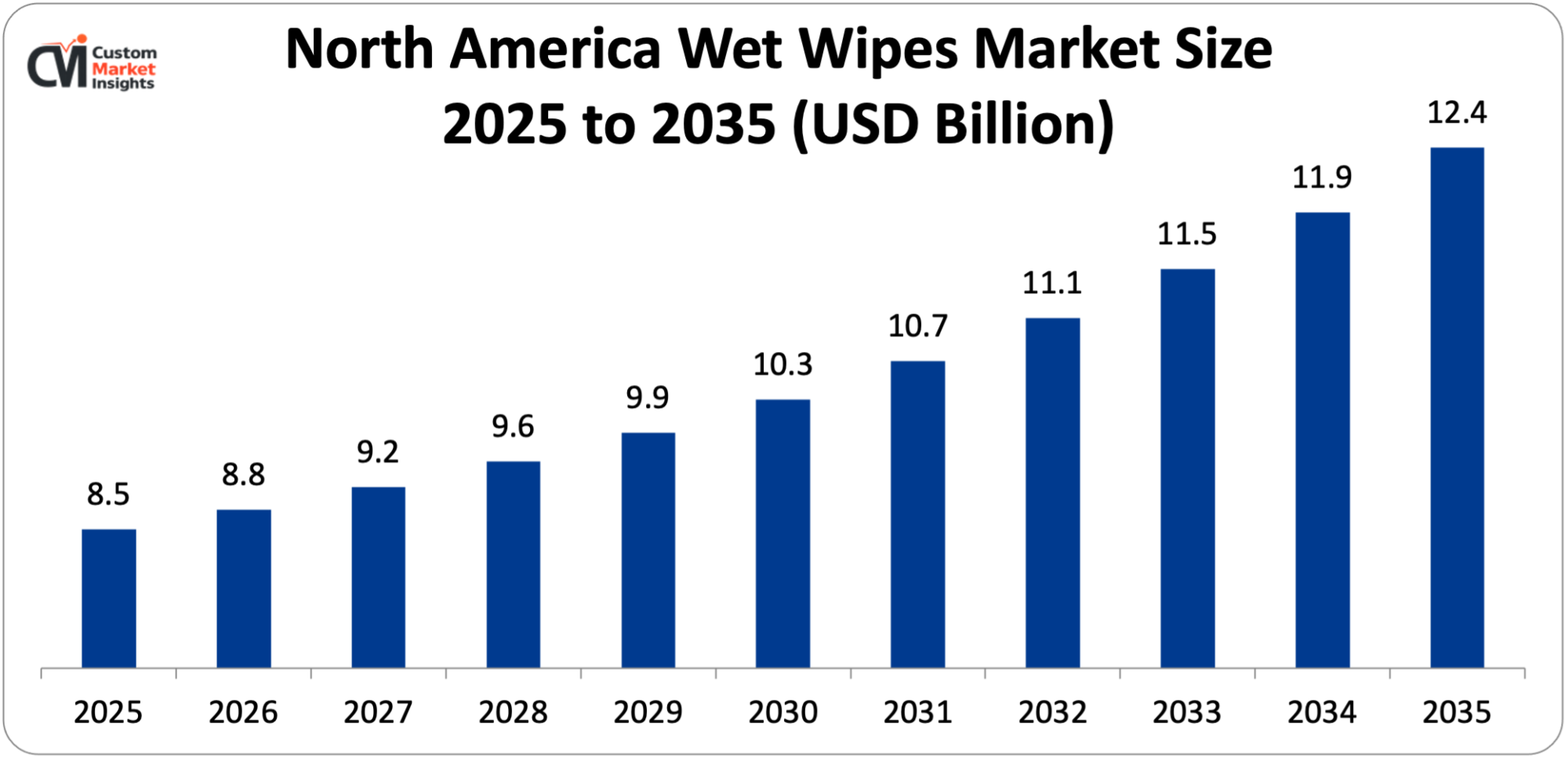
Its market size, in terms of North America wet wipes, is projected to be USD 8.5 billion in 2025 with a growth of about USD 12.4 billion in 2035 with a CAGR of 3.8% between 2026 and 2035.
Why did North America Dominate the Wet Wipes Market in 2025?
In 2025, North America will dominate the global market with an estimated market share of 38%. The market is witnessing growth owing to consumers’ awareness about personal hygiene, sharply rising demand for convenient cleaning and maintenance products, and the use of wipes for multiple purposes. In the North American region, consumers frequently procure wet wipes for baby care, personal hygiene, household cleaning, and disinfection, which will continue to rise with time. Existing manufacturers, an efficient retail network, and the emerging e-commerce market, along with the increased need of antibacterial and disinfectant wet wipes for use in hospitals, offices, and households, will drive the market growth. Consumer trend towards biodegradable and eco-friendly wipes will support product innovation and sustenance of the revenue.
US Wet Wipes Market Trends
In the North American region, the US leads the industry expansion over the projected period. The rising innovative product launch, such as dissolvable, nonwoven wipe material, drives the market expansion. In April 2025, flushable wipes brand Dude Wipes is rolling out LiL’ Dude Wipes-- flushable wipes built for tiny cheeks and huge messes. Now available in stores across the U.S. and direct to consumer via Walmart.com, LiL' Dude Wipes is the brand's first foray into the toddler aisle with full in-store and online marketing support. Designed to keep up with everything from messy potty training to big kid cleanups, LiL' Dude Wipes grow with children from two to 10 years of age. Bringing the same toilet-safe, plant-based clean Dude Wipes is celebrated for the next generation of dudes.
Why is Europe Experiencing a Significant Growth in the Wet Wipes Market?
Europe holds a significant market share of 30% in 2025. The demand is largely affected by the recent trend of rising awareness about hygiene and convenience to users. EU policies have been observed to support and drive sustainable products, products with biodegradable materials. The German and UK markets are the largest in the EU, accounting for 20% of the total market share. Countries in the EU include Germany, the UK and France. The competitive landscape in the market is dominated by the large players like Reckitt Benckiser and SCA Hygiene Products. The EU programs clearly indicate a reduction in plastics and the popularity of sustainability and biodegradable products, which reflects a growing consumer demand for environmentally friendly alternatives in various markets.
UK Wet Wipes Market Trends
The UK held the dominant position in the market. This growth can be attributed to the rising product launch. In May 2025, Aquapak developed a dissolvable nonwoven wipe material using their Hydropol polymer technology. This may help alleviate the problems caused by disposable hygiene products such as wet wipes and sanitary pads. It replaces plastics with a completely biodegradable, water-soluble, and non-toxic replacement that readily decomposes in a domestic sewage system. The wipes break down upon flushing without leaving any microplastics and can be flushed without any risk of blocking the sewers, avoiding ‘fatbergs’—large clumps of solid waste mainly made up of wet wipes and grease in the sewer systems. This technology also presents a plastic-free alternative to sanitary products, which can consist of up to 90 % plastic and take hundreds of years to break down in the environment.
Why is the Asia Pacific is growing at a rapid rate in the Wet Wipes Market?
The Asia Pacific is expected to grow at the highest CAGR of 5.6% over the projected period. The fast-paced development of cities, increasing disposable income, and improving awareness of personal hygiene in all the developing countries, like China, India, and neighboring Southeast Asian countries, have built a high-potential market for wet wipes. Growing middle class population and shifting consumer life styles have attracted a dramatic shift in demand for convenient personal care, household and table hygiene products in the form of wet wipes.
China Wet Wipes Market Trends
China led the Asia Pacific market. The expanding e-commerce portals and contemporary retail chains have facilitated the wide availability and easy reach of products across the country. Moreover, the consistent growth of the wet wipes market in China is driven by the increasing demand for antibacterial and disinfectant surface wipes in hospitals, airports, and households.
Why is the Middle East & Africa Region is growing rapidly in the Wet Wipes?
The MEA region is growing at a steady rate over the projected period. The growth is mainly influenced by increasing urbanization, improving disposable income, and increased awareness for hygiene maintenance. South Africa and the UAE are leading the market with considerable scope for future growth as consumers are placing increased credibility on products for hygiene and convenience.
The most significant markets in the MEA region are South Africa and the UAE with a competitive market comprising both local and international players, including Edgewell Personal Care and Reckitt Benckiser. As the region develops, the local marketers are innovating and marketing their products with a focus on the local factors, such as cultural preferences and consumer behavior, to encourage sales, thus resulting in a positive outlook for the future of wet wipes.
UAE Wet Wipes Market Trends
The UAE is growing at the highest CAGR during the forecast period. The increase in awareness regarding health & hygiene drives the market growth.
Top Players in the Wet Wipes Market and Their Offerings
Unilever
Lola
Johnson & Johnson
Kimberly-Clark Corporation
Organic
Lil-Lets
Cottons
Natracare
Organyc
Playtex
Procter & Gamble
Cora
The Honest Company
Unicharm Corporation
Veeda
Others
Key Developments
Wet wipes market has experienced considerable changes in the last two years as the market players are trying to diversify their technological aspects and develop product portfolios using strategic approaches.
In January 2026, For the first time in its 135-year history, Harrisons, a leading UK manufacturer of nonwoven wipes, launched a set of fully in-house manufactured wet wipes. The expanded offering bolsters Harrison's support for key sectors of the economy, including foodservice, janitorial, facilities management, industrial, aerospace, automotive, and printing. (h https://www.tomorrowscleaning.com/cleaning-news/harrisons-launches-new-wet-wipes )
These strategic measures have enabled the companies to reinforce their competitive positions, increase the product line, boost their technological competencies, and also seize growth opportunities in the fast-growing Wet Wipes market.
The key players in the market are Unilever, Lola, Johnson & Johnson, Kimberly-Clark Corporation, L. Organic, Lil-Lets, Cottons, Natracare, Organyc, Playtex, Procter & Gamble, Cora, The Honest Company, Unicharm Corporation, Veeda, Others.
What role do government regulations play in shaping this market's development?
The government regulation significantly influences the wet wipes market growth by ensuring that the product uses appropriate ingredients, appropriately labels the product, and is suitable for the environment. The regulatory body ensures that wet wipes designed for personal hygiene and Pampers meet health and safety requirements.
How does the price point impact market growth and adoption?
Price is one of the key factors in the expanding wet wipes market because the low price will lead to the widespread use of products in all households. The competitive prices of these products, along with the options in pack sizes, will enable producers to appeal to millions of different customer categories worldwide, including those in developing countries.
What is the projected market size by the end of the forecast period?
According to the present analysis and forecast modeling, the market of wet wipes will witness a significant growth of about USD 34.9 billion in the year 2035 with the growing innovative product launch, increasing health awareness, growing uses across industries, and increasing product launch with a CAGR of 4.5% between the years 2026 and 2035.
Which region is anticipated to dominate the market during the forecast period?
It is projected that North America will hold the largest market share in the Wet Wipes market in the forecast period, with a share of about 38% of the global market share, which is attributed to the presence of major players and increasing health & hygiene awareness.
Which region is expected to grow at the fastest CAGR in this market?
The Asia Pacific is expected to grow at the highest CAGR of 5.6% during the forecast period. The growth in the region is owing to the rising disposable income and increasing product launches.
What are the key driving factors influencing the growth of the wet wipes market?
Market growth is mainly due to the increasing consumer consciousness regarding hygiene and sanitation, the rising demand for easy-to-carry cleaning products, and the growing application of wipes across baby care, personal care, and house cleaning.
Ayush Kadam is a Senior Market Research Analyst at Custom Market Insights, with over seven years of experience in syndicated and custom market research. He specializes in market sizing, competitive intelligence, industry trends, forecasting, and strategic insights, helping clients turn complex data into actionable business decisions.