
Global Energy As a Service Market Size Likely to Grow at a CAGR of 12.6% By 2035
Key highlights
- Market valued at USD 87.2 Bn in 2026, projected to reach USD 254 Bn by 2035.
- Expected to grow at a CAGR of 12.6% over 2026-2035.
- North America is the largest regional market; Asia Pacific grows fastest.
Market Size and Growth
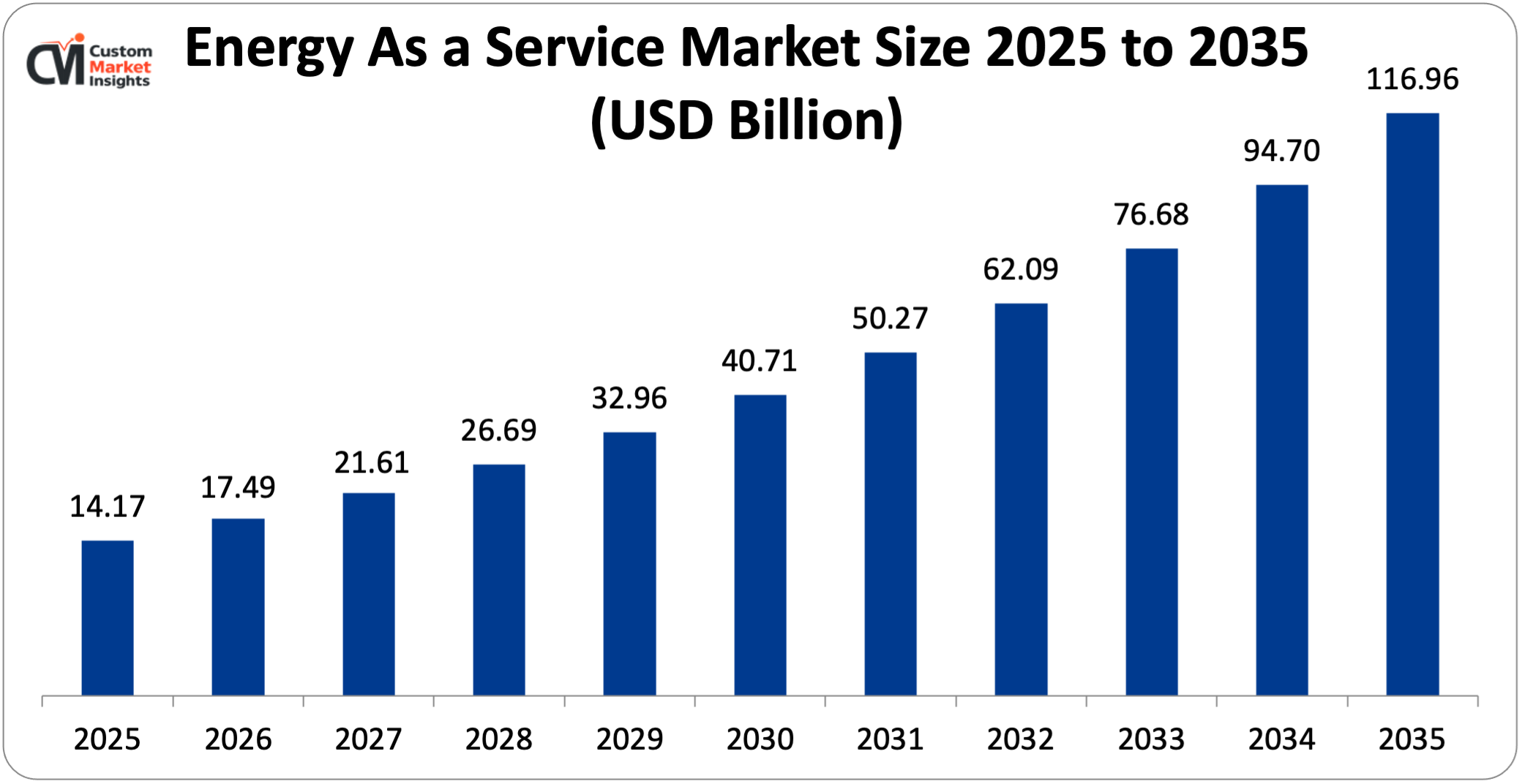
The market size of global energy as a service will be estimated at USD 77.4 billion in 2025 and is expected to grow to between USD 87.2 billion in 2026 and about USD 253.5 billion by 2035, with a current CAGR (compound annual growth rate) of 12.6% during the period of 2026 to 2035.
To learn more about this report - request a sample report PDF
Energy As a Service Market Revenue and Trends
Energy-as-a-Service (EaaS) represents a subscription-based, usage-based delivery of energy services (electricity provision, energy efficiency, infrastructure operation, optimization, and others), where the end customer consumes energy services without involvement in the traditional full ownership model of the energy assets or infrastructure. In the EaaS business model, a third-party service provider manages the energy system (renewable generation, storage, network management, energy trading, and control platforms), while the customer pays according to predefined key performance indicators (usage and responsiveness of the system). EaaS benefits include minimizing high capital costs, improving energy efficiency, and meeting organizational sustainability objectives, and it is well established in most commercial, industrial, and public organization systems.
What are the Factors That Have a Significant Contribution to the Growth of the Energy As a Service Market?
One significant trend that is contributing to the growth of the market is the increase in focus on energy efficiency. Today organizations are becoming increasingly aware of energy consumption issues and actively seeking to reduce costs and meet their sustainability targets. This trend is one of the reasons, along with surging energy prices and more stringent efficiency regulations, that drive industries, businesses, and public sector organizations to adopt energy-efficient solutions that do not require considerable initial investments.
The need is addressed by EaaS providers through a wide range of energy management services, which include analysis of energy needs, smart usage and real-time monitoring, and management and performance of energy flow, all provided on flexible and affordable service-based costing arrangements. In this context, the use of technology (Internet of Things sensors, smart meters, data collection and review systems, and advanced data analytics) allows EaaS providers to perform constant energy monitoring and management, optimize output while eliminating inefficiencies, minimize waste, and provide cost savings for their customers.
Additionally, the use of performance-based contracts, whereby the customer pays the service provider according to the quantity of saved energy, can be an attractive incentive by minimizing the risk for the customer in terms of cost development. The implementation of the government policies related to energy efficiency can reinforce this trend as energy efficiency standards become more demanding and limits to carbon emissions are stricter. By outsourcing this non-core process to specialists, companies can concentrate on key activities, reduce their costs, and improve their performance. In fact, the greater attention paid to energy efficiency confirms the growth of demand in the EaaS market.
One of the key factors that can be said to significantly supplement the market growth of EaaS, which is also transforming the market, is the dominating trend of outsourcing by the corporates, which is fueled by a multitude of reasons, including the insight of companies to be able to add the maximum value and devote their own core competencies; and the insight of companies to minimize or reduce the operating costs; and the focus of companies on their core business processes and, thus, outsourcing the non-core-related processes, such as energy management, to a specialized service provider who can provide expertise in the same.
Managing the various energy infrastructure (procurement, monitoring, operation, maintenance, control, conditioning, and optimization of the same), along with the various related technologies and equipment such as sensors, meters, controls, software systems, and others, requires certain technical skills along with persistent supervision or monitoring and, at times, capital investment as well. While outsourcing through the adoption of EaaS models would help the companies to not spend on this front, it would also help them to reap the benefits of professionally managed, optimized, and reliable energy infrastructure, which is driven by technology and innovation to minimize and maximize the performance and make the system reliable.
Regional Insights
North America held the highest market share in 2025. This expansion is driven predominantly by the region‘s intensive regard for decarbonization and carbon net-zero targets, especially in the US and Canada, as the organizations are actively switching to renewable and energy-efficient systems.
Besides, the Asia Pacific market is expected to grow at the highest CAGR during the forecast period. This is because the region is witnessing rapid urbanization and industrialization, particularly in China, India, and other Southeast Asian countries, thus requiring more electricity consumption and demanding the existing energy infrastructure to cater to it. Furthermore, the region is witnessing more certainty of clean energy/wind and decarbonization, which is strongly driven by concerned governments.
Report Scope
| Feature of the Report | Details |
| Market Size in 2026 | USD 87.2 billion |
| Projected Market Size in 2035 | USD 253.5 billion |
| Market Size in 2025 | USD 77.4 billion |
| CAGR Growth Rate | 12.6% CAGR |
| Base Year | 2025 |
| Forecast Period | 2026-2035 |
| Key Segment | By Service Type, End Use and Region |
| Report Coverage | Revenue Estimation and Forecast, Company Profile, Competitive Landscape, Growth Factors and Recent Trends |
| Regional Scope | North America, Europe, Asia Pacific, Middle East & Africa, and South & Central America |
| Buying Options | Request tailored purchasing options to fulfil your requirements for research. |
Recent Developments
- In November 2025, Energy technology company SLB (SLB.N), opens new tab, launched a new artificial intelligence tool on Monday to automate processes and workflows for energy companies moving to leverage AI to unlock growth. SLB's new technology, Tela, will be embedded into the company's portfolio of applications and platforms, and users will interact through a simple conversational interface.
- In September 2025, Hithium, a leading global provider of integrated energy storage products and solutions, unveiled its AI data center ESS solution at RE+ 2025. The portfolio includes the ∞Power 6.25MWh 8h long-duration BESS, the ∞Power N2.28MWh 1h BESS, and a dedicated lifespan assessment model for AIDC ESS. The solution addresses both the real-time and reliability requirements of data centers while helping boost renewable energy utilization. This marks a breakthrough in applying long-duration storage to the data center industry.
List of the prominent players in the Energy As a Service Market:
- Johnson Controls
- Honeywell International Inc.
- Engie
- Siemens
- Veolia
- EDF
- Schneider Electric
- Bernhard
- General Electric
- Entegrity
- Wendel
- Ørsted A/S
- NORESCO LLC
- Centrica plc
- Enel SpA
- Others
The Energy As a Service Market is segmented as follows:
By Service Type
- Supply Services
- Energy Optimization Services
- Demand Services
By End Use
- Commercial
- Industrial
Regional Coverage:
North America
- U.S.
- Canada
- Mexico
- Rest of North America
Europe
- Germany
- France
- U.K.
- Russia
- Italy
- Spain
- Netherlands
- Rest of Europe
Asia Pacific
- China
- Japan
- India
- New Zealand
- Australia
- South Korea
- Taiwan
- Rest of Asia Pacific
The Middle East & Africa
- Saudi Arabia
- UAE
- Egypt
- Kuwait
- South Africa
- Rest of the Middle East & Africa
Latin America
- Brazil
- Argentina
- Rest of Latin America

Rushikesh Dorge
Head - Client RelationsRushikesh Dorge is a seasoned Market Research and Business Consulting Professional with over six years of experience in market intelligence, competitive analysis, forecasting, and business strategy. At Custom Market Insights, he helps organizations identify growth opportunities a
View profile and reportsAbout Custom Market Insights
Custom Market Insights is a market research and advisory company. It publishes syndicated reports across 18+ industries and delivers custom research, feasibility studies and market entry strategy for companies, investors and consultancies.
###