
Global Inspection Robotics in Oil and Gas Market Size Likely to Grow at a CAGR of 6.5% By 2035
Key highlights
- Oil and gas structures like pipelines, offshore platforms, storage tanks, and refineries are supposed to be periodically inspected to avoid leaks, corrosion, and equipment breakdown.
- The application of robotic inspection systems within oil and gas companies is on the rise in order to check pipelines, storage tanks, offshore platforms, and refinery equipment.
- The market of oil and gas inspection robotics will also witness a high growth in the Asia Pacific region owing to the rapid growth of the energy infrastructure and growing investment in the oil and gas exploration activities.
- In May 2025, Bridger Photonics announced its Gas Mappings LiDAR technology, which involves the use of drones to scan the levels of methane emissions in isolated industrial areas.
Market Size and Growth
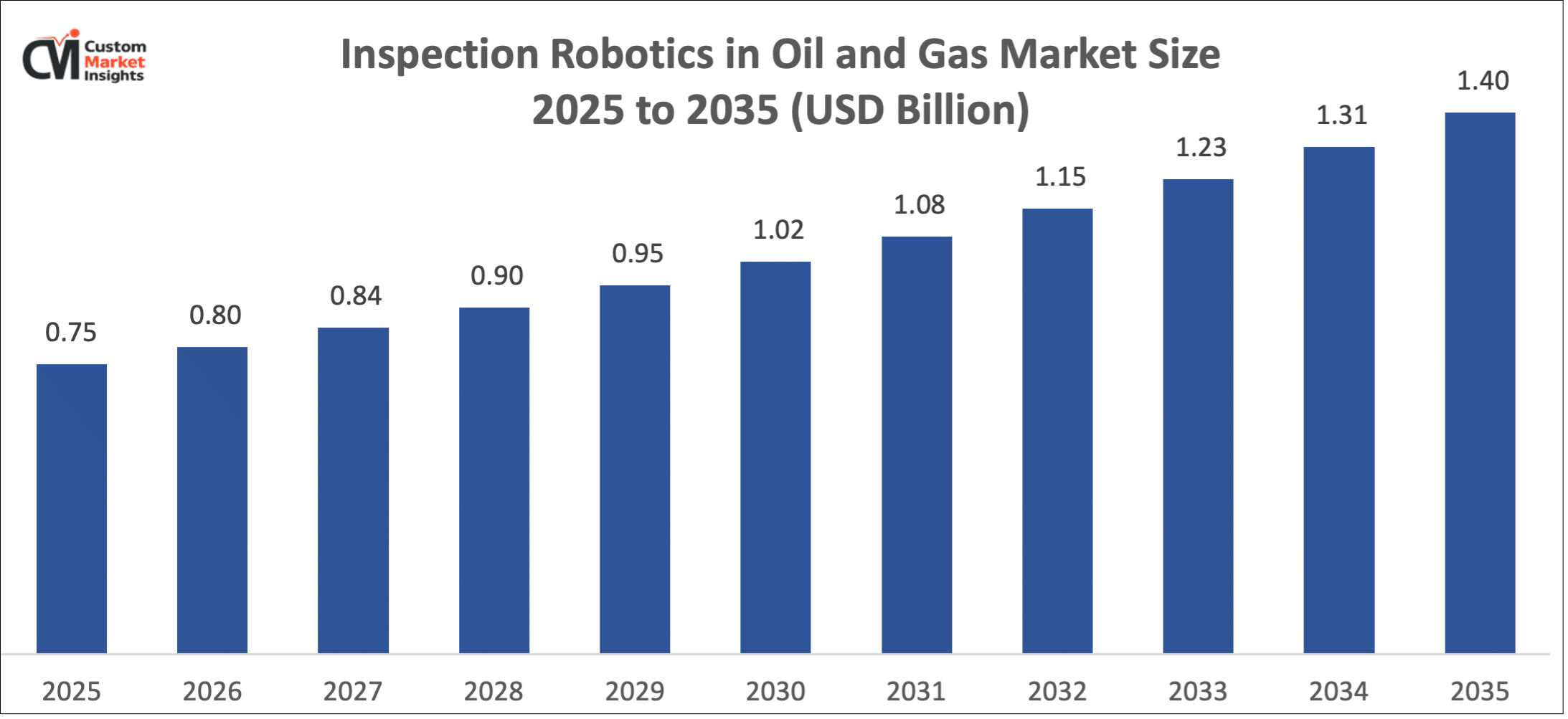
The oil and gas market inspection robotics will reach USD 0.80 billion during the year 2026, USD 1.40 billion during the year 2035 and with a projected CAGR of 6.5% between the years 2026 and 2035.
To learn more about this report - request a sample report PDF
Inspection Robotics in Oil and Gas Market Revenue And Trends
The Inspection robotics market in oil and gas is growing vigorously because more energy companies are turning to the automated technologies in order to enhance the safety of their operations and monitoring of the infrastructure condition. Oil and gas structures like pipelines, offshore platforms, storage tanks, and refineries are supposed to be periodically inspected to avoid leaks, corrosion, and equipment breakdown. More accurate and efficient inspections in the complex industrial settings are being supported by advanced robotics having high-resolution cameras, ultrasonic sensors, LiDAR, and thermal imaging technology. The incorporation of robotic inspection solutions is also accelerated by the tightening of the safety rules and the necessity to decrease the operational risks in dangerous conditions. Unmanned robots are also able to work in tight places, underwater and in hot plants where human workers find it challenging or hazardous to inspect.
Source: Custom Market Insights analysis.
What are the Factors that Significantly Exert an Influence on the development of Inspection robotics in oil and gas Market?
Market in Expanded Inspection robotics in oil and gas Market Strict environmental regulations are strongly shaping the growth of inspection robotics in the oil and gas market as the need to comply with aging energy infrastructure and the need to increase safety regulations. Oil and gas infrastructures including pipelines and offshore platforms, storage tanks and refineries have to undergo regular checks to identify corrosion, cracks and structural damages. Preventive maintenance and operational safety are of concern to regulatory bodies and energy operators to prevent accidents, damage to the environment, and expensive shutdowns. Consequently, businesses are adopting robotic inspection robots such as crawler robots, aerial drones and underwater remotely operated vehicles (ROVs) to inspect sensitive assets located in dangerous or inaccessible areas.
The quick development of robotic technologies and digital asset monitoring solutions is also another significant reason to support the development of inspection robotics in the oil and gas market. The latest generation of inspection robots has high-resolution cameras, ultrasonic sensors, and LiDAR scanners, as well as artificial intelligence-based sensors to find defects. These technologies allow checking the state of equipment in real-time and letting operators identify faults before they develop into significant operation failures. Also, the combination of cloud-based analytics and predictive maintenance systems will assist corporations with strengthening their asset management, lowering the expenses of manual check-ups, and improving the efficiency of the operations. A combination of these technological innovations is driving the use of robotic systems in inspection solutions in both onshore and offshore oil and gas fields around the world.
Segment Insight
By Technologies
Unmanned Aerial Vehicles (UAVs), crawling robots, submersible robots, and automated guided vehicles (AGVs) are changing the work of inspection in the oil and gas infrastructure. UAVs find extensive application in aerial surveys of pipelines, offshore platforms, and flare stacks with the speed at which operators are able to inspect large facilities. Crawling robots are widely used within pipelines and storage tanks to locate corrosion, cracks, and structural damages in a limited space. In offshore inspection of the offshore assets, underwater pipelines, and drilling equipment, submersible robots and remotely operated vehicles are essential to inspect the underwater sites. In the meantime, AGVs are also deployed in the refineries and large processing plants to perform automated maintenance and inspection operations. The robotic technologies on this reduce manual checking risks, enhance the accuracy of the operations, and improve operational efficiency.
By Applications
The major areas of application of inspection robotics in the oil and gas industry include pipeline inspection, tank inspection, offshore platform inspection, and refinery inspection. The pipelines should be monitored regularly since the corrosion, leakage, and mechanical damages may cause expensive environmental and operational accidents. Robots used to inspect tanks also assist in identifying structural flaws, sedimentation, and corrosion of a large storage vessel without the need for a human worker to enter. Offshore systems are based on robotic systems and drones to check structural elements, flare stacks, and production equipment, which are situated in dangerous regions. Robotic inspection technologies are also installed by refineries to track complicated processing devices, heat exchangers, and pipelines. These applications allow energy companies to enhance planning of maintenance and downtime and are able to control the safety of operations.
By End-User
The primary oil and gas market end-users of inspection robotics are upstream, midstream and downstream. The upstream companies also have inspection robots to check out drilling rigs, offloading platforms, and subsea apparatus used in the exploration and production of oil and gas. Midstream operators use robotic technologies in the transportation networks to check the pipelines, monitor the storage tanks, and maintain the infrastructure. Downstream plants like refineries and petrochemical plants use robotic inspection systems to measure the performance of equipment used in the plants and identify structural damage and keep the operations safe. Due to the increased complexity of the oil and gas infrastructure and more stringent safety standards, the need for robotic inspection solutions in all sectors of the industry is increasing.
Outlook
As per the recent industry forecasts, the oil and gas market of inspection robotics will continue to expand within the timeframe of 2026-2035 due to the rising demand of the automated inspection technologies and the necessity to enhance operational safety of the energy infrastructure. The application of robotic inspection systems within oil and gas companies is on the rise in order to check pipelines, storage tanks, offshore platforms, and refinery equipment. Robotics, artificial intelligence, and real-time data analytics are advanced technologies that are enhancing the accuracy of inspection and allowing the use of predictive maintenance practices. Moreover, the increased concern regarding minimization of operational risks, downtime, and optimization of asset management is driving energy companies to invest in modern robotic inspection systems in their onshore and offshore locations.
Regional Insights
The market of oil and gas inspection robotics will also witness a high growth in the Asia Pacific region owing to the rapid growth of the energy infrastructure and growing investment in the oil and gas exploration activities. China, India, Australia, and other countries in the southeast of Asia are building new pipelines, offshore platforms and refineries to sustain the increasing demand in energy. The operators are also embracing robotic inspection technology as these facilities continue to expand, thereby enhancing better monitoring of assets, early detection of structural damages and safety of operation. Increasing use of automation and digital technologies in energy industries is another way of intensifying market demand in the region.
It is also expected that the Europe region would see considerable growth because of the growing focus on the industrial safety standards and modernization of the oil and gas infrastructure of the aging ones. Several European energy companies have put money in sophisticated inspection equipment to keep pipelines, offshore installations and refinery plants safe. On the same note, North America remains a significant market with vast oil and gas infrastructure and a high rate of digital inspection technologies. More and more energy companies operating in the region are using drones or robotic crawlers and remote-operated vehicles to perform inspections with greater efficiency and less risk compared to the manual inspection methods. In general, the increasing attention to automation, safety management, and predictive maintenance is contributing to the global development of the inspection robotics in oil and gas sector.
Report Scope
| Feature of the Report | Details |
| Market Size in 2026 | USD 0.80 billion |
| Projected Market Size in 2035 | USD 1.40 billion |
| Market Size in 2025 | USD 0.75 billion |
| CAGR Growth Rate | 6.5% CAGR |
| Base Year | 2025 |
| Forecast Period | 2026-2035 |
| Key Segment | By Technologies, Applications, End-User and Region |
| Report Coverage | Revenue Estimation and Forecast, Company Profile, Competitive Landscape, Growth Factors and Recent Trends |
| Regional Scope | North America, Europe, Asia Pacific, Middle East & Africa, and South & Central America |
| Buying Options | Request tailored purchasing options to fulfil your requirements for research. |
Recent Developments
- In May 2025, Bridger Photonics announced its Gas Mappings LiDAR technology, which involves the use of drones to scan the levels of methane emissions in isolated industrial areas. The system allows the highest precision in the measurement and detection of a leak in methane in all the facilities, like the offshore platforms, LNG terminals, and pipeline networks. The technology has two modes of monitoring that enable the operators of the technology not only to identify sources of leaks but also to quantify volumes of emission when conducting aerial inspections, which enhances efficiency in detecting methane and environmental monitoring.
List of the prominent players in the Inspection Robotics in Oil and Gas Market:
- GE Inspection Robotics
- Honeybee Robotics
- IKM Subsea
- Inuktun Services Ltd.
- International Submarine Engineering (ISE) Ltd.
- FMC Technologies
- Hydrovision Ltd.
- OC Robotics
- Fugro
- TechnipFMC
- Saipem
- Schlumberger
- Halliburton
- Baker Hughes
- ABB Ltd.
- Others
The Inspection Robotics in Oil and Gas Market is segmented as follows:
By Technologies
- Unmanned Aerial Vehicles (UAVs)
- Crawling Robots
- Submersible Robots
- Automated Guided Vehicles (AGVs)
By Applications
- Pipeline Inspection
- Tank Inspection
- Offshore Platform Inspection
- Refinery Inspection
By End-User
- Upstream Oil and Gas
- Midstream Oil and Gas
- Downstream Oil and Gas
Regional Coverage:
North America
- U.S.
- Canada
- Mexico
- Rest of North America
Europe
- Germany
- France
- U.K.
- Russia
- Italy
- Spain
- Netherlands
- Rest of Europe
Asia Pacific
- China
- Japan
- India
- New Zealand
- Australia
- South Korea
- Taiwan
- Rest of Asia Pacific
The Middle East & Africa
- Saudi Arabia
- UAE
- Egypt
- Kuwait
- South Africa
- Rest of the Middle East & Africa
Latin America
- Brazil
- Argentina
- Rest of Latin America
Rushikesh Dorge
View profile and reportsAbout Custom Market Insights
Custom Market Insights is a market research and advisory company. It publishes syndicated reports across 18+ industries and delivers custom research, feasibility studies and market entry strategy for companies, investors and consultancies.
###