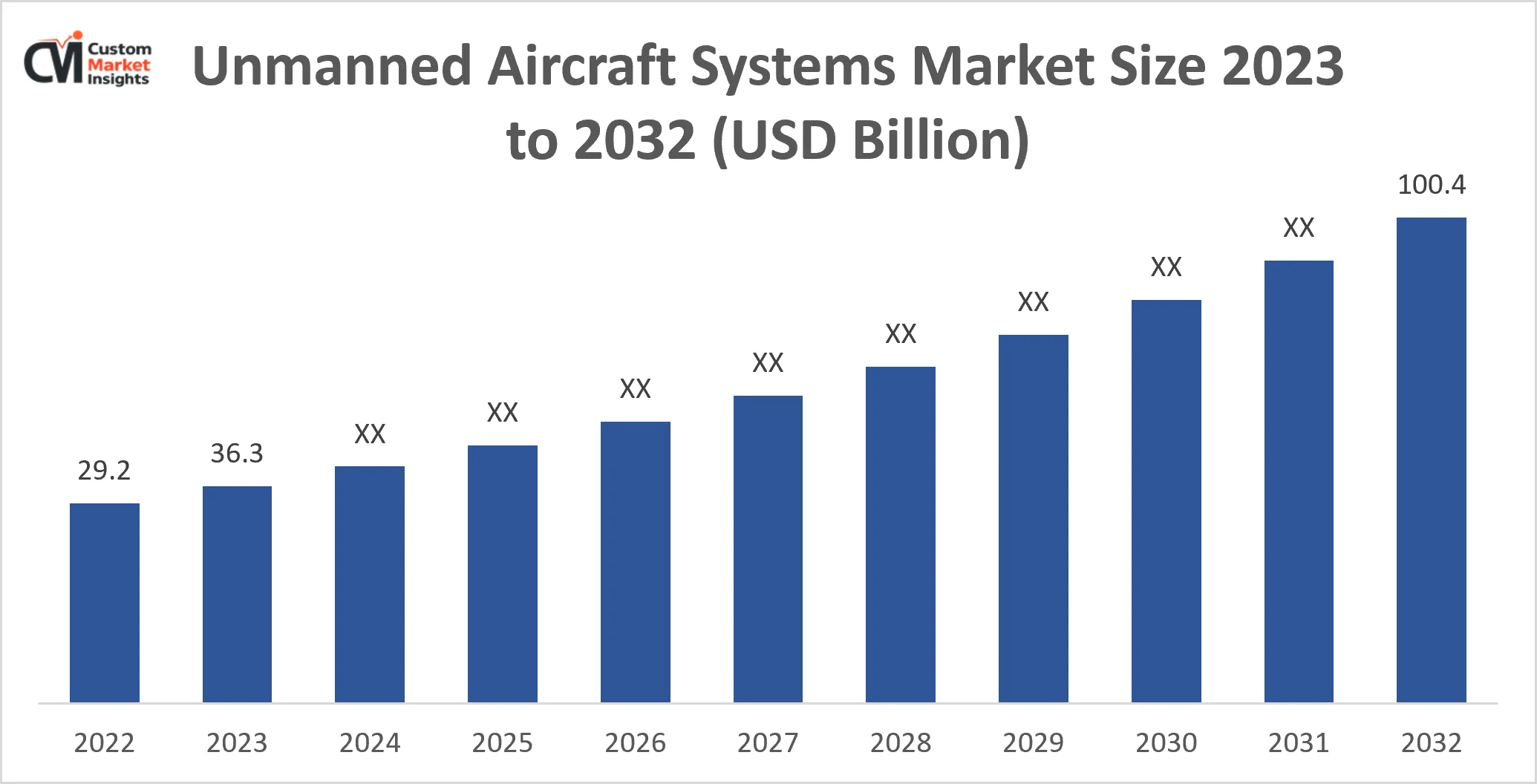
Valued at USD 36.3 Bn in 2023, the market is projected to reach USD 100 Bn by 2032, growing at a 14.9% CAGR. Europe holds the largest share, while Asia-Pacific grows fastest. The report is segmented by type, size and application.
The global unmanned aircraft systems market was valued at USD 36.3 Bn in 2023 and is projected to reach USD 100 Bn by 2032, growing at a CAGR of 14.9%. Europe is the largest regional market and Asia-Pacific is growing fastest.
Global Unmanned Aircraft Systems Market 2023–2032 (By Billion)
As per the current market research conducted by CMI Team, the Global Unmanned Aircraft Systems Market is expected to record a CAGR of 14.9% from 2023 to 2032. In 2022, the market size is projected to reach a valuation of USD 29.2 Billion. By 2032, the valuation is anticipated to reach USD 100.4 Billion.
Unmanned aircraft systems (UAS), commonly referred to as drones, are aerial machines that fly autonomously or remotely without human control. Drones can be used as weapons in battle or to reimagine the delivery of humanitarian aid. They can carry out tracking, monitoring, and surveillance tasks or contribute to scientific research advancement.
Drones have the potential to revolutionize human labor and even conduct risky duties, but they also pose a threat to the fundamental principles of a free and democratic society. One of the main drivers of the expansion of the worldwide UAS market is the rise in demand for UAVs across industries including the military & defense, homeland security, and commercial segments.
Additionally, governments and environmental organizations can use unmanned aircraft systems to monitor forests for illegal logging, protect green space, observe wildlife, and monitor erosion. When disaster strikes, unmanned aircraft systems can play crucial roles in analyzing and mitigating their impacts when time is of the essence. Additionally, UAS are practically unrestricted in their capacity to do such tasks in hazardous environments, complete darkness, intense heat, and a variety of other situations that might pose serious threats to human aircraft.
Unmanned Aircraft Systems Market: COVID–19 Impact Analysis
Global economies have been significantly impacted by the COVID-19 pandemic. For several industries, COVID-19 has created a number of difficulties. It has been determined that COVID-19 is a global epidemic, which has resulted in lockdowns in every nation and a downturn in the economies.
Consumer products and industrial activities are only two areas of life that are impacted by this situation. Given the limitations and restrictions placed on human activities as a result of the pandemic epidemic, unmanned aircraft systems have emerged as a key utility product in these circumstances. Numerous uses for UASs of all sizes, from microscopic to large, show that both public and private entities may use UAVs in the future as a planning and preparedness tool for situations like these.
This is being utilized by health officials to do tasks like spraying disinfectants in potentially polluted areas, which is one of the essential ways that people use disinfectants to counteract the COVID-19 impact.
Unmanned Aircraft Systems Market: Growth Drivers
Increasing use of UAS by the military and other government entities accelerates the market’s growth
The growing safety concerns of armed forces and other organizations throughout the world are going to be very beneficial for the market for unmanned aircraft systems.
The defense departments of several advanced economies, including the United States, China, India, Japan, and others, have made significant expenditures to equip their armies with the tools they need, most of which consist of UAVs and other drones.
The increased use of UAVs by various governmental organizations has fueled the expansion of unmanned aircraft systems in the world market.
The increasing applications of UAS in air strikes accelerate the market’s growth
Global armed conflicts and deadly terrorist assaults have significantly increased in recent years around the world. According to media reports, Sub-Saharan Africa has at least 15 nations with ongoing armed hostilities in 2020.
Among others, Nigeria, Kenya, Mali, Sudan, and the Democratic Republic of the Congo. These ongoing violent conflicts often increase the need for different surveillance UAVs, fueling the expansion of the unmanned aircraft systems industry. Further boosting the need for UAS for air strikes that tend to drive UAS demand globally is the rise of ISR missions by the Military & Defense sector for peace processes in extremely stressful combat situations.
Unmanned aircraft systems provide airborne ISR services for the Department of Defense and Intelligence Community, including information gathering, processing, analysis, and distribution to intelligence, defense, and homeland security personnel. These applications have significantly increased the demand for UAS, which is further fueling the expansion of its industry.
Unmanned Aircraft Systems Market Segmentation Analysis
The unmanned aircraft systems market is segmented into type, size, and application. Based on type, the market for fixed wing unmanned aircraft systems segment is estimated to lead the market. During the projection period, the fixed wing market segment is anticipated to dominate. Due to the increased usage of fixed drones for swift aerial surveys of vast areas, it has taken over.
The forms of fixed wing drones range from straight to swept to delta. The advantages of fixed-wing systems include simple assembly and minimal maintenance needs, longer flight periods, the capacity to swiftly cover a large area, stability, excellent image quality, and other advantages. Map-making and surveying, search-and-rescue missions, and ISR (Intelligence, Surveillance, and Reconnaissance) missions are just a few of the aerial duties that fixed-wing drones are utilized.
The rotary-wing UAV industry is expected to expand at the highest CAGR of all unmanned aerial vehicle markets. This is mainly because it is more agile and smaller than other drone kinds, easier to use, has a larger cargo capacity, and costs about the same as other drone types. Additionally, these drones require less space to take off because they have the ability to hover in midair.
By size, very small unmanned aircraft systems are the leading and dominating segment in the unmanned aircraft systems market during the forecast period. The very small sized unmanned aircraft are quite popular for leisure use. Nano and macro UAS make up very small unmanned aircraft systems. Nano unmanned aircraft weigh up to 250 g, whereas macro unmanned aircraft typically weigh between 250 g and 2 kg.
Very tiny UAS have been widely used as a result of the growing need for nano and macro-UAVs in precision agriculture, which have the ability to significantly increase the effectiveness of managing water, nutrients, and diseases. The market is expanding because of the broad variety of applications for nano and macro UAS in agriculture.
By application, the commercial segment is anticipated to dominate the market during the forecast period. The market is expanding as a result of the widespread use of remote location monitoring and surveying in the area. Additionally, commercial and recreational drones are employed to monitor disaster-affected areas, help sufferers, and conduct search and rescue operations.
Global demand for commercial unmanned aircraft systems has increased as a result of the COVID-19 pandemic response. Since autonomous flight eliminates the need for expensive manpower and AI-driven data collection and processing shortens the time it takes to produce results that directly influence decision-making, autonomy and artificial intelligence (AI) are, and will remain, the main drivers promoting commercial UAS adoption and associated market growth.
The military need for tactical and strategic Unmanned Aircraft Systems (UAS) is rising, which is promoting the segment's expansion. The number of deaths may be drastically decreased by using surveillance and reconnaissance robots to learn about the layout of the battlefield and the opposing forces in the area.
Report Scope
Feature of the Report
Details
Market Size in 2023
USD 36.3 Billion
Projected Market Size in 2032
USD 100.4 Billion
Market Size in 2022
USD 29.2 Billion
CAGR Growth Rate
14.9% CAGR
Base Year
2023
Forecast Period
2024-2033
Key Segment
By Type, Size, Application and Region
Report Coverage
Revenue Estimation and Forecast, Company Profile, Competitive Landscape, Growth Factors and Recent Trends
Regional Scope
North America, Europe, Asia Pacific, Middle East & Africa, and South & Central America
Buying Options
Request tailored purchasing options to fulfil your requirements for research.
Key Insights:
Based on type segmentation, the fixed wing segment is estimated to hold the largest market share during the forecast period.
Based on size segmentation, the very small unmanned aircraft systems segment is the leading revenue-generating category during the forecast period.
Based on application segmentation, the commercial unmanned aircraft systems segment is the leading revenue-generating category during the forecast period.
On the basis of geography/region, the North America region was the leading revenue generator in 2021.
Recent Development
April 2021: With the new DJI Air 2S, DJI set a new standard for excellent flying performance and breathtaking pictures. This little camera drone is an all-in-one device that combines advanced camera improvements, reliable flight performance, and premium pre-programmed content creation features.
April 2021: Aeroports de Catalunya, a publicly traded corporation owned by the Generalitat de Catalunya, and Ehang formed cooperation. The cooperation sought to offer passenger transportation, airborne logistics, infrastructure for takeoff and landing, airspace management, regulatory certification, etc. The collaboration will advance the use of UAS in Europe by promoting safe, clever, and environmentally friendly autonomous aerial transportation systems.
Regional Landscape
Throughout the projection period, North America is expected to continue to be among the most alluring markets and this region is accounted for the majority revenue share in the market. The United States leads the market in North America and is a well-known manufacturer of military unmanned aircraft systems (UAS) that exports its UASs to a number of other countries. The market for unmanned aircraft systems in this region is settled and hence generates more revenue than any other region.
The Asia-Pacific area is anticipated to develop quickly throughout the projection period. In order to combat rising labor costs, nations like China and Japan are increasingly adopting automation and cutting-edge technology across a variety of industries. These nations are also backing regional government programs and expanding their investments in key UAS technologies.
Competitive Landscape
Our report offers both quantitative and qualitative insights into the WebRTC market and major development initiatives adopted by the key players. Further, it offers competitive details and market share analysis. The report further includes relevant financial information, products and services offered, SWOT analysis, and recent developments of the players profiled.
List of the prominent players in the global unmanned aircraft systems market:
Parrot
Lockheed Martin
Airbus
Boeing
BAE
DJI
Northrop Grumman
Thales
IAI
Textron
Others
The global Unmanned Aircraft Systems Market is segmented as follows:
By Type
Fixed Wing
Rotary Wing
By Size
Very small
Small
Mini
Large
By Application
Commercial
Military
Civil
Others
Regional Coverage
North America
U.S.
Canada
Mexico
Rest of North America
Europe
Germany
France
U.K.
Italy
Spain
Rest of Europe
Asia Pacific
China
Japan
India
New Zealand
Australia
South Korea
Rest of Asia Pacific
The Middle East & Africa
Saudi Arabia
UAE
Egypt
Kuwait
South Africa
Rest of the Middle East & Africa
Latin America
Brazil
Argentina
Rest of Latin America
CMI.Market Research Report2023-2032
Global Unmanned Aircraft Systems Market 2024–2033
Updated: September 2026 · Formats: PDF, Excel, PPT
Which are the driving factors of the Unmanned Aircraft Systems Market?
The key factors driving the Market are Increasing use of UAS by the military and other government entities accelerate the market’s growth And The increasing applications of UAS in air strikes accelerate the market’s growth.
Who are the key players in the Unmanned Aircraft Systems market?
The key players in the market are Parrot, Lockheed Martin, Airbus, Boeing, BAE, DJI, Northrop Grumman, Thales, IAI, Textron, Others
Which region held the largest market share in the Unmanned Aircraft Systems market?
"North America" had the largest share in the Unmanned Aircraft Systems Market.
What is the growth rate of the Unmanned Aircraft Systems market?
The global market is projected to grow at a CAGR of 14.9% during the forecast period, 2023-2032.
How much is the Unmanned Aircraft Systems market?
The Unmanned Aircraft Systems Market size was valued at USD 29.2 Billion in 2022.
Ayush Kadam is a Senior Market Research Analyst at Custom Market Insights, with over seven years of experience in syndicated and custom market research. He specializes in market sizing, competitive intelligence, industry trends, forecasting, and strategic insights, helping clients turn complex data into actionable business decisions.