
Brazil Tea and Coffee Botanical Ingredient Market Size Likely to Grow at a CAGR of 7.97% By 2035
Key highlights
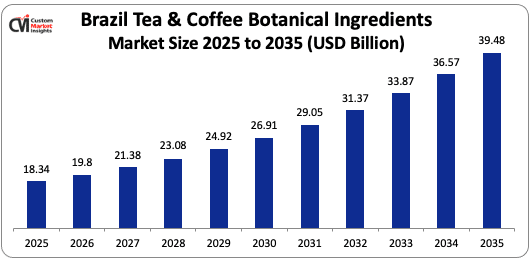
- Market valued at USD 19.8 Bn in 2026, projected to reach USD 39.48 Bn by 2035.
- Expected to grow at a CAGR of 7.97% over 2026-2035.
- Brazil is the largest regional market.
Market Size and Growth
Brazil's tea and coffee botanical ingredient market size is expected to record a CAGR of 7.97% from 2026 to 2035. In 2026, the market size was USD 19.8 Billion. By 2035, the valuation is anticipated to reach USD 39.48 Billion.
To learn more about this report - request a sample report PDF
Brazil Tea and Coffee Botanical Ingredient Market Revenue and Trends
Brazil's tea and coffee botanical ingredient market is majorly driven by rising demand for natural caffeine, functional beverages, and antioxidant-rich ingredients across nutraceutical, food, and personal care applications, alongside speedy expansion of plant-based and clean-label product trends. Plus, increased consumption of herbal and tea infusions is adding to market growth. The key dynamics include increased use of highly pure botanical extracts, innovation in RTD and energy beverages, and a shift in the direction of traceable and sustainable sourcing practices. Brazil’s raw material base is also keeping the cash registers ringing herein.
What are the Factors that Significantly Contribute to the Growth of Brazil Tea and Coffee Botanical Ingredient Market?
One of the major factors contributing to the growth of Brazil's tea and coffee botanical ingredients market is the increased consumer demand for functional, natural, and clean-label products across the nutraceutical, beverage, food, and personal care markets. Rising health awareness is driving the interest in ingredients that are rich in polyphenols, antioxidants, and natural caffeine, usually derived from coffee beans and tea leaves. The trend is seen from the speedy expansion of energy drinks, functional beverages, and dietary supplements, wherein the botanical extracts are used for enhancing both – product appeal and nutritional value.
The other factor driving the growth of Brazil's tea and coffee botanical ingredients market is a strong farming advantage with the expansion of technological capabilities regarding the processing of ingredients. Brazil, as a large-scale producer of coffee, does benefit from raw materials available in abundance, robust export potential, and cost-efficiency. This is thus an upscale production of botanical ingredients. Advancements in extraction technologies like supercritical CO₂ are enhancing yield, functionality, and purity of coffee and tea derivatives, thereby rendering them suitable for a broad spectrum of high class applications. There are also raised investments in traceability systems, sustainable agricultural practices, and eco-friendly production methods that are aligning the market with standards laid down worldwide.
Segment Insight
By Ingredient
Botanical extracts led Brazil tea and coffee botanical ingredients market in 2025. This was due to the increased demand for various botanical extracts from nutraceutical, functional beverage, and pharmaceutical industries, wherein consistency, precision, and efficacy are paramount. The dry extracts are broadly used in tablets, capsules, and powdered formulations, whereas liquid extracts are preferred in liquid supplements and beverages due to simple operation. Natural botanical colorants are estimated to register the highest CAGR between 2026 and 2035 due to them offering subtle hues apart from functional advantages, thereby facilitating dual-purpose applications in the formulations of products. The colorants are broadly used in RTD teas, functional beverages, wellness drinks and flavoured coffees, wherein visual differentiation does matter. Natural colors are also linked with authenticity and higher quality.
Report Scope
| Feature of the Report | Details |
| Market Size in 2026 | USD 19.8 Billion |
| Projected Market Size in 2035 | USD 39.48 Billion |
| Market Size in 2025 | USD 18.34 Billion |
| CAGR Growth Rate | 7.97% CAGR |
| Base Year | 2025 |
| Forecast Period | 2026-2035 |
| Key Segment | By Ingredient Type and Region |
| Report Coverage | Revenue Estimation and Forecast, Company Profile, Competitive Landscape, Growth Factors and Recent Trends |
| Buying Options | Request tailored purchasing options to fulfil your requirements for research. |
Recent Developments
- Nestlé and Barry Callebaut are joining hands to facilitate reforestation as well as agroforestry projects in the region’s coffee-growing counties, thereby aiming to secure supply of raw materials in the long run.
List of the prominent players in the Brazil Tea and Coffee Botanical Ingredient Market:
- Herboflora
- Amazonia Botanicals
- Leorganic
- Matte Leão
- Companhia Cacique de Café Solúvel
- Cocam Cia de Café Solúvel e Derivados
- IGUAÇU Coffee
- Sensient Technologies Corporation
- Döhler
- IFF (International Flavors & Fragrances)
- Finlays
- Others
The Brazil Tea and Coffee Botanical Ingredient Market is segmented as follows:
By Ingredient Type
- Whole & Cut Botanicals
- Milled & Powdered Botanicals
- Botanical Extracts
- Oleoresins (Non-Volatile Resin Extracts)
- Natural Botanical Colorants

Rushikesh Dorge
Head - Client RelationsRushikesh Dorge is a seasoned Market Research and Business Consulting Professional with over six years of experience in market intelligence, competitive analysis, forecasting, and business strategy. At Custom Market Insights, he helps organizations identify growth opportunities a
View profile and reportsAbout Custom Market Insights
Custom Market Insights is a market research and advisory company. It publishes syndicated reports across 18+ industries and delivers custom research, feasibility studies and market entry strategy for companies, investors and consultancies.
###