
Global Metalworking Fluids Market Size Likely to Grow at a CAGR of 5.5% By 2035
Key highlights
- The global market for metalworking lubricants is growing steadily.
- By Distribution Channel The manufacturer's direct sales channel dominates the market and accounts for the largest market share.
- 0 machining due to regulatory standards and innovative manufacturing.
- In August 2025: Quaker Houghton introduced a new line of bio-based and low-VOC metalworking fluids that last longer in the sump and work better for machining.
Market Size and Growth
The global market for metalworking fluids is expected to grow from USD 12.63 billion in 2026 to about USD 21.47 billion by 2035, with a compound annual growth rate (CAGR) of 5.5% from 2026 to 2035.
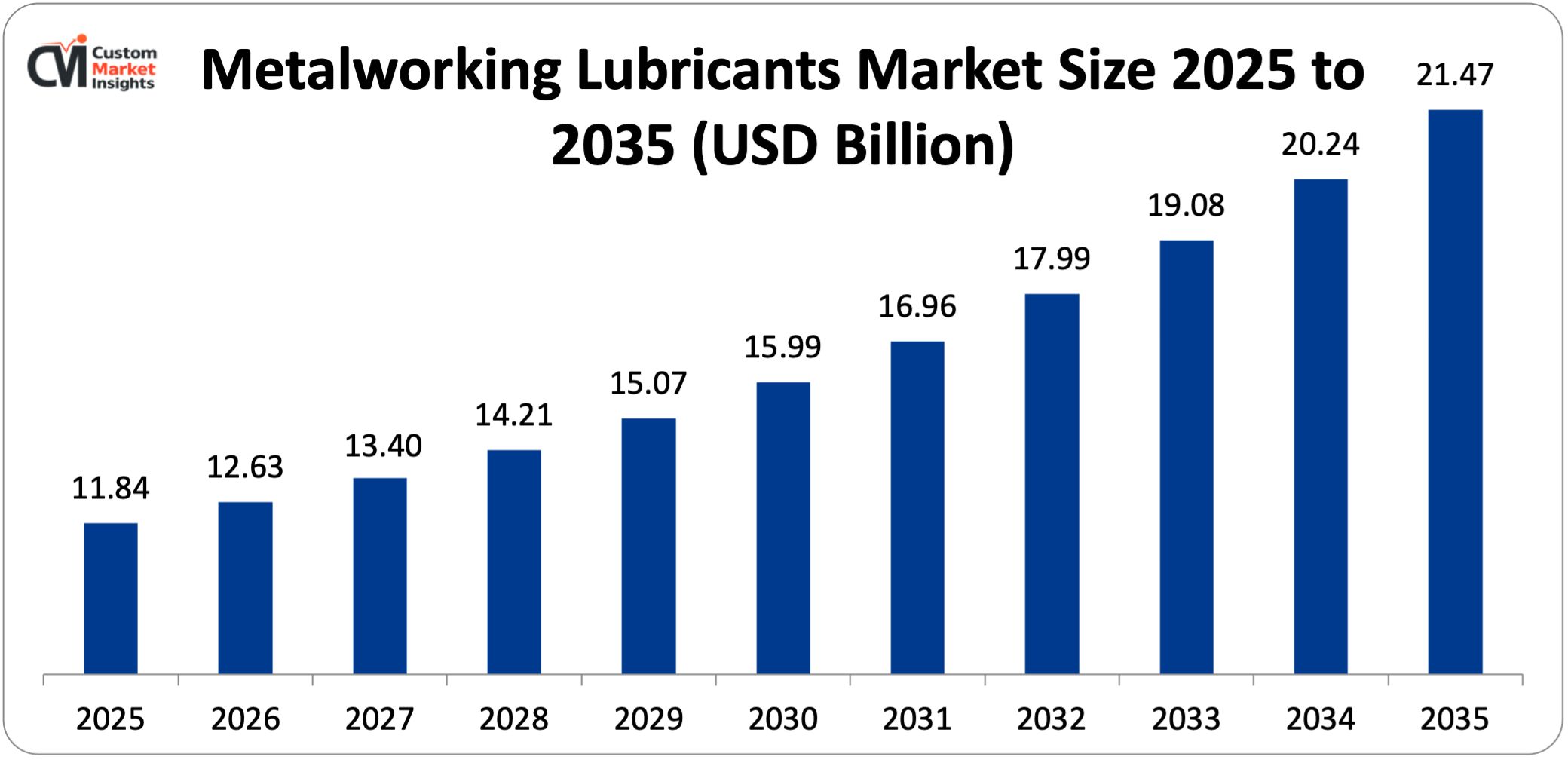
To learn more about this report - request a sample report PDF
Metalworking Fluids Market Revenue and Trends
Metalworking lubricants include cutting fluids, grinding fluids, forming oils, drawing oils, rolling oils, and protective fluids that are used in machining, stamping, forging, drawing, and other metal forming processes to lower friction, get rid of heat, make the surface smoother, make tools last longer, and stop rust. The global market for metalworking lubricants is growing steadily. This is because the automotive, aerospace, machinery, and metal fabrication industries are all growing, there is a growing need for high-precision parts, more people are using advanced CNC machining, and there are new high-performance, bio-based, and low-VOC metalworking fluids being developed around the world.
Source: Custom Market Insights analysis.
What are the Factors That Have a Significant Contribution to the Growth of the metalworking fluids market?
The growth in global manufacturing activity, advancements towards lightweight automotive and aircraft manufacturing, and the growing demand for improved surface finishing in precision machined parts have driven the demand for efficient lubrication solutions that promote production efficiency, increased tool life, and part performance. According to industry analysts, the growing demand for complex machining using CNC machining has seen specialized lubricating fluids being employed continually by firms in the sector. Manufacturers have responded to the demands of the day through innovations geared towards the production of advanced fluids that reduce production downtime and waste while ensuring compliance with workplace and environmental regulations.
Some of the developments have seen the creation of semi and fully synthetic metalworking fluids, bio-ester and fully bio based metalworking fluids, MQLs, and smart lubricants, which not only offer improved functionality but also increased longevity and safety for workers involved in their application processes. Some other trends fueling the industry include advancements in fluid composition aimed at providing protection from corrosion and contamination, regulation changes in the handling and disposal of hazardous substances, and government support for technological investments in manufacturing.
Segment Insight
By Product Type
Cutting fluids accounted for the largest share of the metalworking fluids market in 2025 due to their wide use in turning, milling, drilling, and grinding applications in automotive, aerospace, and general engineering industries. Such types of lubricants are required to facilitate chip removal, tool protection, and heat dissipation in machining processes at high speeds. There has been considerable development in novel low-foaming and high-performance synthetic and semi-synthetic products with improved surface finish capabilities and reduced environmental impact (considered by machine shops and manufacturers to be crucial in terms of productivity enhancement and increased tool life).
By Distribution Channel
The manufacturer's direct sales channel dominates the market and accounts for the largest market share. It is the principal means of procuring bulk quantities, customized product offerings, technical advice, and fluid management services. Manufacturer direct sales provide application engineering, fluid monitoring services, and troubleshooting to automotive parts suppliers, aerospace companies, and high-volume precision-critical metal fabrication facilities. Therefore, they serve as the preferred distribution channel among industrial users of industrial performance-based lubricants.
Regional Insights
Asia Pacific has become the largest consumer market of metalworking lubricants since there are numerous plants in the region, rapid development of the automotive, machinery, and electronics industries in China and India, a rising level of metal fabrication processes, and increased usage of CNC machines. In the Asia Pacific, there is a significant amount of large-scale industrial production, competitive prices, and capacity increases, which ensure high consumption of metalworking fluids.
Moreover, in North America, there has been fast growth of the market of metalworking lubricants due to the sophisticated aerospace and automotive industries, high precision manufacturing, strict environmental regulations, and an increase in demand for eco-friendly fluids, which have excellent characteristics. For example, the U.S. enjoys a leading position in technology, huge investments in quality products, and Industry 4.0 machining due to regulatory standards and innovative manufacturing.
Report Scope
| Feature of the Report | Details |
| Market Size in 2026 | USD 12.63 billion |
| Projected Market Size in 2035 | USD 21.47 billion |
| Market Size in 2025 | USD 11.84 billion |
| CAGR Growth Rate | 5.5% CAGR |
| Base Year | 2025 |
| Forecast Period | 2026-2035 |
| Key Segment | By Product Type, Formulation, Application, End Use Industry and Region |
| Report Coverage | Revenue Estimation and Forecast, Company Profile, Competitive Landscape, Growth Factors and Recent Trends |
| Regional Scope | North America, Europe, Asia Pacific, Middle East & Africa, and South & Central America |
| Buying Options | Request tailored purchasing options to fulfil your requirements for research. |
Recent Developments
- In August 2025: Quaker Houghton introduced a new line of bio-based and low-VOC metalworking fluids that last longer in the sump and work better for machining. These fluids were made to meet the growing needs for sustainability and regulations in the automotive and aerospace industries.
List of the prominent players in the Metalworking Fluids Market:
- Quaker Houghton Corporation
- Fuchs Petrolub SE
- Blaser Swisslube AG
- Henkel AG & Co. KGaA
- Castrol Limited (BP)
- TotalEnergies SE
- Chemours Company
- Buhmwoo Group
- Yushiro Chemical Industry Co. Ltd.
- Cimcool Industrial Products LLC
- Others
The Metalworking Fluids Market is segmented as follows:
By Product Type
- Cutting Fluids
- Straight Cutting Oils
- Water-Miscible Cutting Fluids
- Grinding Fluids
- Specialty Cutting Oils
- Forming Fluids
- Stamping & Drawing Oils
- Forging Lubricants
- Rolling Oils
- Wire Drawing Lubricants
- Quenching Fluids
- Water-Based Quenchants
- Polymer Quenchants
- Oil Quenchants
- Rust Preventives & Cleaners
- Solvent-Based Rust Preventives
- Water-Based Rust Preventives
- Alkaline Cleaners
- Other Product Types
By Formulation
- Neat Oils
- Soluble Oils
- Semi-Synthetic Fluids
- Synthetic Fluids
- Other Formulations
By Application
- Turning & Milling
- Drilling & Grinding
- Metal Forming & Stamping
- Honing & Lapping
- Heat Treatment
- Other Applications
By End Use Industry
- Automotive
- Aerospace & Defense
- General Manufacturing & Engineering
- Medical Devices
- Energy & Power Generation
- Other End Use Industries
Regional Coverage:
North America
- U.S.
- Canada
- Mexico
- Rest of North America
Europe
- Germany
- France
- U.K.
- Russia
- Italy
- Spain
- Netherlands
- Rest of Europe
Asia Pacific
- China
- Japan
- India
- New Zealand
- Australia
- South Korea
- Taiwan
- Rest of Asia Pacific
The Middle East & Africa
- Saudi Arabia
- UAE
- Egypt
- Kuwait
- South Africa
- Rest of the Middle East & Africa
Latin America
- Brazil
- Argentina
- Rest of Latin America
Rushikesh Dorge
View profile and reportsAbout Custom Market Insights
Custom Market Insights is a market research and advisory company. It publishes syndicated reports across 18+ industries and delivers custom research, feasibility studies and market entry strategy for companies, investors and consultancies.
###