Global Carbon Capture Utilization and Storage (CCUS) Market
Global Carbon Capture Utilization and Storage (CCUS) Market 2025 – 2035
Market size, share and growth analysis by service, technology and end use industry, across all major regions and key countries, with forecasts for 2025–2035. The competitive landscape profiles 15+ companies.
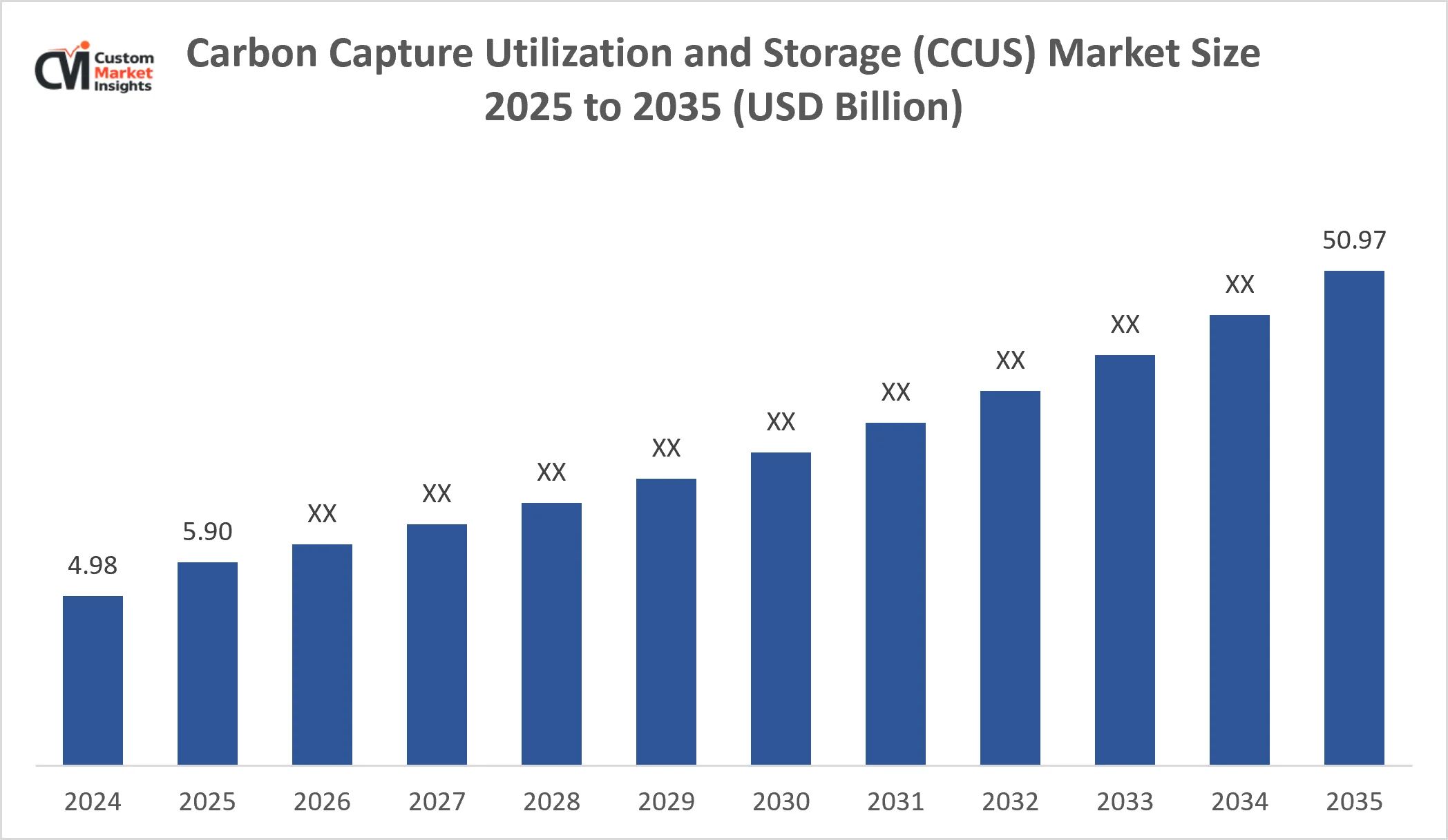
The global carbon capture utilization and storage (ccus) market was valued at USD 5.9 Bn in 2025 and is projected to reach USD 50.97 Bn by 2035, growing at a CAGR of 24.06%. North America is the largest regional market and Europe is growing fastest.
Reports Description
As per the Carbon Capture Utilization and Storage (CCUS) Market analysis conducted by CMI Team, the global Carbon Capture Utilization and Storage (CCUS) Market is expected to record a CAGR of 24.06% from 2025 to 2035. In 2025, the market size is projected to reach a valuation of USD 5.90 Billion. By 2035, the valuation is anticipated to reach USD 50.97 Billion.
Carbon Capture Utilization and Storage (CCUS) Market Overview
The Carbon capture utilization and storage market is expected to grow owing to the favorable government policies incentivizing CCUS deployment, surging demand for CO₂ in enhanced oil recovery (EOR) operations, and corporate net‑zero emissions commitments.
Currently, over 80 large‑scale CCUS facilities are operational worldwide, collectively capturing approximately 40 million metric tons of CO₂ per year, highlighting the technology’s emerging role in decarbonizing heavy industries. This major investment centers around power generation, oil and gas and petrochemical sectors wherein captured CO₂ either finds use in industrial processes or is stored permanently in geological formations.
Carbon Capture Utilization and Storage (CCUS) MarketSignificant Growth Factors
Demand for Carbon-neutral Products: As the companies are prioritizing sustainability the demand for carbon-neutral products is expected to increase across various industries. This trend pushes companies like manufacturers, power folks and chemical giants to adopt some cool tech called Carbon Capture and Utilization (CCUS). They use this to reduce the carbon 'footprints' because it's better for the environment and it keeps them aligned with tough standards. More people are really willing to pay extra for eco products that aren't so bad for the climate too. That's good incentive to invest in big fancy infra to make that happen.
Rise of CCUS Hubs: The development of CCUS hubs clusters of capture, transport, and storage facilities facilitates economies of scale, reduces unit costs, and encourages shared infrastructure among industrial emitters. By aggregating CO₂ streams from multiple sources, hubs enable cost‑effective utilization of pipelines, compression facilities, and storage sites. This hub strategy for attracting both government and private investment is really effective at cutting down the barriers that people and projects face.
Increased Focus on Carbon Dioxide Removal Credits: The emergence of credits for carbon dioxide removal (CDR) is now allowing CCUS projects to enter into new markets. Suddenly these projects are able to get paid for taking carbon out of the atmosphere, in effect making them a tradable commodity. This opens up a whole new win for them that they just didn't have before. Companies who operate under voluntary or compliance markets can buy credits from CDR programs to offset emissions that can't otherwise be reduced and to meet their climate goals. This market mechanism incentivizes the development of CCUS facilities by monetizing captured CO₂ through credits representing verified removal.
Increasing CCUS Demand in Enhanced Oil Recovery (EOR) Operations: Enhanced oil recovery (EOR) has long been a primary utilization pathway for captured CO₂, where injected CO₂ improves oil extraction from mature reservoirs. Rising global oil prices and the need to maximize production from existing fields have renewed interest in CO₂‑EOR projects, driving CCUS deployment. Operators leverage captured CO₂ to boost hydrocarbon recovery while simultaneously storing CO₂.
Technological Advancements in CCUS Technologies: Continuous innovation when it comes to technologies that do things like capture carbon, use that carbon for something else, and also store it away is cutting costs and making those technologies better. Breakthroughs in advanced solvents, solid sorbents, membrane separation, and cryogenic techniques improve capture efficiency and reduce energy consumption. Moreover, digitalization, automation, and artificial intelligence optimize process control, maintenance, and safety.
Carbon Capture Utilization and Storage (CCUS) Market Significant Threats
The Carbon Capture Utilization and Storage (CCUS) Market faces several significant threats that could impact its growth and profitability in the future. Some of these threats include:
Technical Failures and Reliability Issues: The complex CCUS systems includes various processes such as capture, transport, injection and storage and each steps has potential failure points. Equipment is breaking down and there are pipe leaks at critical storage sites. Everything from operational performance to safety and the environment is at risk because of all this. Technical failures may lead to costly shutdowns, remediation efforts, and regulatory penalties, undermining investor confidence. Of course, there are also important ongoing monitoring and maintenance tasks that increase operational complexity.
Low Utilization Rates and Underutilization of Infrastructure: Many CCUS projects face underutilization when CO₂ volumes fall below design capacity, leading to idle capture equipment and pipelines. The fluctuations in the industrial output or the reduced carbon di-oxide supply can lead to the suboptimal asset utilization along with the rising per-ton costs and eroding project economics.
Policy and Regulatory Uncertainties: Changing political landscapes and inconsistent rules make it really hard for all the people and companies that want to roll out Carbon Capture and Storage projects. Companies are feeling like trying to nail this down is really hard. Policy changes, election outcomes, and evolving carbon pricing mechanisms can alter incentives, eligibility for tax credits, and permitting requirements. In some jurisdictions, unclear long‑term regulations on CO₂ storage liability and cross‑border transport complicate project planning.
Carbon Capture Utilization and Storage (CCUS) Market Opportunities
Renewed Momentum of CCUS Projects: There's been such a strong sense of recognition lately that CCUS (Carbon Capture Utilization and Storage) is kind of a life raft for decarbonization. That's really led to us seeing pipelines around the world that are starting to move and get active. Governments, big development banks, and private investors are putting in more money and that really speeds up getting new projects off the ground and starting construction. Recent high‑profile announcements, such as major CCUS hubs in North America and Europe, signal renewed momentum.
Geographic Distribution of CCUS Projects: Diversifying how CO2 Capture and Utilization Systems (CCUS) are put to use in different parts of the country really reduces the risk of it all falling at once and it lets CCUS work for even more people too. North America and Europe are way ahead of the game when it comes to installed capacity, but in places like Asia Pacific, the Middle East and Latin America, there are some exciting new projects. Interesting pilots and full scale projects are being launched in those regions. This geographic expansion is driven by regional climate commitments, abundant geological storage resources, and industrial emission sources.
Report Scope
Feature of the Report
Details
Market Size in 2025
USD 5.90 Billion
Projected Market Size in 2035
USD 50.97 Billion
Market Size in 2024
USD 4.98 Billion
CAGR Growth Rate
24.06% CAGR
Base Year
2024
Forecast Period
2025-2035
Report Coverage
Revenue Estimation and Forecast, Company Profile, Competitive Landscape, Growth Factors and Recent Trends
Regional Scope
North America, Europe, Asia Pacific, Middle East & Africa, and South & Central America
Buying Options
Request tailored purchasing options to fulfil your requirements for research.
Carbon Capture Utilization and Storage (CCUS) Market Regional Analysis
North America: North America is estimated to have the largest market share in 2024, accounting for 37.49% of the market, owing to rising demand for environmentally friendly technologies and increased use of CO₂ in improved oil recovery procedures, which will boost the CCUS sector in nations such as the United States and Canada. The United States uses 75.0% of global carbon capture infrastructure in enhanced oil recovery activities, accounting for about 30 metric tons per year. Under the 45Q provision, the country enacted the FUTURE Act (Furthering Capital Carbon Capture, Utilization, Technology, Underground Storage, and Reduced Emissions) to give subsidies for storing carbon dioxide from industrial and electricity sources for utilization in enhanced oil recovery.
Europe: Carbon capture, utilization, and storage (CCUS) is becoming increasingly important in the European economy and nations as the continent seeks to fulfil ambitious climate objectives. The Europe region is expected to hold a 28.50% share of the market in 2024. With several European governments committing to net-zero greenhouse gas emissions, CCUS has emerged as a critical technology for decarbonizing difficult-to-abate industries. It has potential in areas like energy, industry, and heavy transportation, where reducing emissions is extremely difficult. Several European countries have made investments in CCUS projects, separately and in conjunction with neighboring countries.
Asia-Pacific: Carbon capture technologies have enormous potential to reduce carbon emissions in countries all over the globe, particularly in Asia. The Asia-Pacific region is expected to account for an 18.41% share of the market in 2024. In Asia-Pacific, CCUS technology intends to absorb carbon dioxide from exhaust emissions before depositing it underground or converting it into goods such as concrete, jewelry plastics, and others. In addition, with the rise in international collaboration, increased green capital, and introduction of novel approaches, the expense of carbon capture technologies is likely to decrease to an extent in the future. In accordance with the International Energy Agency (IEA), the administrative expenses for carbon capture in the power & energy industry decreased by 35% when big and small-scale businesses' CCUS installations were compared.
LAMEA: Latin American governments are increasingly concentrating on environmental sustainability and lowering emissions, and CCUS provides a chance to reduce emissions from a variety of sectors, including power, mining, and manufacturing. The region's extensive resources of natural origin, such as formations of rock ideal for CO₂ storage, provide favorable circumstances for CCUS implementation. Carbon capture, utilization, and storage (CCUS) plays a crucial role in the regions of the Middle East and Africa, notably in the oil and gas industry. Given the region's significant extraction of oil and gas, CCUS offers a way to reduce carbon emissions while maintaining energy output. CCUS can help reduce the ecological impact of oil extraction operations while also allowing for improved oil recovery, essentially forming a symbiotic link between reducing emissions and oil production.
Carbon Capture Utilization and Storage (CCUS) MarketKey Developments
In recent years, the Carbon Capture Utilization and Storage (CCUS) Market has experienced a number of crucial changes as the players in the market strive to grow their geographical footprint and improve their product line and profits by using synergies.
In August 2023, Mitsubishi Heavy Industries, Ltd. (MHI) announced that it had delivered and installed a compact CO2 pilot capture system, CO2MPACT, to Heidelberg Materials at its cement plant in Edmonton, Alberta, Canada.
These important changes facilitated the companies widening their portfolios, bolstering their competitiveness, and exploiting the possibilities for growth available in the Carbon Capture Utilization and Storage (CCUS) Market. This phenomenon is likely to persist since most companies are struggling to outperform their rivals in the market.
Carbon Capture Utilization and Storage (CCUS) Market Competitive Landscape
The Carbon Capture Utilization and Storage (CCUS) Market is highly competitive, with a large number of service providers globally. Some of the key players in the market include:
Air Products and Chemicals Inc.
Aker Solutions
BP plc
Chevron Corporation
Equinor ASA
ExxonMobil Corporation
Mitsubishi Heavy Industries Ltd.
Royal Dutch Shell plc
Schlumberger Limited
TotalEnergies SE
Fluor Corporation
Linde Plc
JGC Holdings
Honeywell International
Halliburton Company
Others
These companies implement a series of techniques in order to penetrate into the market, such as innovations, mergers and acquisitions, and collaboration.
New market entrants in the global CCUS sector are developing innovative business models with technologies to boost scalability and cost efficiency. Startups and emerging companies are developing next-generation carbon capture solutions, including modular capture units, solid sorbents, and electrochemical separation, to optimize their energy consumption and capture costs.
Many inventions include digital tools as necessary elements, such as AI and IoT, to optimize CO₂ monitoring, transport, and storage operations. Emerging players are also investigating niche utilization pathways, such as converting CO₂ to sustainable fuels, carbonates, or construction materials, thus opening new avenues of revenue.
The Carbon Capture Utilization and Storage (CCUS) Market is segmented as follows:
By Service
Capture
Transportation
Utilization
Storage
By Technology
Pre-Combustion Capture
Oxy-Fuel Combustion Capture
Post-Combustion Capture
By End Use Industry
Oil & Gas
Power Generation
Iron & Steel
Chemical & Petrochemical
Cement
Others
Regional Coverage:
North America
U.S.
Canada
Mexico
Rest of North America
Europe
Germany
France
U.K.
Russia
Italy
Spain
Netherlands
Rest of Europe
Asia Pacific
China
Japan
India
New Zealand
Australia
South Korea
Taiwan
Rest of Asia Pacific
The Middle East & Africa
Saudi Arabia
UAE
Egypt
Kuwait
South Africa
Rest of the Middle East & Africa
Latin America
Brazil
Argentina
Rest of Latin America
CMI.Market Research Report2025-2035
Global Carbon Capture Utilization and Storage (CCUS) Market 2025 – 2035
Updated: September 2026 · Formats: PDF, Excel, PPT
Which type led the Carbon Capture Utilization and Storage (CCUS) market?
The "Capture" category dominated the market in 2024.
What are the drivers for the growth of the market?
The reasons for the market's growth include the need for carbon-neutral products, the rise of CCUS hubs, a greater emphasis on carbon dioxide removal credits, higher demand for CCUS in enhanced oil recovery operations, and advancements in CCUS technologies.
Who are the major players in the market?
The major players in the market are Air Products and Chemicals Inc., Aker Solutions, BP plc, Chevron Corporation, Equinor ASA, ExxonMobil Corporation, Mitsubishi Heavy Industries, Ltd., Royal Dutch Shell plc, Schlumberger Limited, TotalEnergies SE, Fluor Corporation, Linde Plc, JGC Holdings, Honeywell International, and Halliburton Company.
Which region is expected to dominate the market?
North America is expected to dominate the market over the forecast period.
What will be the valuation of the market in 2035?
The market is anticipated to reach US$ 50.97 billion by 2035, growing at a CAGR of 24.06% from 2025 to 2035.
At what rate the market is expected to grow?
The market is expected to record a CAGR of 24.06% during the forecast period, growing from USD 50.97 million in 2035.
Ayush Kadam is a Senior Market Research Analyst at Custom Market Insights, with over seven years of experience in syndicated and custom market research. He specializes in market sizing, competitive intelligence, industry trends, forecasting, and strategic insights, helping clients turn complex data into actionable business decisions.
Carbon Capture Utilization and Storage (CCUS) Market Segmentation Analysis
By Service
Capture: The capture segment as a provider of services is gaining traction in the CCUS market. The segment is estimated to account for 60.64% share of the market in 2024. Industries are increasingly looking for complete solutions to minimize emissions of carbon while focusing on core activities. Carbon capture as a service is a realistic alternative, allowing businesses to outsource the difficult process of capturing, transferring, and storing CO2 emissions to specialist suppliers. The practice coincides with the development of sustainability outsourcing, allowing enterprises to harness the knowledge of CCUS suppliers while avoiding the high initial costs and technological constraints associated with creating in-house capabilities.
Transportation: The transportation segment as a service type is developing as a critical trend with significant prospects in the CCUS market's evolving environment. The transportation segment is expected to hold 20.40% share of the market in2024. As enterprises increase their attention on reducing emissions, the necessity for efficient and dependable carbon dioxide transportation has grown critical. Carbon transportation as a service meets this demand by offering specialized logistical solutions for the safe and efficient transfer of collected CO2 from sources of emission to storage facilities.
Utilization: The CCUS market is witnessing a significant shift in focus towards carbon utilization, driven by changing market requirements and usage trends. The utilization segment accounted for 11.14% share of the market in2024. As industries seek innovative ways to mitigate carbon emissions, carbon utilization has emerged as a key strategy. The trend encompasses repurposing captured CO2 for various valuable applications, such as producing synthetic fuels, chemicals, and building materials.
Transportation: The storage segment as a service has increased in popularity in the CCUS market as a result of distinct market behavior and developing circumstances. The storage segment is anticipated to hold 7.83% share of the market in 2024. As industry and governments ramp up their initiatives to tackle climate change, the need for trustworthy and safe carbon storage systems is increasing. Carbon storage as a service solves this requirement by providing specialized skills in securely collecting and infusing CO2 into rock formations and assuring long-term sequestration.
By Technology
Pre-Combustion Capture: Pre-combustion capture technology is seeing growing industrial adoption and expansion as a result of many major variables. The segment is estimated to account for 15.38% share of the market in 2024. This technique has great potential for lowering emissions since it allows carbon dioxide to be separated before petroleum and natural gas are consumed, resulting in a more environmentally friendly fuel for combustion. The compatibility of pre- combustion capture with a range of sectors, including the production of electricity and specific industrial processes such as gasification, is driving its rise.
Oxy-Fuel Combustion Capture: Oxy-fuel combustion capture technology is getting attention from the industry and deployment due to its ability to comply with stringent emission reduction laws. The segment holds 36.69% share of the market in 2024. This method involves burning fossil fuels in an oxygen-free atmosphere, creating flue gas mostly composed of carbon dioxide and water vapor. This focused CO2 stream makes the capture technique easier and more resource-efficient than older methods.
Post-Combustion Capture: Post-combustion capture technology is becoming more popular and widespread due to a variety of critical factors. The pre-combustion segment is anticipated to hold 47.92% share of the market in 2024. This method minimizes emissions by storing carbon dioxide after the burning of fossil fuels, resulting in it applying to a wide range of industries, notably power generation and other manufacturing processes. Companies are looking for practical carbon capture solutions as demand for cleaner energy sources grows, as does government pressure to reduce emissions.
By End Use Industry
Oil & Gas: Carbon capture, utilization, and storage (CCUS) is becoming more popular in the oil and gas business as a proactive approach to both ecological and financial considerations. The oil & gas segment dominated the market with a share of 43.45% share of the market in 2024. This industry's consumption behavior indicates a dual emphasis on decreasing the sector's carbon footprint by collecting emissions from production operations and using collected CO2 for enhanced oil recovery (EOR). Since carbon dioxide is not soluble in oil, injecting it boosts the level of pressure in the reservoir, assisting in the movement of oil into the production well.
Power Generation: The innovations around carbon capture, utilization, and storage (CCUS) services in the power generation business represent a dynamic transition toward more environmentally friendly and sustainable energy production. The segment is estimated to hold 9.15% share of the market in 2024. As the industry is under increasing pressure to minimize carbon emissions, CCUS solutions are being used to gather and preserve carbon dioxide (CO2) released from power stations, particularly those that use fossil fuels. These services allow power companies to meet severe environmental laws while ensuring a consistent electricity supply.
Iron & Steel: Trends and development potential for carbon capture, utilization, and storage (CCUS) services in the iron and steel sector represent a key transition toward sustainable production processes. As this industry struggles with high carbon emissions as a result of its energy- intensive procedures, CCUS services provide a game-changing answer. Harvesting emissions of carbon dioxide from steel factories reduces their environmental effect while also complying with emission reduction targets.
Chemical & Petrochemical: The Inflation Reduction Act (IRA) went into play in January 2023, forcing petrochemical firms to reconsider their operations and accelerate the implementation of fresh company tactics aimed at decreasing their carbon footprints. One of the biggest and most effective ways to reduce carbon dioxide emissions in the petrochemical business is to adopt innovative technologies. Considering the business is highly dependent on hydrocarbon sources along with extremely energy-intensive operations, the requirement for reducing emissions is crucial.
Cement: The cement industry's continuing developments for carbon capture, use, and storage (CCUS) emphasize a proactive approach to the sector's significant carbon emissions and ethical responsibilities. With cement manufacturing accounting for a significant portion of worldwide emissions of carbon dioxide, CCUS has become known as a critical instrument for emissions reduction. This industry's trends include absorbing carbon dioxide (CO2) from cement manufacturing facilities and using the collected CO2 to make useful goods such as construction materials or chemicals.
Others: Carbon capture, utilization, and storage (CCUS) trends and development potential in the fertilizer and construction industries show an innovative approach to reducing emissions and environmentally friendly procedures. In the fertilizer industry, the tendency is to absorb carbon dioxide emissions from manufacturing processes and repurpose the captured CO2 for increased oil recovery or as a raw material for fertilizer manufacture. CCUS is gaining ground in the construction sector as collected CO2 is used to create building materials such as building materials, effectively conserving emissions within buildings.
Get the full report structure, sample pages and data tables in the free sample.