MBA Education Market Size, Trends and Insights By Duration of Course (0-12 months, 12-24 months, 24 months and above), By Types of Programs (Management, Marketing and Sales, Finance And Accounting, HR, Others), By Course Type (Executive MBA, Fresher MBA, E-learning MBA), and By Region - Global Industry Overview, Statis…
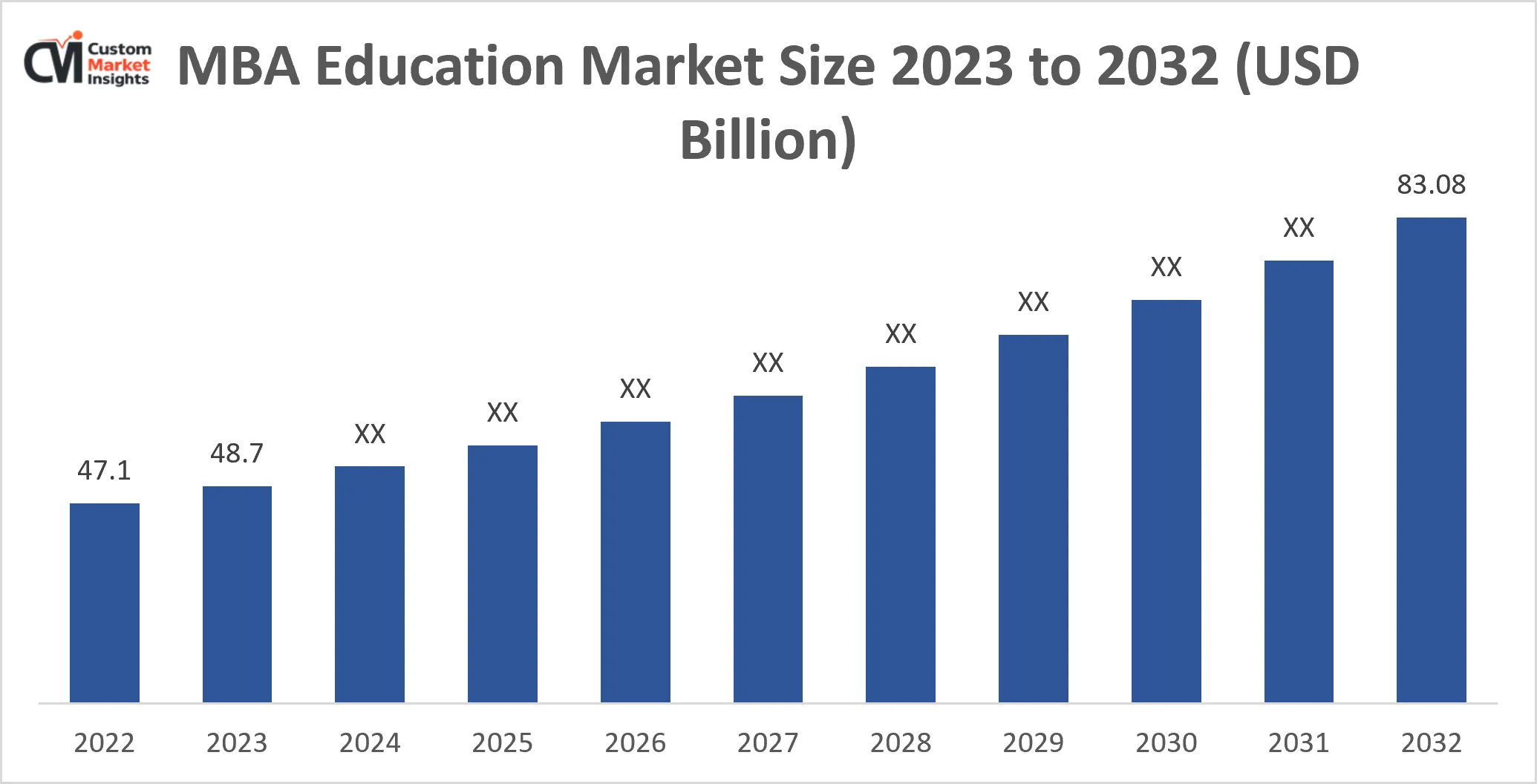
The global MBA education market was valued at USD 48.7 Bn in 2023 and is projected to reach USD 83.08 Bn by 2032, growing at a CAGR of 15.6%. Europe is the largest regional market and Asia-Pacific is growing fastest.
Global MBA Education Market 2023–2032 (By Billion)
As per the current market research conducted by CMI Team, the global MBA Education Market is expected to record a CAGR of 15.6% from 2023 to 2032. In 2022, the market size is projected to reach a valuation of USD 47.1 billion. By 2032, the valuation is anticipated to reach USD 83.08 billion.
10 MBA Institutes Around Globe
Rank
Region
Institute
Fees (USD)
1
North America
Harvard Business School
73,200 - 91,600
2
North America
Stanford Graduate School of Business
72,000 - 87,000
3
North America
Wharton School of the University of Pennsylvania
69,000 - 83,000
4
North America
MIT Sloan School of Management
67,500 - 81,500
5
North America
Columbia Business School
65,000 - 79,000
6
Europe
London Business School
94,000 - 123,000
7
Europe
INSEAD
91,000 - 119,000
8
Europe
HEC Paris
88,000 - 116,000
9
Asia-Pacific
National University of Singapore
53,000 - 71,000
10
Asia-Pacific
Chinese University of Hong Kong
52,000 - 70,000
Source: According to CMI Market Research Team Analysis
The MBA education market comprises institutions providing Master of Business Administration (MBA) programs and related services. It caters to universities, business schools, and other educational organizations offering MBA degrees and executive education.
This market focuses on developing students' business knowledge, leadership abilities, and strategic thinking for managerial roles. Current trends include specialized programs for specific industries, technology integration in curricula, experiential learning, diversity in student cohorts, sustainable practices, and emphasis on entrepreneurship and soft skills development.
The MBA education market encompasses institutions providing MBA programs and related services. Key trends include specialized programs, technology integration, experiential learning, diversity, sustainability, and emphasis on entrepreneurship and soft skills development. Additionally, there is a growing focus on global perspectives, industry partnerships, and alumni networks to enhance career opportunities for MBA graduates.
The MBA Education Market presents significant growth opportunities due to several factors:
Growing Demand for Skilled Professionals: The increasing need for skilled professionals with business acumen and leadership abilities is driving the demand for MBA education. Employers seek individuals equipped with advanced business knowledge and management skills to drive organizational growth and success.
Career Advancement and Higher Earning Potential: MBA education offers career advancement opportunities and the potential for higher salaries. Many professionals pursue an MBA to enhance their career prospects, gain access to executive-level positions, and increase their earning potential in various industries.
Globalization and International Business: The globalization of business presents opportunities for MBA graduates to navigate and excel in the global marketplace. Multinational corporations and organizations operating across borders require professionals with a global perspective and cross-cultural understanding, making MBA education valuable in this context.
Industry Specialization and Niche Markets: The market demands professionals with specialized knowledge in specific industries or niche markets. MBA programs offer concentrations or specializations that cater to these demands, enabling individuals to gain expertise in areas such as finance, marketing, healthcare management, technology, and sustainability.
Emerging Entrepreneurial Landscape: The flourishing of entrepreneurship and start-up ecosystems globally has unlocked avenues for aspiring business owners to gain essential business acumen and skills through MBA education. This enables them to gain valuable insights into entrepreneurship, innovation, and strategic planning, equipping them with the tools to successfully launch and manage their own ventures.
MBA Education Market - Mergers and Acquisitions
The MBA Education Market has seen several mergers and acquisitions in recent years, with companies seeking to expand their market presence and leverage synergies to improve their product offerings and profitability. Some notable examples of mergers and acquisitions in the MBA Education Market include:
INSEAD and Sorbonne University: INSEAD, a renowned business school, established an executive education partnership with Sorbonne University in 2018. This collaboration aimed to offer executives access to top-quality business education and expertise.
Hult International Business School's Acquisition of Ashridge Executive Education: Hult International Business School acquired Ashridge Executive Education in 2018. This acquisition aimed to enrich Hult's executive education offerings and expand its global reach, facilitating the delivery of comprehensive leadership development programs.
Harvard Business School and Harvard Medical School: Harvard Business School and Harvard Medical School joined forces in 2019 to introduce a collaborative MBA/MD program. This initiative aimed to equip future leaders with a distinctive skill set to tackle healthcare challenges by merging business and medical education.
NYU Stern School of Business acquired NYU Tandon School of Engineering in 2019, leading to the creation of NYU Stern Tandon School of Business. This merger aimed to encourage collaboration between business and technology, enabling cross-disciplinary education and research in areas like fintech and entrepreneurship.
MIT Sloan School of Management partnered with MIT Media Lab in 2019 to drive innovation at the intersection of business and technology. This collaboration aimed to promote interdisciplinary research and education, combining business expertise with technological advancements. The partnership facilitated exploration of emerging technologies such as AI and blockchain, and their impact on industries, fostering innovative solutions and transformative business models.
These Partnership and acquisitions have helped companies expand their product offerings, improve their market presence, and capitalize on growth opportunities in the MBA Education Market. The trend is expected to continue as companies seek to gain a competitive edge in the market.
The MBA Education Market faces several significant threats that could impact its growth and profitability in the future. Some of these threats include:
Shifting Business Landscape: The dynamic and rapidly evolving business landscape poses a significant threat to the MBA education market. Changes in technology, globalization, and industry disruption require constant updates to curricula to ensure relevance and address emerging trends. Failure to adapt to these changes can lead to a gap between the skills taught in MBA programs and the skills demanded by employers.
Rising Competition from Alternative Programs: The emergence of alternative education programs, such as online courses, specialized certifications, and executive education offerings, poses a threat to traditional MBA programs. These alternatives provide flexible learning options, targeted skill development, and shorter time commitments, attracting individuals who seek specific knowledge or career advancement without pursuing a full MBA degree.
Cost and Return on Investment Concerns: The high cost of MBA education, coupled with concerns about the return on investment, can deter prospective students. Rising tuition fees, coupled with the opportunity cost of leaving employment for full-time programs, require careful evaluation of the financial benefits and career prospects associated with obtaining an MBA degree. Economic uncertainties and student loan burdens further amplify these concerns.
Changing Employer Preferences: Employers' preferences and recruitment practices are evolving, and some companies are shifting their focus away from traditional MBA qualifications. They may prioritize skills gained through hands-on experience, specialized certifications, or specific industry knowledge. This shift in employer preferences can impact the demand for MBA graduates and create challenges for MBA programs in positioning their graduates effectively in the job market.
Report Scope
Feature of the Report
Details
Market Size in 2023
USD 48.7 Billion
Projected Market Size in 2032
USD 83.08 Billion
Market Size in 2022
USD 47.1 Billion
CAGR Growth Rate
15.6% CAGR
Base Year
2023
Forecast Period
2024-2033
Key Segment
By Duration of Course, Types of Programs, Course Type and Region
Report Coverage
Revenue Estimation and Forecast, Company Profile, Competitive Landscape, Growth Factors and Recent Trends
Regional Scope
North America, Europe, Asia Pacific, Middle East & Africa, and South & Central America
Buying Options
Request tailored purchasing options to fulfil your requirements for research.
Category-Wise Insights
By Duration of Course:
0-12 months: MBA programs with a duration of 0-12 months are known as accelerated or intensive programs. These programs provide a fast-paced and focused curriculum, allowing students to earn an MBA degree in a shorter timeframe. The trend in this segment includes the growing popularity of one-year MBA programs, attracting professionals seeking to enhance their skills and quickly transition to higher positions.
12-24 months: MBA programs ranging from 12 to 24 months are the standard full-time offerings that provide a well-rounded curriculum encompassing diverse business disciplines. These programs facilitate extensive learning and practical exposure, enabling students to acquire profound expertise. An emerging trend in this category is the seamless integration of hands-on experiences, including internships and consulting assignments, to facilitate the seamless application of theoretical concepts into real-world scenarios. This practice bridges the gap between academic knowledge and practical implementation, fostering a holistic learning experience.
24 months and above: MBA programs with a duration of 24 months and above are typically part-time or executive programs designed for working professionals. These programs offer flexibility, allowing individuals to balance their work commitments while pursuing an MBA degree. The trend in this segment includes the incorporation of online and hybrid learning formats to accommodate the needs of busy professionals and provide greater accessibility to MBA education.
By Types of Programs:
Management: MBA programs with a management focus provide students with a solid foundation in general management principles and strategies. Current trends include a growing emphasis on developing leadership skills, hands-on learning experiences, and a focus on fostering innovation and managing change effectively.
Marketing and Sales: MBA programs focusing on marketing and sales provide students with the knowledge and skills to analyse markets, comprehend consumer behaviour, and create successful sales strategies. Current trends in this area involve embracing digital marketing tactics, utilizing data analytics, and emphasizing the development of robust customer relationships in the modern digital landscape.
Finance and Accounting: MBA programs in finance and accounting concentrate on financial analysis, investment strategies, and managerial accounting techniques. Key trends in this area include a heightened focus on financial technology (fintech), sustainable finance practices, and risk management in response to the evolving landscape of financial markets.
HR: MBA programs focused on Human Resources (HR) concentrate on talent management, organizational behaviour, and HR strategy. Emerging trends in this domain include a shift towards strategic HR approaches, promoting diversity and inclusion, and integrating technology into HR practices, such as leveraging HR analytics and adopting digital HR platforms.
Others: MBA programs in specialized areas cater to specific industries or functional domains such as healthcare, technology, entrepreneurship, and operations management. These programs adapt to industry-specific trends like healthcare reforms, technology-driven innovation, and optimizing supply chain processes to provide targeted education and facilitate career growth.
By Course Type:
Executive MBA: Executive MBA programs target experienced professionals seeking advanced management education while continuing their careers. These programs typically offer a flexible schedule, allowing professionals to balance work and studies. A trend in the Executive MBA market is the incorporation of leadership development, strategic thinking, and global business perspectives to meet the evolving needs of senior executives.
Fresher MBA: Fresher MBA programs cater to recent graduates or individuals with limited work experience. These programs provide a comprehensive foundation in business principles, management concepts, and leadership skills. A trend in the Fresher MBA market is the integration of experiential learning, internships, and industry collaborations to bridge the gap between academia and industry demands and enhance graduates' employability.
E-learning MBA: E-learning MBA programs offer flexibility and accessibility through online platforms. Students can complete coursework remotely, allowing for personalized learning experiences. A trend in the E-learning MBA market is the use of interactive technologies, virtual classrooms, and multimedia resources to create engaging and interactive learning environments. The COVID-19 pandemic has further accelerated the adoption of e-learning in MBA education.
MBA Education Market - Regional Analysis
The MBA Education Market is segmented into various regions, including North America, Europe, Asia-Pacific, Latin America, and the Middle East and Africa. Here is a brief overview of each region:
North America: Within the North American MBA education market, there is a notable focus on cultivating entrepreneurial skills, fostering innovation, and integrating cutting-edge technology and data analytics into the academic programs. Leading establishments such as Harvard Business School, Wharton School, and Stanford Graduate School of Business hold dominant positions in delivering exceptional MBA education in this region.
Europe: In Europe, one-year MBA programs are gaining popularity, while sustainability and responsible business practices are emphasized. Leading institutions include INSEAD, London Business School, and HEC Paris.
Asia-Pacific: The Asia-Pacific region showcases specialized MBA programs for finance, technology, and healthcare, with a growing demand for global perspectives. Prominent players are China Europe International Business School (CEIBS), Indian School of Business (ISB), and National University of Singapore Business School.
LAMEA: LAMEA's MBA education market focuses on leadership development, soft skills, and the integration of Islamic finance principles. Key players are Universidad de los Andes, American University in Cairo, and University of Cape Town Graduate School of Business.
Competitive Landscape – MBA Education Market
The MBA Education Market is highly competitive, with a large number of manufacturers and retailers operating globally. Some of the key players in the market include:
Harvard Business School
Stanford Graduate School of Business
Wharton School University of Pennsylvania
INSEAD
London Business School
MIT Sloan School of Management
Columbia Business School
Chicago Booth School of Business
Kellogg School of Management Northwestern University
Haas School of Business University of California, Berkeley
Others
These companies operate in the market through various strategies such as product innovation, mergers and acquisitions, and partnerships. For example, in 2022, notable partnerships in various industries emerged. For instance, technology giants Google and Microsoft joined forces to enhance cloud computing solutions. In the healthcare sector, pharmaceutical companies Pfizer and BioNTech collaborated to develop and distribute COVID-19 vaccines. These partnerships aimed to leverage expertise and resources for mutual growth and innovation.
In the ever-changing MBA education market, several new players have emerged, bringing innovation and development to the forefront. These newcomers are using technology, introducing fresh teaching methods, and offering distinctive program structures to stand out. They are attracting students with their modern curriculum and hands-on learning opportunities.
Meanwhile, established leaders like Harvard Business School, INSEAD, and Wharton School continue to dominate the market, thanks to their esteemed reputation, vast alumni networks, and industry connections. These institutions have established a strong presence by consistently delivering top-notch education, producing successful graduates, and nurturing strong business partnerships.
Which are the driving factors of the MBA Education Market?
The key factors driving the Market are Growing Demand for Skilled Professionals, Career Advancement and Higher Earning Potential, Globalization and International Business, Industry Specialization and Niche Markets And Emerging Entrepreneurial Landscape.
Who are the top players operating in the MBA Education Market?
The key players operating in the MBA Education Market are Harvard Business School, Stanford Graduate School of Business, Wharton School University of Pennsylvania, INSEAD, London Business School, MIT Sloan School of Management, Columbia Business School, Chicago Booth School of Business, Kellogg School of Management Northwestern University, Haas School of Business University of California Berkeley, Others.
What will be the CAGR of Global MBA Education Market?
The Global MBA Education Market is expanding growth with a CAGR of approximately 15.6% during the forecast period (2023 to 2032).
What is the existing size of MBA Education Market?
The Global MBA Education Market size was valued at USD 47.1 Billion in 2022 and it is projected to reach around USD 83.08 Billion by 2032.
Ayush Kadam is a Senior Market Research Analyst at Custom Market Insights, with over seven years of experience in syndicated and custom market research. He specializes in market sizing, competitive intelligence, industry trends, forecasting, and strategic insights, helping clients turn complex data into actionable business decisions.