
Global Health and Fitness Club Market Size Likely to Grow at a CAGR of 8.2% By 2035
Key highlights
- A health and fitness club is a place where people can get support with their health and fitness in methods other than working out.
- North America held the highest market share in 2025.
- 5000 list, the most prestigious ranking of the fastest-growing private companies in America.
Market Size and Growth
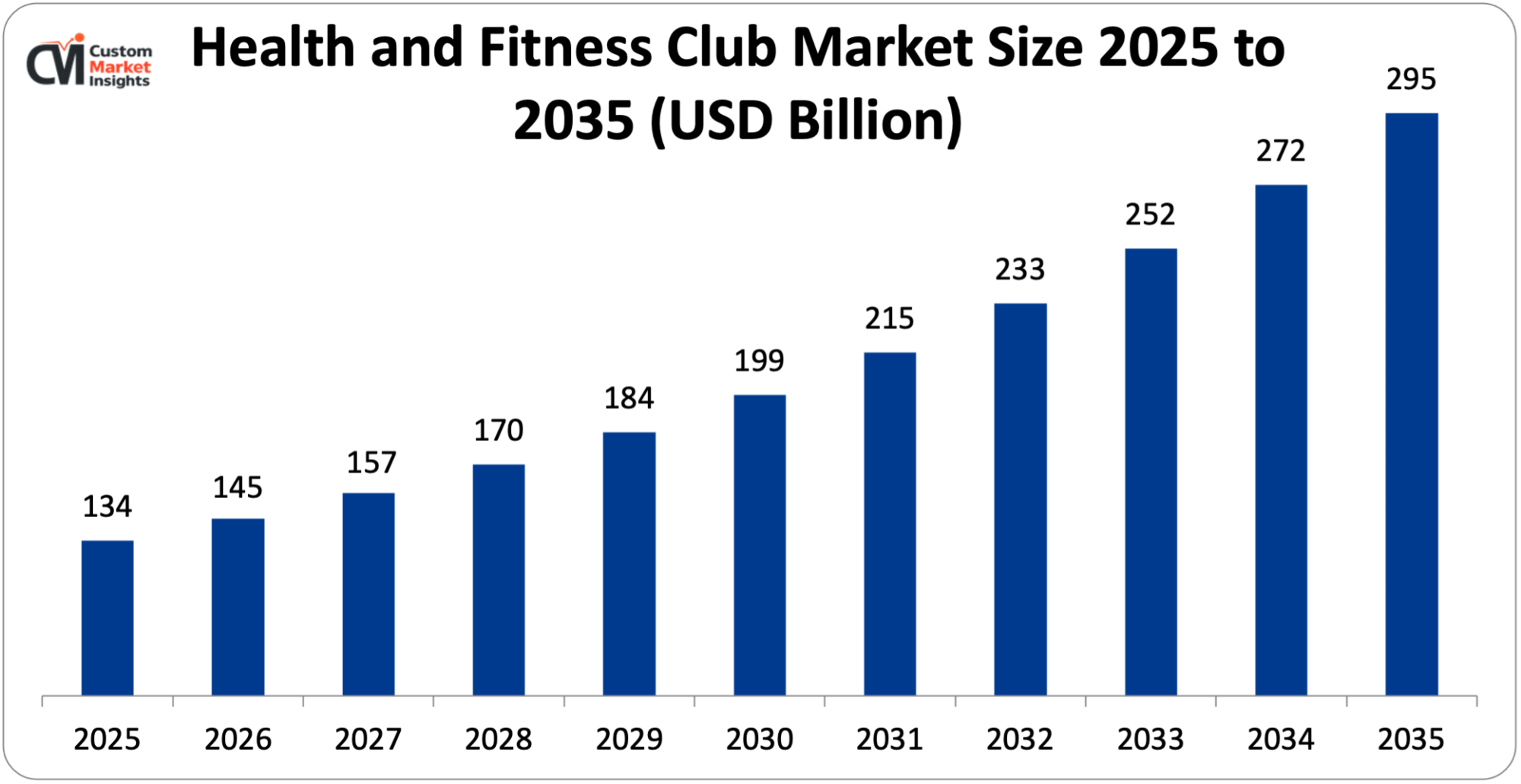
The market size of global health and fitness clubs will be estimated at USD 134 billion in 2025 and is expected to grow to between USD 145 billion in 2026 and about USD 295 billion by 2035, with a current CAGR (compound annual growth rate) of 8.2% during the period of 2026 to 2035.
To learn more about this report - request a sample report PDF
Health and Fitness Club Market Revenue and Trends
A health and fitness club is a place where people can get support with their health and fitness in methods other than working out. People often pay to utilize different types of workout equipment at these kinds of places, such as free weights, cardio machines, and tools for strength training. Health clubs have more things to do than traditional gyms. They have areas to work out, play sports, become fit, seek help with mental health problems, and hang out with friends. This open area promotes a healthy training culture that values all aspects of health, such as mental and social well-being, as well as physical strength and endurance.
Members can obtain professional advice and individualized workout plans to help them lose weight, gain muscle, become more flexible, and eat healthier. They can also get help with making changes to their lives and becoming better. You can also have a lot of fun at health clubs. They have pools, spas, cafes, and occasionally even places for youngsters to play. These are places where people can live healthy lives and become better persons with the help of others in their neighborhood.
What are the Factors That Have a Significant Contribution to the Growth of the Health and Fitness Club Market?
The growing introduction of amenities is expected to drive the market. The number of amenities includes massage rooms, physical therapy rooms, running tracks, saunas, shower rooms, juice bars, swimming pools, and squash courts. These kinds of facilities make the space more comfortable and allow for a more complete approach to health and fitness. In the past years, clubs with amenities that make things easier and more comfortable have opened. This will drive the market over the coming years. For instance, Bamford, a high-end lifestyle and wellness brand based in the UK, will establish its science-based and eco-friendly fitness center in the Cotswolds in March 2023. The new club has a heated plunge pool outside, a steam room, a sauna, and a shower room.
Also, the health and fitness club business is growing because more people are moving to cities and living sedentary lives. Urbanization leads to a growing middle class that lives in cities. Their lives are more sedentary because they work at desks and don’t get as much exercise. People are becoming more conscious of health risks like obesity and related chronic diseases because of this change in lifestyle. This is driving up demand for fitness solutions. Fitness clubs take advantage of this by offering urban residents quick and easy ways to work out, wellness programs, and all-around health services. The UN says that 55% of the world’s people live in cities. By 2050, that number is predicted to climb to 68%.
Regional Insights
North America held the highest market share in 2025. A culture of fitness and wellness that is becoming more common, more people being aware of their health, more money to spend, and more people accepting digital fitness solutions and wearable technology are all important factors in North America’s rise. Corporate wellness programs are a big part of getting more people to join fitness clubs at work. More and more people are joining premium and boutique health clubs that offer specialized services like yoga, cycling, HIIT, and personalized fitness plans. This is what driving the market growth.
Besides, the Asia Pacific market is expected to grow at the highest CAGR during the forecast period. This is attributed to the growing urbanization and increasing middle class population. Furthermore, the growing campaign regarding health is another important factor driving the industry.
Report Scope
| Feature of the Report | Details |
| Market Size in 2026 | USD 145 billion |
| Projected Market Size in 2035 | USD 295 billion |
| Market Size in 2025 | USD 134 billion |
| CAGR Growth Rate | 8.2% CAGR |
| Base Year | 2025 |
| Forecast Period | 2026-2035 |
| Key Segment | By Type, Age Group and Region |
| Report Coverage | Revenue Estimation and Forecast, Company Profile, Competitive Landscape, Growth Factors and Recent Trends |
| Regional Scope | North America, Europe, Asia Pacific, Middle East & Africa, and South & Central America |
| Buying Options | Request tailored purchasing options to fulfil your requirements for research. |
Recent Developments
- In August 2025, Inc., the leading media brand and playbook for the entrepreneurs and business leaders shaping the future, announced that Crunch Fitness is named on the annual Inc. 5000 list, the most prestigious ranking of the fastest-growing private companies in America. The list provides a data-driven snapshot of the most successful companies within the economy's most dynamic segment—its independent, entrepreneurial businesses. Past honorees include companies such as Microsoft, Meta, Chobani, Under Armour, Timberland, Oracle, and Patagonia. (https://www.prnewswire.com/news-releases/crunch-fitness-joins-the-2025-inc-5000-list-of-americas-fastest-growing-private-companies-302527913.html)
List of the prominent players in the Health and Fitness Club Market:
- Planet Fitness Inc.
- Yanre Fitness
- Barry's Bootcamp
- Equinox Holdings Inc
- CrossFit LLC
- Life Time Fitness Inc.
- Basic-Fit NV
- 24 Hour Fitness LLC
- Exos
- Crunch Fitness LLC
- Life Time Fitness Inc
- Goodlife Health Clubs
- Jetts Fitness
- EFM Health Clubs Australia
- Speediance Life Tech Corp
- Keep
- Supermonkey Gym
- Fiture
- Daily Yoga
- Lefit
- LA Fitness LLC
- WNQ
- Shua Fitness
- Body Strong Fitness
- Relax (Group) Co. Ltd
- Shanxi Orient Fitness & Health Industry Co. Ltd
- Healthify Me
- Fitternity
- Talwalkars Better Value Fitness Ltd
- Konami Sports Club
- Others
The Health and Fitness Club Market is segmented as follows:
By Type
- Personal Training
- Group Training
- Self-Training
By Age Group
- Up to 20 Years
- Between 20 and 40 Years
- 40 to 55 Years
- Over 55 Years
Regional Coverage:
North America
- U.S.
- Canada
- Mexico
- Rest of North America
Europe
- Germany
- France
- U.K.
- Russia
- Italy
- Spain
- Netherlands
- Rest of Europe
Asia Pacific
- China
- Japan
- India
- New Zealand
- Australia
- South Korea
- Taiwan
- Rest of Asia Pacific
The Middle East & Africa
- Saudi Arabia
- UAE
- Egypt
- Kuwait
- South Africa
- Rest of the Middle East & Africa
Latin America
- Brazil
- Argentina
- Rest of Latin America
Rushikesh Dorge
View profile and reportsAbout Custom Market Insights
Custom Market Insights is a market research and advisory company. It publishes syndicated reports across 18+ industries and delivers custom research, feasibility studies and market entry strategy for companies, investors and consultancies.
###