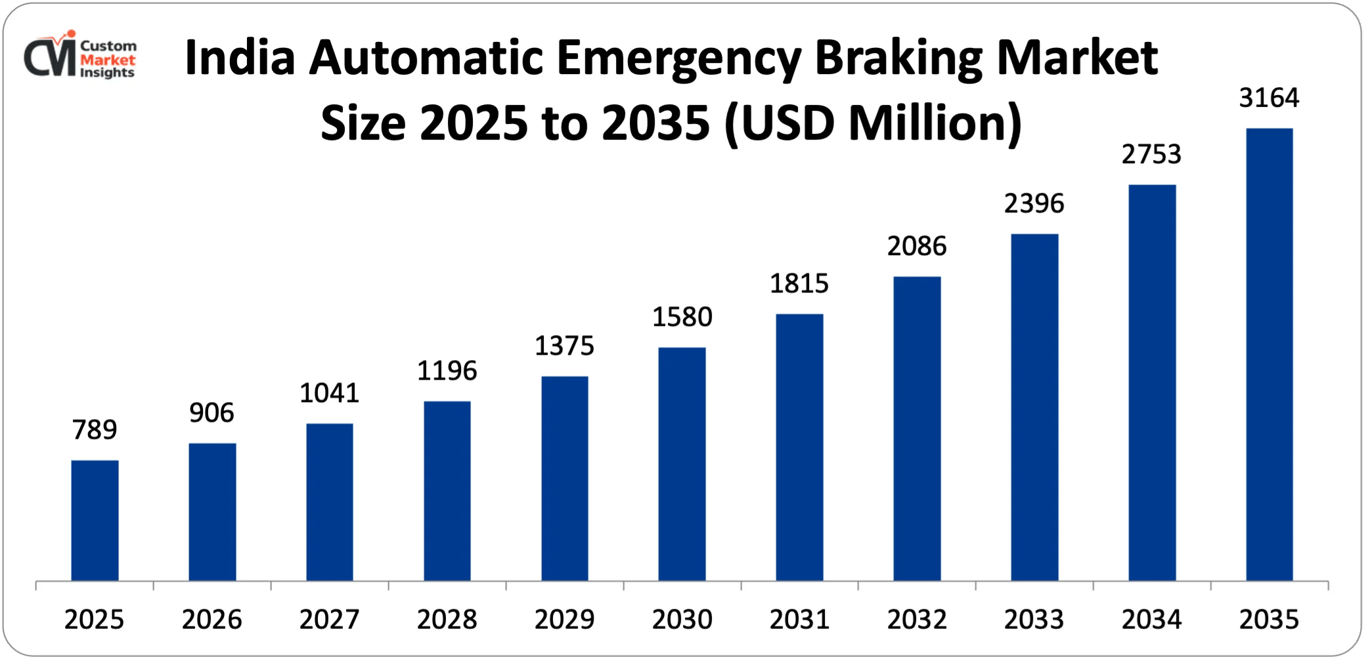
The market size of India's automatic emergency braking is estimated at USD 789 million in 2025 and is expected to grow to between USD 906 million in 2026 and about USD 3164 million by 2035, with a current CAGR (compound annual growth rate) of 14.9% during the period from 2026 to 2035.
Automatic Emergency Braking (AEB) is an advanced driver assistance system (ADAS). This system will automatically apply the brakes to avoid or limit a collision. Several sensors are used within AEB systems to detect obstacles ahead of the car.
These sensors include cameras and radar; some vehicles also use LiDAR. If the driver does not react correctly to an imminent collision, then the braking system will be activated automatically. AEB is becoming commonplace on passenger vehicles and commercial vehicles to help improve road safety, reduce injuries caused by accidents, and increase intelligent vehicle safety technologies.
Market Highlight
- By product, the low-speed AEBS segment held the largest revenue share in 2025.
- By technology, the forward collision warning segment would have the highest share of the market in 2025.
- By brake, the disc segment would have the highest share of the market in 2025.
- By vehicle, the passenger vehicle segment would have the highest share of the market in 2025.
Significant Growth Factors
India automatic emergency braking market trends present significant growth opportunities due to several factors:
- Growing adoption of Advanced Driver Assistance Systems (ADAS): India's automatic emergency braking market is growing with the increasing popularity of Advanced Driver Assist Systems (ADAS). The ADAS penetration rate in the passenger vehicle segment increased to 8.3% in the first half of 2025 from 6.2% in the first half of 2024, according to the secondary analysis. In addition, the number of variants equipped with ADAS has risen from 241 to 434. Hence, companies are investing more in radar sensors, cameras, ECUs, and software. For instance, in August 2024, Aptiv invested over US$45 million (around ₹375-378 crore) to augment the capacity of its manufacturing unit in Oragadam, Chennai. This manufacturing unit was set up to support advanced technology such as radars, cameras and next generation ECUs. In January 2025, Tata Motors said it will increase its spending on vehicle innovation and capital expenditure by about US$ 210 million (₹2,000 crore) in its commercial vehicle segment. More than 40% of this will go to new technologies such as electrification, ADAS and connected car platforms. The company also showcased 14 commercial vehicles with ADAS at Bharat Mobility Global Expo 2025. In February 2026, Mahindra & Mahindra expanded its partnership with Mobileye, choosing its high-end ADAS platforms for several future vehicle models. These will be built from 2027. Thus, these investments are contributing to manufacturers and suppliers expanding their local engineering capabilities, manufacturing integrated safety electronics and the number of vehicle platforms capable of incorporating advanced driver assist systems. These technologies are becoming more available in India and the potential install base for AEB systems will increase.
- Rising Production and Sales of Passenger Vehicles: India automatic emergency braking market is supported by the growing production and sales of passenger vehicles, which is expanding the customer base that can be targeted. Domestic sales of passenger vehicles rose to 4.30 million units in FY 2024-25 from 4.22 million units in FY 2023-24, a rise of around 2 percent, the Society of Indian Automobile Manufacturers (SIAM) said. Production also climbed to 5.06 million units from about 4.90 million units in the same period, an increase of about 3.3%. Sales figures increased to 2.80 million units from about 2.52 million units, up about 11% YoY with utility vehicle sales playing a big role in helping sales figures increase to 2.80 million units from about 2.52 million units, up about 11% YoY. With the increase in vehicle production, automotive manufacturers are starting to develop technologically advanced models with features such as collision warning, automatic braking and other ADAS features. As they produce in higher volumes, automakers can benefit from economies of scale in buying parts such as cameras, radar sensors, electronic control units and brake parts. This may help to make AEB technology more accessible to more vehicle segments. The increased popularity of utility vehicles and high-end passenger cars means there are opportunities to fit AEB systems. Therefore, the growing production and sales of passenger vehicles will likely boost the demand for AEB systems in India. But even if car sales increase, it doesn’t mean AEB sales will increase at the same rate, as it is contingent upon the vehicle spec, price and safety requirements.
What are the Major Advances Changing the India Automatic Emergency Braking Market Today?
- Localization of ADAS Manufacturing and Engineering: Localization of Advanced Driver Assistance Systems (ADAS) manufacturing is one of the main drivers in creating a healthy Automatic Emergency Braking (AEB) market within India. By manufacturing the required technology such as radar sensors, cameras, electronic control units and software locally, the industry will have less reliance on imports and will create a more efficient supply chain. This will make the AEB technology cheaper for local automotive players. Localizing will also allow suppliers to tailor their collision detection algorithms to suit the different conditions found on Indian roads. These include varied traffic situations, unclear lane markings, two-wheelers, pedestrians and unpredictable objects. In April 2026, Valeo launched a high-definition surround view camera production line at their Sanand plant in Gujarat. They also have a research and development center in Chennai where they develop automotive software. HL Klemove have set up an ADAS radar manufacturing plant in Chennai. Mobileye also announced in October 2025 that they had partnered with VVDN Technologies to localize ADAS technologies for Indian automotive players. This will create a strong local supply chain for ADAS technologies, allowing AEB compatible components to be more widely available. Overall, this will encourage automotive players to incorporate collision prevention systems into more vehicles. However, there are many factors that will determine whether AEB will be cheaper and more widely adopted. These include cost, validation and vehicle manufacturer requirements.
- Advances in Radar and Camera Technology: Improvements in radar and camera solutions have improved the Automatic Emergency Braking (AEB) capabilities on vehicles in India. Today’s advanced automotive radars provide accurate measurements to determine the range and relative velocity, whilst high resolution cameras use image recognition and AI to distinguish between pedestrians, cyclists, 2-wheelers, etc. Using sensor fusion techniques, combining data from the radar and camera, objects can be identified and braking decisions made to help improve performance in the complex environments experienced in India. Recent developments in the industry have helped improve performance further. In January 2026, Aptiv announced that an Indian commercial vehicle manufacturer has chosen Aptiv’s Gen 6 ADAS platform. This solution provides next generation radar, a smart camera with AI vision technology and software tailored to Indian conditions. This includes detecting 3 Wheelers, large animals, pedestrians, road workers and cyclists. TRAI recommended that automotive radar may be used in free use within the 77 – 81GHz band. This helps boost high resolution automotive radar solutions. The ARAI has also developed Indian traffic datasets using multiple sensors to train algorithms for ADAS, sensor fusion and validation. All of these developments are helping manufacturers develop AEB systems more suited to driving conditions in India which could improve safety performance.
Category Wise Insights
By Product
Why Low-speed AEBS Hold a Prominent Position in the Market?
The low-speed AEBS segment held the largest revenue share in 2025. Automotive manufacturers are increasingly using technologies that help avoid or reduce low speed collisions. Low speed Automated Emergency Braking Systems (AEBS) use cameras and radar-based sensors to identify any close-by objects or vehicles and will automatically apply the vehicle brakes if a collision is imminent. This increasing demand comes from the increased use of ADAS features in passenger vehicles, greater awareness of road safety and avoiding small collisions and therefore reducing repair costs.
The high-speed AEBS segment is growing at the highest CAGR during the projected period. Automotive manufacturers are increasingly incorporating advanced safety technologies into their vehicles to avoid or reduce the impact of collisions.
These technologies include radar, camera and intelligent software-based systems that detect vehicles/obstacles in front of the vehicle, calculate the risk of a collision and then autonomously engage braking. Increasing connectivity on highways, increased demand for long distance commercial transport and increasing demand for advanced driver assistance systems are driving growth in this market.
Furthermore, the Ministry of Road Transport and Highways in India has mandated that AEBS compliant with AIS-162 should be fitted to certain medium and heavy commercial vehicle types, which must be implemented for new models from January 2027 and all relevant models from October 2027.
By Technology
Why Forward Collision Warning Capture the Highest Market Share in the India Automatic Emergency Braking Market?
The forward collision warning segment would have the highest share of the market in 2025. As the automotive industry increasingly incorporates collision detection and driver alert technologies, Front Collision Warning (FCW) systems use cameras and radar sensors to detect potential front collisions.
Visual, audio and haptic alerts can be sent to drivers enabling them to apply the brakes or avoid a collision. Increasing usage of Advanced Driver Assistance Systems (ADAS), increased awareness of vehicle safety and improved sensor technology are helping drive demand.
The dynamic brake support segment is growing at the fastest rate over the projected period. As vehicle manufacturers incorporate more advanced technologies for collision avoidance within passenger and commercial vehicles, DBS solutions employ radar and camera technology to identify vehicles in-front of the host vehicle.
If it is determined that insufficient braking force has been applied by the driver to avoid a collision then assistance will be provided to help prevent a collision. Higher adoption rates of ADAS, growing awareness of vehicle safety, and advances in sensor fusion and electronic braking are driving demand in this market.
By Brake
Why Disc Capture the Highest Market Share in the India Automatic Emergency Braking Market?
The disc segment would have the highest share of the market in 2025. Growth is supported by rising vehicle production, increasing adoption of disc brakes in higher-value vehicle models, expanding electric vehicle production, and growing integration of electronic braking technologies.
The drum segment is growing at the highest CAGR over the projected period. As drum brakes remain widely used in cost-sensitive vehicle categories, particularly two-wheelers, entry-level vehicles, and certain commercial vehicles.
By Vehicle
Does Passenger Vehicle Capture the Highest Revenue Share in the India Automatic Emergency Braking Market?
The passenger vehicle segment would have the highest share of the market in 2025. The increase in vehicle sales and consumer awareness of safety ratings, along with the growing adoption of Advanced Driver Assistance Systems (ADAS), is providing an impetus to manufacturers to include AEB in new models. With higher production volumes and lower cost sensors, AEB will be able to be added to a higher range of passenger vehicles driving revenue in this market.
The commercial vehicle segment is growing at the highest CAGR over the projected period. India made about 1.03 million commercial vehicles in FY 2024-25, focusing on collision avoidance, driver safety and vehicle safety laws, the Society of Indian Automobile Manufacturers (SIAM) said. Domestic sales were around 956,671 units. Sales were down some 1.2% in FY 2023-24, but the increasing need for freight movement, highway development and safer trucks and buses presents an opportunity for improved braking technology.
The India automatic emergency braking market has experienced considerable changes in the last two years as the market players are trying to diversify their technological aspects and develop product portfolios using strategic approaches.
These strategic measures have enabled the companies to reinforce their competitive positions, increase the product line, boost their technological competencies and also seize growth opportunities in the fast-growing India automatic emergency braking market.