
Global Medical Devices Market Size Likely to Grow at a CAGR of 7.1% By 2035
Key highlights
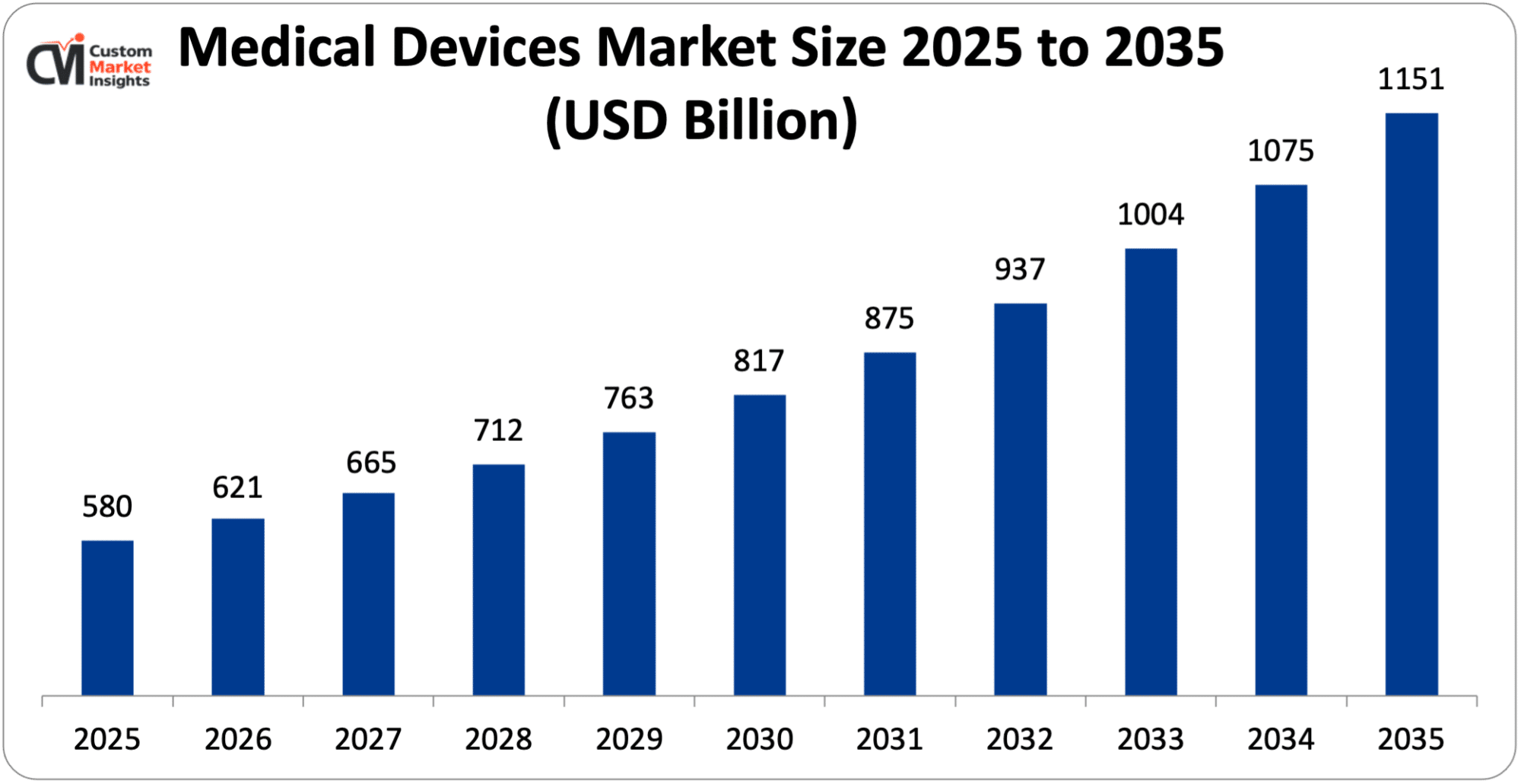
- Market valued at USD 621 Bn in 2026, projected to reach USD 1,151 Bn by 2035.
- Expected to grow at a CAGR of 7.1% over 2026-2035.
- North America is the largest regional market; Asia Pacific grows fastest.
The market size of global medical devices will be estimated at USD 580 billion in 2025 and is expected to grow to between USD 621 billion in 2026 and about USD 1151 billion by 2035, with a current CAGR (compound annual growth rate) of 7.1% during the period of 2026 to 2035.
To learn more about this report - request a sample report PDF
Medical Devices Market Revenue and Trends
A medical device is any element, device, instrument, apparatus, machine, implant, software, or related article that is used for the purpose of diagnosis, prevention, monitoring, treatment, or correction of different health conditions that is intended to be used physically or mechanically rather than chemically. The term represents a broad range of devices and related equipment from simple diagnostic patient monitoring equipment such as thermometers and syringes to advanced imaging equipment, computers, and robotic surgery platforms to implantable devices such as pacemakers and defibrillators. The dynamics of the medical devices market foster its growth and evolution.
The drivers include the increasing burden of chronic disease, the aging populations, technological advances such as surgically available minimally invasive and robotically assisted procedures, and the growing healthcare infrastructure. Restraints include high prices of modern devices, requirements for regulatory approval, and reimbursement policies. Opportunities include the increasing use of telemedicine, the rising older population demanding more home healthcare and remote monitoring devices, and the greater access to healthcare in emerging markets. The trends include digital health, personalized healthcare, outpatient care, and many others. All these factors influence the market variably and propel its growth.
What are the Factors That Have a Significant Contribution to the Growth of the Medical Devices Market?
Positive government policies and initiatives are a major factor positively influencing the growth of the medical devices sector due to capital investments and consumer monetary support from governments, which improve the readiness, concentration, innovation, and utilization of new health devices. Governments around the world are launching schemes to widen their health infrastructure, facilitate local manufacturing (like "Make in India"), and enhance access to economical medical devices through subsidies and price regulation.
It is further regulating and facilitating their approvals at such a quick pace that without disturbing the quality and safety parameters, they are completing their early market entry. Moreover, the expansion of public health expenditure, the development of insurance coverage, and the growth of digital health and telemedicine are all increasing the use of modern diagnostic and treatment devices. These moves are not only stimulating demand for such devices but also building consumers and growth opportunities for the manufacturers.
An increased emphasis on the need for early diagnosis will also be a contributing factor to growth in the medical devices sector, as hospital or health care systems globally tilt toward prioritization of disease prevention in order to lower costs associated with treatment and long-term disease management. As the results of interventions undertaken at early stages of, for example, cancer, cardiovascular abnormalities, diabetes, and strokes tend to be more favorable compared to those at later stages, the market for high-performance diagnostic imaging devices (magnetic resonance imaging (MRI), computerized tomography (CT), and ultrasound), IVD kits, and point-of-care diagnostic devices beyond existing screening programs and routine health monitoring programs has been steadily rising. With the push for remedial medicine gaining momentum globally, these devices’ market potential is likely to skyrocket in the future.
Regional Insights
North America held the highest market share in 2025. The development is owing to the innovative product launch especially in the US and its approval in the market. For instance, in December 2025, Abbott announced the U.S. Food and Drug Administration (FDA) has approved the company's Volt™ PFA System to treat patients battling atrial fibrillation (AFib). Abbott will soon begin commercial PFA cases in the United States and will continue its expansion of sites in the European Union following Volt CE Mark approval earlier this year.
Besides, the Asia Pacific is expected to grow at the highest CAGR during the projected period. The rising investment in healthcare infrastructure and growing product launch by internation company in the country like India drives the industry growth. For instance, in July 2025, AliveCor, the global leader in AI-powered cardiology, announced the launch of its revolutionary Kardia 12L ECG system in India, following its successful introduction in the United States.
Report Scope
| Feature of the Report | Details |
| Market Size in 2026 | USD 621 billion |
| Projected Market Size in 2035 | USD 1151 billion |
| Market Size in 2025 | USD 580 billion |
| CAGR Growth Rate | 7.1% CAGR |
| Base Year | 2025 |
| Forecast Period | 2026-2035 |
| Key Segment | By Type, End User and Region |
| Report Coverage | Revenue Estimation and Forecast, Company Profile, Competitive Landscape, Growth Factors and Recent Trends |
| Regional Scope | North America, Europe, Asia Pacific, Middle East & Africa, and South & Central America |
| Buying Options | Request tailored purchasing options to fulfil your requirements for research. |
Recent Developments
- In October 2025, HeartX, powered by HealthTech Arkansas and MedAxiom — along with dozens of leading cardiovascular programs around the country — has selected the seven startup healthcare companies that will participate in the 2025 accelerator program. HeartX is a cardiovascular-focused healthcare accelerator that facilitates guaranteed hospital pilot projects and clinical trials for accomplished, early-stage companies bringing new cardiovascular innovations to market.
List of the prominent players in the Medical Devices Market:
- Medtronic
- Johnson & Johnson MedTech
- Abbott Laboratories
- Siemens Healthineers
- Stryker Corporation
- BD
- GE HealthCare
- Philips Healthcare
- Boston Scientific
- Medline Industries
- Cardinal Health
- Baxter International
- Fresenius Medical Care
- Danaher Corporation
- Roche Diagnostics
- Terumo Corporation
- Olympus Corporation
- Smith & Nephew
- Zimmer Biomet
- Alcon
- Others
The Medical Devices Market is segmented as follows:
By Type
- Orthopedic Devices
- Diagnostic Imaging Devices
- Cardiovascular Devices
- In-vitro Diagnostic (IVD)
- Minimally Invasive Surgery Devices
- Diabetes Care Devices
- Wound Management
- Ophthalmic Devices
- Dental Devices
- Nephrology Devices
- General Surgery
- Others
By End User
- Hospitals & ASCs
- Clinics
- Others
Regional Coverage:
North America
- U.S.
- Canada
- Mexico
- Rest of North America
- Germany
- France
- U.K.
- Russia
- Italy
- Spain
- Netherlands
- Rest of Europe
Asia Pacific
- China
- Japan
- India
- New Zealand
- Australia
- South Korea
- Taiwan
- Rest of Asia Pacific
The Middle East &; Africa
- Saudi Arabia
- UAE
- Egypt
- Kuwait
- South Africa
- Rest of the Middle East & Africa
Latin America
- Brazil
- Argentina
- Rest of Latin America

Rushikesh Dorge
Head - Client RelationsRushikesh Dorge is a seasoned Market Research and Business Consulting Professional with over six years of experience in market intelligence, competitive analysis, forecasting, and business strategy. At Custom Market Insights, he helps organizations identify growth opportunities a
View profile and reportsAbout Custom Market Insights
Custom Market Insights is a market research and advisory company. It publishes syndicated reports across 18+ industries and delivers custom research, feasibility studies and market entry strategy for companies, investors and consultancies.
###