
Global Smart Grid Cybersecurity Market Size Likely to Grow at a CAGR of 28.2% By 2035
Key highlights
- The cybersecurity market of smart grids is growing at a fast rate with more power utilities and energy providers adopting digital grid infrastructure in order to enhance their energy management and operational efficiency.
- On-premise deployment commands a big portion of the smart grid security market because most power utilities would like to have all the control to sensitive grid infrastructure and other vital operational information.
- These interconnected systems, however, demand robust frameworks of cybersecurity in case of unauthorized access, data breach, and system downtime.
- It can be predicted that the Asia-Pacific market will experience a robust growth in the smart grid cybersecurity market as a result of the growing energy infrastructure and the growth in investments in smart grid technologies.
Market Size and Growth
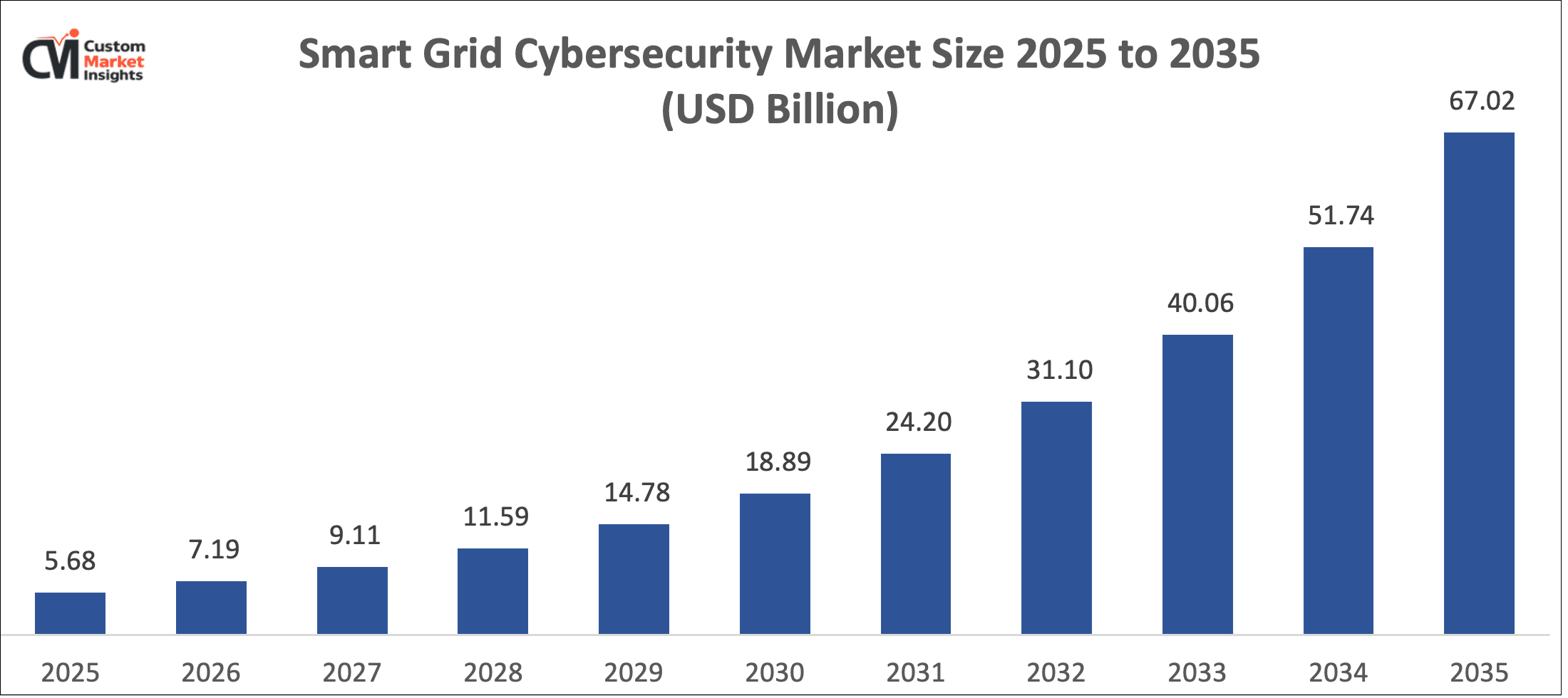
Smart grid cybersecurity market size has a projected USD 7.19 billion in the year 2026, USD 67.02 billion in the year 2035 and a projected CAGR of 28.2% between the years 2026 and 2035.
To learn more about this report - request a sample report PDF
Smart Grid Cybersecurity Market Revenue and Trends
The cybersecurity market of smart grids is growing at a fast rate with more power utilities and energy providers adopting digital grid infrastructure in order to enhance their energy management and operational efficiency. Modernization of electricity networks, which is represented by the use of smart meters, automated substations, and controlled grid systems connected with each other, has greatly exposed them to cyber attacks. This has led to utilities investing in the latest cybersecurity systems, including network intrusion detection systems and endpoint protection platforms, as well as secure communication protocols in order to protect critical power infrastructure.
Source: Custom Market Insights analysis.
The regulators are also coming up with more stringent regulations on cybersecurity to safeguard the national energy systems against cyberattacks and malfunctions. Besides that, grid protection is being enhanced by the incorporation of artificial intelligence, real-time threat intelligence, and cloud-based security platforms. On the whole, the trend of digitalization of energy infrastructure, the growth of cyber risk awareness, and more strict regulatory systems are leading to the spread of the smart grid cybersecurity market worldwide.
What are the Factors that Significantly Exert an Influence on the development of Smart grid cybersecurity Market?
The high-rate digitalization of the electricity infrastructure in the power sector is the factor that greatly influences the development of the smart grid cybersecurity market. Utilities are increasingly implementing smart meters, automated substations, and distributed energy resources as well as sophisticated grid management platforms to improve energy efficiency and grid reliability. However, these structures are interconnected as well, which increases the susceptibility of the exposed energy infrastructure to cyberattacks. Regulators and governments are therefore establishing strict cybersecurity policies and implementation to protect country power grids against cyberattacks. Therefore, power utilities and grid operators are deliberating on the application of advanced internet security programs such as network security programs, identity management systems, and real-time threat monitoring programs.
Another essential reason why the market has grown is the further development of technologies and grid monitoring solutions related to cybersecurity. The films and the development of artificial intelligence, machine learning, and cloud-based security software are assisting utilities in detecting and stopping or responding to abnormal network usage, preventing cyber intrusions, and reacting to threats more efficiently. Further, with renewable energy sources and electric vehicles increasing their level of integration and distributed energy systems gaining popularity, the grid network becomes more complicated, which contributes to the need for more advanced cybersecurity solutions. The combination of all these technological innovations and the growing awareness of cyber risks to the critical infrastructure are bound to result in the growth of the long-term cybersecurity market in smart grids.
Segment Insight
By Deployment Mode
The mode of deployment is also significant in the uptake of smart grid cybersecurity solutions. On-premise deployment commands a big portion of the smart grid security market because most power utilities would like to have all the control to sensitive grid infrastructure and other vital operational information. Such a model offers increased security, customization of the system, and direct control of cybersecurity measures in energy facilities. Nevertheless, the cloud-based deployment is becoming popular as more utilities are implementing digital grid technologies and remote monitoring systems. Cloud services can be used to effectively manage cybersecurity at scale, share intelligence on a real-time basis about threats, and more rapidly update software so that grid operators can identify and react to cyber threats more effectively over distributed grids.
By Type of Security
The smart grid cybersecurity market is developing in stages of protection of several levels, such as endpoint security, network security, application security, and database security. The security of endpoints prevents unauthorized access and malware attacks on smart meters, sensors, and connected devices. Network security solutions protect communication networks between substations, control centers, and grid infrastructure. Application security is aimed at securing grid management software and energy management platforms against cyber intrusion and vulnerabilities. In the meantime, database security would provide assurance that all sensitive data on operation and consumers' energy do not fall into the hands of data breaches. All these security layers can assist utilities in keeping the grid operations reliable and ensuring the critical infrastructure is not damaged by cyber-attacks.
By Application
The use of smart grid cybersecurity solutions in applications like energy generation, control of transmission and distribution, and management of energy consumption are some of the key fields where smart grid solutions have been significantly demanded. Cybersecurity systems are used to safeguard the plant control systems, monitoring equipment, and energy production data against cyber threats at power generation facilities. Cybersecurity platforms in transmission and distribution networks are useful in safeguarding substations, grid communication networks, and automated control systems used to regulate the flow of electricity in various regions. Also, the smart meters and consumer energy management platforms used at the consumption level must have well-developed security frameworks that would safeguard the data of the users and provide well-operating energy monitoring systems.
By End-User
Smart grid cybersecurity solutions mainly target the power utilities, energy infrastructure operators, and governmental energy agencies tasked with control of national electricity networks. The greatest proportion of power plants, substations, and grid communication systems is the area of power generation companies and grid operators because securing them against cyberattacks is extremely vital. The government agencies also implement cybersecurity tools to track grid security, implement regulatory adherence, and safeguard the energy infrastructure nationwide. Moreover, the at-risk energy providers and renewable energy operators are becoming more inclined towards implementing cybersecurity solutions to maintain security in distributed energy systems and provide safe and continuous delivery of power.
Outlook
As per the latest estimates, the market of smart grid cybersecurity will experience consistent growth between 2026 and 2035 because of the further digitalization of the electricity infrastructure and the growing necessity to secure the key power networks against cybercrimes. Globally, power utilities are moving towards smart meters and automated substations as well as the development of advanced grid communication systems to enhance energy efficiency and reliability of the grid. These interconnected systems, however, demand robust frameworks of cybersecurity in case of unauthorized access, data breach, and system downtime. The introduction of state-of-the-art cybersecurity software, network monitoring tools, and threat detection platforms is also facilitating the secure functioning of contemporary energy networks and is likely to help boost the market growth within the forecast period.
Regional Insights
It can be predicted that the Asia-Pacific market will experience a robust growth in the smart grid cybersecurity market as a result of the growing energy infrastructure and the growth in investments in smart grid technologies. Modernizing electricity networks in countries like China, Japan, India, and South Korea is achieved by large scale installation of smart metering systems, automated grid management systems, and integrating renewable energy. These digital grid systems are growing, and there is a growing requirement of high-level cybersecurity solutions to secure critical infrastructure in the energy industry within the region.
Europe will also have a significant increase in the smart grid cybersecurity market as well because of robust regulatory standards and more investments in safe energy infrastructure. A number of European nations are deploying smart grid programs and online energy platforms that would demand a high level of cybersecurity. In the same manner, North America has been embracing advanced cybersecurity measures, with utilities investing in grid modernization, fully automated distribution platforms, and high energy management systems. The increased attention to ensuring the national energy infrastructure is resistant to cyberattacks is the motivation to implement smart grid cybersecurity in these regions.
Report Scope
| Feature of the Report | Details |
| Market Size in 2026 | USD 7.19 billion |
| Projected Market Size in 2035 | USD 67.02 billion |
| Market Size in 2025 | USD 5.68 billion |
| CAGR Growth Rate | 28.2% CAGR |
| Base Year | 2025 |
| Forecast Period | 2026-2035 |
| Key Segment | By Deployment Mode, Security Type, Application and Region |
| Report Coverage | Revenue Estimation and Forecast, Company Profile, Competitive Landscape, Growth Factors and Recent Trends |
| Regional Scope | North America, Europe, Asia Pacific, Middle East & Africa, and South & Central America |
| Buying Options | Request tailored purchasing options to fulfil your requirements for research. |
Recent Developments
- Schneider Electric published the new cybersecurity solutions specifically designed to target the smart grid infrastructure in April 2025. It is the platform that is being used to allow utilities to monitor threats to grid communication networks, augment endpoint protection on the connected devices, and improve the resilience of power distribution systems.
List of the prominent players in the Smart Grid Cybersecurity Market:
- IBM
- Siemens
- Cisco Systems
- BAE Systems
- Schneider Electric
- Honeywell International
- General Electric
- Lockheed Martin
- Palo Alto Networks
- Fortinet
- Others
The Smart Grid Cybersecurity Market is segmented as follows:
By Deployment Mode
- On-Premise
- Cloud
By Security Type
- Endpoint
- Network
- Application
- Database
By Application
- Consumption
- Generation
- Distribution & Control
Regional Coverage:
North America
- U.S.
- Canada
- Mexico
- Rest of North America
Europe
- Germany
- France
- U.K.
- Russia
- Italy
- Spain
- Netherlands
- Rest of Europe
Asia Pacific
- China
- Japan
- India
- New Zealand
- Australia
- South Korea
- Taiwan
- Rest of Asia Pacific
The Middle East & Africa
- Saudi Arabia
- UAE
- Egypt
- Kuwait
- South Africa
- Rest of the Middle East & Africa
Latin America
- Brazil
- Argentina
- Rest of Latin America
Rushikesh Dorge
View profile and reportsAbout Custom Market Insights
Custom Market Insights is a market research and advisory company. It publishes syndicated reports across 18+ industries and delivers custom research, feasibility studies and market entry strategy for companies, investors and consultancies.
###