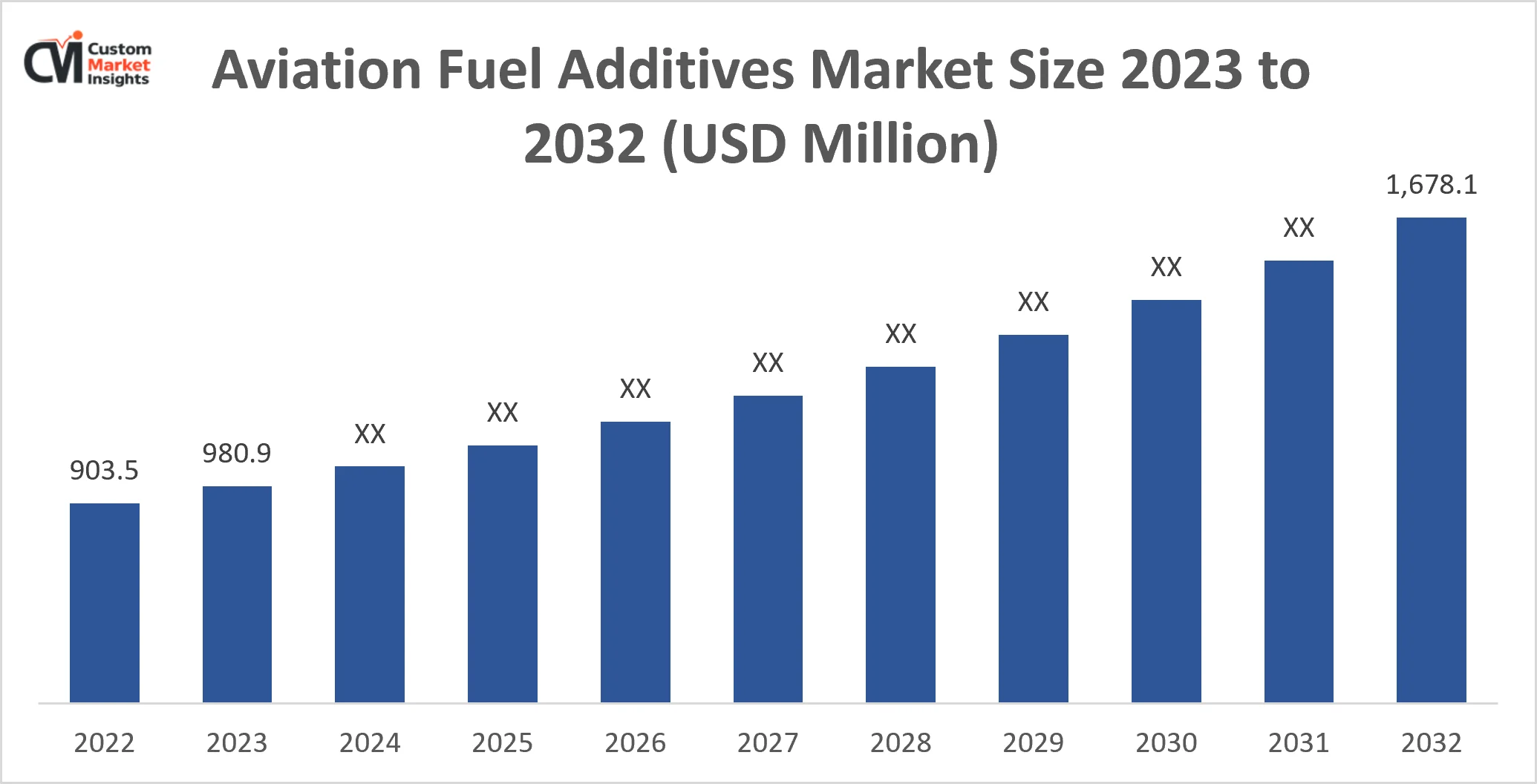
Valued at USD 981 Mn in 2023, the market is projected to reach USD 1.68 Bn by 2032, growing at a 6.2% CAGR. Europe holds the largest share, while Asia-Pacific grows fastest. The report profiles 10 companies.
The global aviation fuel additives market was valued at USD 981 Mn in 2023 and is projected to reach USD 1.68 Bn by 2032, growing at a CAGR of 6.2%. Europe is the largest regional market and Asia-Pacific is growing fastest.
Global Aviation Fuel Additives Market 2023–2032 (By Million)
As per the current market research conducted by CMI Team, the global Aviation Fuel Additives Market is expected to record a CAGR of 6.2% from 2023 to 2032. In 2022, the market size is projected to reach a valuation of USD 903.5 million. By 2032, the valuation is anticipated to reach USD 1,678.1 million.
Aviation Fuel Specification
Property
Value
Specific gravity
0.78 - 0.81
Flash point
38 - 60 °C (100 - 140 °F)
Autoignition temperature
225 - 295 °C (437 - 563 °F)
Energy density
43.1 MJ/kg (18,900 BTU/lb)
Sulfur content
0.01 - 0.15%
Lead content
0.00%
Cetane number
40 - 55
Cloud point
-40 - -45 °C (-40 - -49 °F)
Pour point
-50 - -55 °C (-58 - -67 °F)
Resource: According to CMI Market Research Team Analysis
The aviation fuel additives market refers to the global industry involved in the production, distribution, and utilization of additives specifically designed to enhance the performance, efficiency, and safety of aviation fuels. These additives are utilized in commercial and military aircraft to improve combustion, reduce emissions, prevent engine deposits, and ensure fuel system integrity.
The aviation fuel additives market is dynamic and highly competitive, with key players including chemical manufacturers, oil companies, and specialized additive suppliers. The market operates on a global scale, serving airlines, aircraft operators, and fuel suppliers worldwide. Various elements influence it, including technological advancements, environmental restrictions, fuel economy requirements, and safety concerns.
A growing emphasis on sustainability, driven by using sustainable aviation fuels and the reduction of carbon emissions, is one of the most prominent developments in the aviation fuel additives market.
The market also experiences continuous advancements in additive technology, with a focus on developing high-performance solutions that meet the evolving needs of modern aircraft engines. Additionally, there is an increasing demand for additives that enhance engine maintenance, ensure fuel stability, and meet stringent safety requirements.
The Aviation Fuel Additives Market presents significant growth opportunities due to several factors:
Stringent Environmental Regulations: Increasing environmental concerns and stringent regulations aimed at reducing carbon emissions and pollutants from aircraft are driving the demand for aviation fuel additives. Additives that improve fuel efficiency and reduce emissions help airlines comply with these regulations while enhancing their environmental sustainability.
Growing Air Travel Demand: The steady growth in air travel, fuelled by factors such as rising disposable incomes and increasing global connectivity, is driving the demand for aviation fuel additives. As airlines strive to optimize fuel consumption and enhance operational efficiency, they are increasingly adopting fuel additives to improve engine performance and reduce fuel costs.
Technological Advancements: Continuous advancements in aviation fuel additive technology are driving market growth. Additive manufacturers are investing in research and development to introduce innovative solutions that meet the evolving needs of modern aircraft engines. These advancements aim to enhance fuel efficiency, improve combustion, prevent engine deposits, and ensure safe and reliable operations.
Focus on Safety and Engine Maintenance: The aviation industry places a high emphasis on safety and engine maintenance. Aviation fuel additives that enhance safety by preventing fuel system icing, reducing the risk of flameout, and protecting against corrosion are in high demand. As aircraft operators prioritize engine performance and longevity, the market for additives with robust engine maintenance capabilities is expanding.
Adoption of Sustainable Aviation Fuels (SAF): The increasing adoption of sustainable aviation fuels presents an opportunity for aviation fuel additives. Additives that optimize the performance and compatibility of SAF can play a crucial role in ensuring efficient and reliable operations while reducing carbon emissions.
Emerging Markets and Regional Expansion: The aviation industry's growth in emerging markets, such as Asia-Pacific and Latin America, presents opportunities for market expansion. Additive manufacturers can target these regions and establish partnerships with local airlines and fuel suppliers to tap into new growth opportunities.
Aviation Fuel Additives Market - Mergers and Acquisitions
The Aviation Fuel Additives Market has seen several mergers and acquisitions in recent years, with companies seeking to expand their market presence and leverage synergies to improve their product offerings and profitability. Some notable examples of mergers and acquisitions in the Aviation Fuel Additives Market include:
Evonik Industries and Aviation Fuels & Technologies, LLC (AFT): In 2020, Evonik Industries entered into a partnership with AFT to jointly develop and market an innovative fuel additive for jet fuels. The additive aimed to enhance the performance and stability of aviation fuels while reducing emissions and improving fuel efficiency.
Nouryon and SkyNRG: In 2019, Nouryon and SkyNRG announced a long-term partnership to develop and scale up the production of sustainable aviation fuels. The collaboration focused on the development of technology for converting waste and residue feedstocks into sustainable jet fuels, supporting the aviation industry's efforts to reduce its carbon footprint.
Chevron Corporation's Acquisition of Zeller+Gmelin: In 2018, Chevron Corporation acquired Zeller+Gmelin, a manufacturer of specialty lubricants, including aviation lubricants. This acquisition expanded Chevron's product portfolio and strengthened its presence in the aviation lubricants market.
Innospec's Acquisition of Octel Corp: In 2018, Innospec completed the acquisition of Octel Corp, a manufacturer of fuel and lubricant additives. This acquisition allowed Innospec to enhance its product offerings in the aviation fuel additives market and expand its global footprint.
These mergers and acquisitions have helped companies expand their product offerings, improve their market presence, and capitalize on growth opportunities in the Aviation Fuel Additives Market. The trend is expected to continue as companies seek to gain a competitive edge in the market.
The Aviation Fuel Additives Market faces several significant threats that could impact its growth and profitability in the future. Some of these threats include:
Stringent Environmental Regulations: While environmental regulations drive the adoption of aviation fuel additives, they can also pose challenges. Compliance with increasingly stringent regulations requires continuous innovation and investment in research and development. Additive manufacturers must stay ahead of evolving regulations to ensure their products meet environmental standards and remain competitive in the market.
Fluctuating Oil Prices: The aviation fuel additives market is highly influenced by the price of crude oil, as aviation fuels are derived from petroleum. Fluctuations in oil prices can impact the profitability of additive manufacturers and the overall demand for aviation fuel additives. Sharp increases in oil prices can lead to higher production costs and reduced demand for additives, affecting the market's growth.
Technological Advancements and Changing Industry Dynamics: While technological advancements drive market growth, they can also disrupt the market landscape. The introduction of alternative fuels, such as sustainable aviation fuels, and advancements in engine technologies may reduce the dependence on traditional aviation fuel additives. Additive manufacturers need to adapt to these changing dynamics and invest in innovative solutions to stay competitive and relevant in the evolving aviation industry.
Impact of Global Crises: Global crises, such as economic recessions, geopolitical conflicts, and pandemics, can have a significant impact on the aviation industry and, consequently, the aviation fuel additives market. Reduced air travel demand, financial constraints faced by airlines, and disruptions in the supply chain can hinder market growth. Additive manufacturers need to navigate through these crises and devise strategies to mitigate the adverse effects on their business operations.
Report Scope
Feature of the Report
Details
Market Size in 2023
USD 980.9 Million
Projected Market Size in 2032
USD 1,678.1 Million
Market Size in 2022
USD 903.5 Million
CAGR Growth Rate
6.2% CAGR
Base Year
2023
Forecast Period
2024-2033
Key Segment
By Additives Type, Application Type, Fuel Type and Region
Report Coverage
Revenue Estimation and Forecast, Company Profile, Competitive Landscape, Growth Factors and Recent Trends
Regional Scope
North America, Europe, Asia Pacific, Middle East & Africa, and South & Central America
Buying Options
Request tailored purchasing options to fulfil your requirements for research.
Category-Wise Insights
By Additives Type:
Dispersants: Dispersants are additives used to prevent the formation of engine deposits by dispersing insoluble particles in aviation fuel. The market trends indicate a growing demand for dispersants that offer improved dispersibility, enhanced fuel stability, and compatibility with advanced fuel formulations.
Antioxidant: Antioxidants are additives that inhibit the oxidation of aviation fuel, ensuring fuel stability and preventing the formation of harmful by-products. The market trend shows an increasing focus on antioxidants that provide long-term oxidation protection, compatibility with different fuel types, and improved engine performance.
Anti-Icing: Anti-icing additives are used to prevent the formation of ice crystals in fuel systems, ensuring safe aircraft operations. The market trends reflect a demand for anti-icing additives that offer effective ice prevention, low-temperature operability, and compatibility with different fuel compositions to address the challenges of varying climatic conditions.
Antiknock: Antiknock additives are used to improve the octane rating of aviation gasoline, preventing knocking, or pinging in high-performance piston engines. Market trends in this segment include the development of additives that provide superior knock suppression, increased fuel efficiency, and compliance with stringent environmental regulations.
Others: The "Others" category encompasses various additives in the aviation fuel additives market, including corrosion inhibitors, static dissipators, lubricity improvers, and fuel stabilizers. The trends for these additives involve advancements in additive technologies, customization to meet specific industry requirements, and a focus on enhancing fuel performance and safety standards.
By Application Type
Commercial Aircraft: Commercial aircraft are airplanes specifically designed and utilized for transporting passengers and cargo for commercial purposes. In the aviation fuel additives market, the trends for commercial aircraft revolve around enhancing fuel efficiency to reduce operating costs and minimize environmental impact. Additives that improve combustion efficiency, reduce engine deposits, and optimize fuel performance are in demand to meet stringent environmental regulations and achieve sustainability goals. Additionally, the market emphasizes the development of additives that ensure compliance with aviation fuel specifications and enhance safety in commercial aviation operations.
Military Aircraft: Military aircraft are specifically designed for military operations and defence purposes. In the aviation fuel additives market, the trends for military aircraft involve enhancing performance, and engine protection, and meeting specific military specifications, such as fuel stability, corrosion prevention, and safety requirements.
Others: The "Others" category includes various aircraft types beyond commercial and military, such as general aviation, business jets, helicopters, and unmanned aerial vehicles (UAVs). The trends in the aviation fuel additives market for these aircraft types revolve around customization, efficiency, and safety, addressing the unique needs and requirements of each category.
By Fuel Type
Aviation Gasoline: Aviation gasoline, also known as avgas, is a specialized fuel used in piston-engine aircraft. In the aviation fuel additives market, the demand for avgas additives is driven by trends such as the development of high-performance lead-replacement additives and solutions that enhance fuel stability and prevent engine deposits.
Jet Fuel: Jet fuel is the primary fuel utilized in both commercial and military aircraft equipped with jet engines. In the aviation fuel additives market, there is a significant demand for additives specifically designed for jet fuel. These additives aim to enhance combustion efficiency, reduce emissions, prevent fuel system icing, and optimize engine performance, catering to the unique requirements of jet engines. The trends in this segment include the development of additives for sustainable aviation fuels and the focus on emissions reduction.
The Aviation Fuel Additives Market is segmented into various regions, including North America, Europe, Asia-Pacific, and LAMEA. Here is a brief overview of each region:
North America: In North America, a major trend in the aviation fuel additives market is the increasing focus on sustainability and the adoption of sustainable aviation fuels (SAF). Stringent environmental regulations drive the demand for additives that improve fuel efficiency and reduce emissions. The dominating players in this region include Afton Chemical Corporation, Innospec Inc., and Baker Hughes Company.
Europe: In Europe, the aviation fuel additives market is driven by the region's strong commitment to reducing carbon emissions. The emphasis on sustainability leads to a high demand for additives that enhance fuel efficiency and reduce environmental impact. Key players dominating the European market include BASF SE, Evonik Industries AG, and TotalEnergies.
Asia-Pacific: The aviation fuel additives market is surging in Asia Pacific due to rapid growth in the aviation industry in the region. Factors such as increasing air travel demand, the expansion of aviation infrastructure, and a growing emphasis on fuel efficiency are fuelling market growth. Key players dominating this region include Shell Global Solutions, LANXESS AG, and Chevron Oronite Company LLC.
LAMEA (Latin America, Middle East, and Africa): The LAMEA region, specifically the Middle East and Africa, is witnessing the expansion of the aviation sector, leading to opportunities in the aviation fuel additives market. The demand in this region is characterized by a need for additives that enhance engine performance, ensure fuel stability, and meet safety standards. Prominent players in the LAMEA market include The Lubrizol Corporation, Afton Chemical Corporation, and Innospec Inc.
The Aviation Fuel Additives Market is highly competitive, with a large number of manufacturers and retailers operating globally. Some of the key players in the market include:
Afton Chemical Corporation
BASF SE
Chevron Oronite Company LLC
Shell Global Solutions
Innospec Inc.
LANXESS AG
Evonik Industries AG
TotalEnergies
Baker Hughes Company
The Lubrizol Corporation
Others
These companies operate in the market through various strategies such as product innovation, mergers and acquisitions, and partnerships. For example, In 2021, a major partnership in the aviation fuel additives market was the collaboration between BASF SE and Lufthansa Technik AG. The partnership aimed to develop innovative and sustainable solutions for aircraft engine washing, focusing on improving engine performance, fuel efficiency, and environmental sustainability.
Several new players have entered the aviation fuel additives market with a focus on innovation and development. These companies aim to bring new solutions and technologies to the market, addressing the evolving needs of the aviation industry. While specific new players may vary, some examples include start-ups specializing in sustainable aviation fuel additives and emerging companies leveraging advanced research to develop high-performance additives.
Established key players dominate the aviation fuel additives market through their extensive experience, global presence, and strong product portfolios. These dominant players invest significantly in research and development to introduce innovative additives, maintain strategic partnerships with aircraft manufacturers and fuel suppliers, and provide comprehensive solutions to meet the diverse needs of the aviation industry. Their dominance is further reinforced by their ability to comply with stringent environmental regulations, ensure quality and reliability, and deliver exceptional customer service, solidifying their position as market leaders.
Regional Coverage
North America
U.S.
Canada
Mexico
Rest of North America
Europe
Germany
France
U.K.
Italy
Spain
Rest of Europe
Asia Pacific
China
Japan
India
New Zealand
Australia
South Korea
Rest of Asia Pacific
The Middle East & Africa
Saudi Arabia
UAE
Egypt
Kuwait
South Africa
Rest of the Middle East & Africa
Latin America
Brazil
Argentina
Rest of Latin America
Market share analysis
Global Aviation Fuel Additives Market 2023–2032 (By Additives Type)
Which type led the Aviation Fuel Additives market?
The "Application Type " category dominated the market in 2022
Which are the driving factors of the Aviation Fuel Additives Market?
The key factors driving the Market are Stringent Environmental Regulations, Growing Air Travel Demand, Technological Advancements, Focus on Safety and Engine Maintenance, Adoption of Sustainable Aviation Fuels (SAF) And Emerging Markets and Regional Expansion.
Who are the key players in the Aviation Fuel Additives market?
The key players in the market are Afton Chemical Corporation, BASF SE, Chevron Oronite Company LLC, Shell Global Solutions, Innospec Inc., LANXESS AG, Evonik Industries AG, TotalEnergies, Baker Hughes Company, The Lubrizol Corporation, Others
Which region held the largest market share in the Aviation Fuel Additives market?
"North America" had the largest share in the Aviation Fuel Additives Market.
What is the growth rate of the Aviation Fuel Additives market?
The global market is projected to grow at a CAGR of 6.2% during the forecast period, 2023-2032.
How much is the Aviation Fuel Additives market?
The Aviation Fuel Additives Market size was valued at USD 903.5 Million in 2022.
Ayush Kadam is a Senior Market Research Analyst at Custom Market Insights, with over seven years of experience in syndicated and custom market research. He specializes in market sizing, competitive intelligence, industry trends, forecasting, and strategic insights, helping clients turn complex data into actionable business decisions.