
Superhydrophobic Coatings Market Size, Trends and Insights By Product Type (Anti-corrosion, Self-cleaning, Anti-icing, Anti-wetting), By End-User (Transportation, Textiles & Footwear, Medical, Construction, Electricals & Electronics, Optical, Others), and By Region - Global Industry Overview, Statistical Data, Competitive Analysis, Share, Outlook, and Forecast 2026 – 2035
Report Snapshot
CAGR: 24.8%
| Study Period: | 2026-2035 |
| Fastest Growing Market: | Asia Pacific |
| Largest Market: | North America |
Major Players
- DryWired
- HZO Inc
- Cytonix
- Aculon
- Others
Reports Description
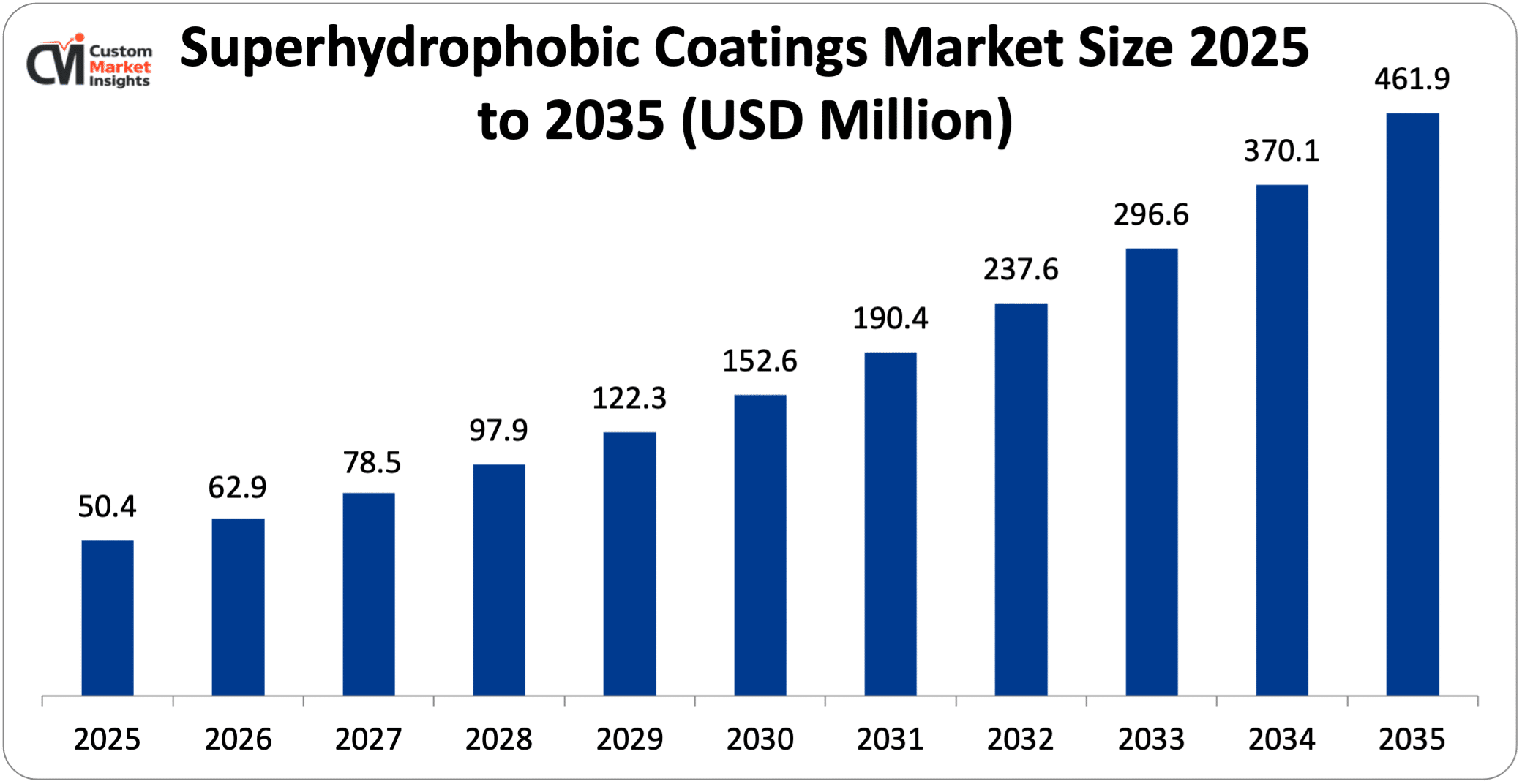
The market size of global superhydrophobic coatings will be estimated at USD 50.4 million in 2025 and is expected to grow to between USD 62.9 million in 2026 and about USD 461.9 million by 2035, with a current CAGR (compound annual growth rate) of 24.8% during the period of 2026 to 2035. Superhydrophobic coatings function as modern surface treatments that create extreme water-repellent capabilities through their ability to duplicate natural phenomena present in lotus leaf surfaces.
The coatings use micro- and nanostructured materials together with low surface energy materials because this combination creates surfaces that cause water droplets to form beads that roll off instead of sticking or spreading across the surface. The additional functionalities provided by these materials include self-cleaning capabilities together with protection against corrosion and ice formation and resistance to stains. Superhydrophobic coatings find extensive use in multiple industrial sectors such as construction and automotive and electronics and textiles and energy because they improve material durability while decreasing maintenance needs and enhancing performance when materials come into contact with water and environmental pollutants.
Market Highlight
- In 2025, North America will dominate the global market with an estimated market share of 60%. Increasing aerospace industry drives the regional market.
- The Asia Pacific is growing at the highest CAGR over the analysis period. The increasing consumer electronics industry drives the industry growth.
- By product type, the anti-wetting segment accounted for the highest revenue share in 2025 of over 55%.
- By end-user, the electricals & electronics segment would have the highest share of the market in 2025.
Significant Growth Factors
The superhydrophobic coatings market trends present significant growth opportunities due to several factors:
- Rising Demand for Water-Repellent & Self-cleaning Surfaces: The superhydrophobic coatings market experiences growth because industries demand water-repellent self-cleaning surfaces, which provide maintenance cost reductions and extended product lifespan. The coatings produce surfaces that allow water droplets to roll off the surface while water droplets remove dust and dirt and other pollutants, thus reducing the need for cleaning and chemical products. This functionality provides the construction and automotive and textile and consumer electronics industries with moisture protection and corrosion resistance and stain defense which extends product durability and operational efficiency. The increasing demand for materials that require minimal maintenance and provide maximum efficiency in urban infrastructure and smart devices drives the worldwide adoption of superhydrophobic coatings.
- Rising Use in Renewable Energy Applications: The market experiences substantial expansion because of the increasing adoption of superhydrophobic coatings which renewable energy technologies especially utilize for solar power and wind power applications. The solar panels now use these coatings to create self-cleaning and anti-dust features, which help the panels maintain their energy conversion capacity by stopping dirt and water and debris from gathering on their surfaces. The system proves particularly useful for regions that experience high dust conditions and face difficulties with water supply for cleaning purposes. Superhydrophobic coatings protect renewable energy facilities from environmental damage and corrosion and ice formation problems, which results in longer equipment lifespan and lower maintenance expenses. Renewable energy investment worldwide will lead to further demand for advanced coatings.
What are the Major Advances Changing the Superhydrophobic Coatings Market Today?
- Bio-inspired & Lotus-effect Engineering: The superhydrophobic coatings market received its first major breakthrough through bio-inspired and lotus-effect engineering because the technology uses natural surface structures to create coatings that repel water and clean themselves. These coatings, which draw their design from lotus leaves, use a combination of tiny micro- and nanostructures that work together with materials that have low surface energy to create water droplets that can easily slide off while taking dust particles and other impurities with them. The new technology enables better coating performance for anti-fouling and anti-icing and corrosion resistance applications because it provides longer-lasting and dependable protection. Industries now demand surface solutions that require minimal upkeep while delivering top performance, which drives bio-inspired engineering to speed up the market introduction of advanced superhydrophobic coatings in construction and automotive and energy sectors.
- Eco-friendly & Fluorine-free Formulations: The superhydrophobic coatings market experiences significant progress from eco-friendly and fluorine-free formulations which emerge as a new market trend. Current environmental regulations and public understanding of PFAS health dangers lead to this market development. The conventional superhydrophobic coatings system required fluorinated materials to create surfaces with reduced energy. The substances persist in the environment which creates health risks and ecological damage that will continue indefinitely. The researchers and manufacturers develop sustainable product alternatives through their work with silica-based bio-polymers and hydrocarbon-derived materials which achieve water-repellent results without damaging the environment. The green formulations enable companies to meet international sustainability objectives which results in better market acceptance of these products throughout construction textiles and consumer goods sectors that need to follow regulations and obtain eco-labels.
Category Wise Insights
By Product Type
Why Anti-wetting Hold a Prominent Position in the Market?
The anti-wetting segment accounted for the highest revenue share in 2025 of over 55%. The rising demand for anti-wetting properties in various industries drives the current expansion of the business. Anti-wetting coatings create a barrier that stops liquids from bonding with surfaces, which helps to keep materials safe from moisture and corrosion and contamination. The construction and automotive and marine and electronics industries benefit from this particular feature because their products face both water and extreme environmental conditions, which decrease product durability. The industrial sector increasingly adopts anti-wetting superhydrophobic coatings because they provide extended durability and lower maintenance expenses and better operational efficiency.
The self-cleaning segment is growing at the highest CAGR during the forecast period. Self-cleaning surface technology systems experience increasing demand, which leads to their market expansion among different industrial sectors. The coatings create surfaces that can automatically remove water and dust and contaminants from their surface, which leads to major reductions in cleaning and upkeep requirements. The solution provides value to building facades and solar panels and automotive exteriors and textiles and consumer electronics because these fields depend on clean surfaces to maintain proper operational functions. The self-cleaning property not only enhances aesthetic appeal but also improves operational efficiency—especially in solar energy systems where dust accumulation can reduce energy output. The market for self-cleaning superhydrophobic coatings experiences steady growth because consumers and industries increasingly demand solutions that require little maintenance, have low costs, and provide sustainable benefits.
By End-User
Why Do Electricals & Electronics Capture the Highest Market Share in the Superhydrophobic Coatings Market?
The electricals & electronics segment would have the highest share of the market in 2025. The growth of the industry originates from the increasing need for moisture-proof electronic products that deliver superior performance. The coatings deliver exceptional defense against water and humidity and condensation, which serve as essential elements that determine the operational reliability and durability of components, including circuit boards and sensors and semiconductors and consumer electronics. The manufacturing industry now uses superhydrophobic coatings more often because smartphone and wearable and IoT system and miniaturized electronic markets are growing at a fast pace.
The transportation segment is growing at a rapid rate over the projected period. The segment growth is driven by increasing demand for advanced surface protection and performance-enhancing solutions across automotive, aerospace, rail, and marine industries. The coatings deliver essential defensive features, which include water repellency, anti-icing protection, and corrosion resistance, together with improved visibility for windshields and mirrors, which enhances safety and operational efficiency. The materials provide automotive and aerospace industries with benefits that include lower drag and simplified maintenance for their systems while they help achieve better fuel efficiency and lower lifecycle operating expenses.
Report Scope
| Feature of the Report | Details |
| Market Size in 2026 | USD 62.9 million |
| Projected Market Size in 2035 | USD 461.9 million |
| Market Size in 2025 | USD 50.4 million |
| CAGR Growth Rate | 24.8% CAGR |
| Base Year | 2025 |
| Forecast Period | 2026-2035 |
| Key Segment | By Product Type, End-User and Region |
| Report Coverage | Revenue Estimation and Forecast, Company Profile, Competitive Landscape, Growth Factors and Recent Trends |
| Regional Scope | North America, Europe, Asia Pacific, Middle East & Africa, and South & Central America |
| Buying Options | Request tailored purchasing options to fulfil your requirements for research. |
Regional Analysis
How Big is North America Superhydrophobic Coatings Market Size?
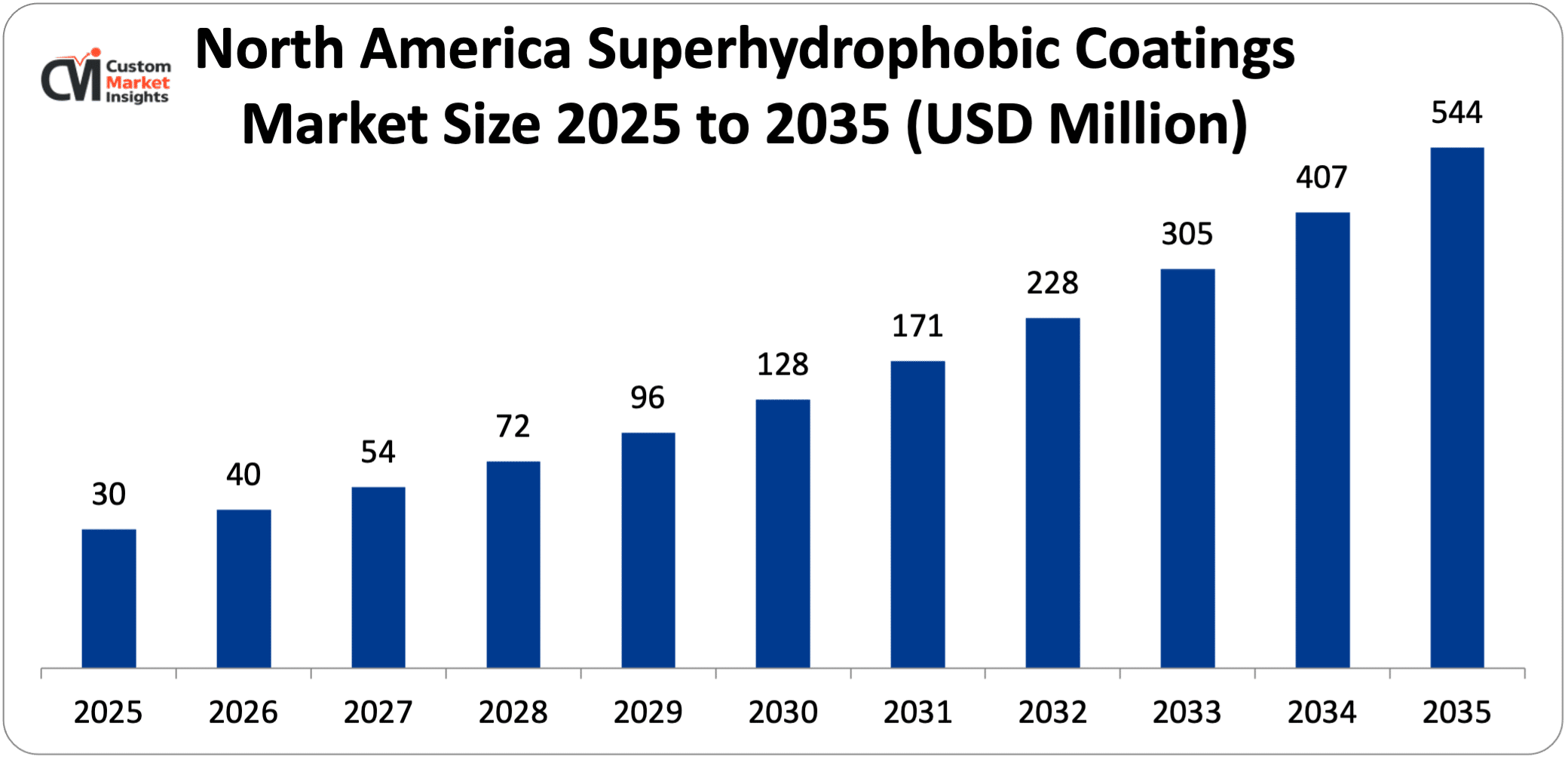
Its market size, in terms of North American superhydrophobic coatings, is projected to be USD 30 million in 2025 with a growth of about USD 544 million in 2035 with a CAGR of 33.5% between 2026 and 2035.
Why did North America Dominate the Superhydrophobic Coatings Market in 2025?
In 2025, North America will dominate the global market with an estimated market share of 60%. The region’s development operates from rising needs of multiple sectors such as automotive and electronics and textiles. The market growth receives additional momentum through regulations that support advanced materials paired with sustainability initiatives as businesses develop new solutions that improve product endurance and efficiency. The competitive landscape operates with strength because RTP Company, NeverWet, and UltraTech International serve as major industry competitors. The U.S. market operates as the main market because it receives large research and development funding together with its strong manufacturing capacity. Companies will introduce new products, which will lead to increased market applications that will establish North America as the main center for superhydrophobic technologies.
US Superhydrophobic Coatings Market Trends
In the North American region, the US is expected to dominate the market over the projected period. The growth is owing to the increasing product launch. For instance, NEI Corporation recently has introduced NANOMYTE SuperCN Plus — a functionally graded coating that imparts superhydrophobic properties to the underlying substrate while providing greater abrasion resistance compared to existing superhydrophobic coatings, according to the company. Surfaces treated with SuperCN Plus force liquids to bead up and roll off, shedding water instantly and leaving the surface completely dry. SuperCN Plus can be applied to a variety of substrate materials, including plastics, metals, glass, painted surfaces, and fabrics. NANOMYTE SuperCN Plus consists of a hard and abrasion resistant outer layer that transitions to a softer material closer to the substrate. Such a functionally graded coating represents a major advancement in the state of the art and is in sharp contrast to monolithic superhydrophobic coatings that consist of a relatively soft material that is easily abraded or rubbed away.
Why is Europe Experiencing a Significant Growth in the Superhydrophobic Coatings Market?
Europe holds a significant market share in 2025. The region’s growth is driven by two factors, which encompass rising environmental regulations together with the movement toward sustainable materials. The UK and Germany lead the world by developing coating technologies that extend product lifespan and lower maintenance expenses in accordance with European Union sustainability requirements. Aculon and P2i compete in the market through their implementation of state-of-the-art technologies, which help them win customers. The strong manufacturing capabilities combined with research and development activities serve as essential factors that drive business growth. The European market will experience substantial growth because industries adopt these coatings and regulations support their use while consumers seek materials that deliver exceptional performance.
UK Superhydrophobic Coatings Market Trends
The UK held the dominant position in the market in 2025. The expansion occurs because more businesses adopt advanced material technologies while their need for these technologies grows. The market will experience substantial growth because new applications for electronics, automotive, textile and industrial equipment technologies will drive demand for these superior water-repellent and self-cleaning and corrosion-resistant coatings.
Why is the Asia Pacific Growing at a Highest CAGR in the Superhydrophobic Coatings Market?
The Asia Pacific is expected to grow at the highest CAGR over the projected period. The region’s growth results from three main factors, which include rising industrialization and urban development and increased need for advanced materials used in electronics and construction. China and Japan have emerged as the leading nations, whose governments support them through initiatives that promote innovation and technology adoption. The market competition has changed because both domestic businesses and international firms now compete for market dominance. The region gains a competitive advantage through the presence of major companies such as Lotus Leaf Coatings and Hydrophobic Coatings. The Asia-Pacific market will develop into a central research center for superhydrophobic technologies because companies will increasingly dedicate resources to research and development and industry partnerships will enhance their commercial growth.
China Superhydrophobic Coatings Market Trends
China holds the prominent market share in the industry. The environmental regulations and sustainable manufacturing practices that receive strong government support currently drive businesses to adopt environmentally sustainable water-based coating solutions. The superhydrophobic coatings market in China experiences continuous revenue expansion because of industrial-scale operations and technological progress and government policy backing.
Why is the Middle East & Africa Region is growing rapidly in the Superhydrophobic Coatings?
The MEA region is growing at a steady rate over the projected period. The development of the industry results from two main factors, which include rising infrastructure investments and the growing demand for advanced materials across multiple industries. The UAE and South Africa have started to investigate superhydrophobic coatings, which offer advantages for use in both the construction and automotive industries. The market lacks development because only a small number of important companies operate within the territory. The expansion of technology understanding creates fresh business possibilities, which enable organizations to establish partnerships with others. Superhydrophobic coatings face specific challenges and opportunities in the region because of its unique climate, which creates potential for future development.
UAE Superhydrophobic Coatings Market Trends
The UAE is growing at the highest CAGR during the forecast period. The area’s growing infrastructure development is the main factor driving the industry expansion.
Top Players in the Superhydrophobic Coatings Market and Their Offerings
- Nanex Co.
- Advanced Nanotech Lab
- Beijing Yahe Nutritive High-Tech Co., Ltd.
- Lotus Leaf Coatings Inc.
- DryWired
- HZO Inc
- Cytonix
- Aculon
- PPG Industries Inc.
- NEI Corporation
- NTT Advanced Technology Corporation
- P2i Ltd
- Pearl Nano LLC
- Nasiol Nano Coating
- Rust-Oleum
- Surfactis Technologies
- The Sherwin-Williams Company
- UltraTech International Inc.
- Others
Key Developments
Superhydrophobic coatings market has experienced considerable changes in the last two years as the market players are trying to diversify their technological aspects and develop product portfolios using strategic approaches.
- In October 2025, Researchers have unveiled a cotton fabric treated with a fully bio-based, superhydrophobic coating. This innovative technology, which harnesses rosin acid and chitosan nanoparticles, ensures effective oil-water separation without the use of fluorinated compounds, while also boasting durability in challenging conditions.
These strategic measures have enabled the companies to reinforce their competitive positions, increase the product line, boost their technological competencies, and also seize growth opportunities in the fast-growing superhydrophobic coatings market.
The Superhydrophobic Coatings Market is segmented as follows:
By Product Type
- Anti-corrosion
- Self-cleaning
- Anti-icing
- Anti-wetting
By End-User
- Transportation
- Textiles & Footwear
- Medical
- Construction
- Electricals & Electronics
- Optical
- Others
Regional Coverage:
North America
- U.S.
- Canada
- Mexico
- Rest of North America
Europe
- Germany
- France
- U.K.
- Russia
- Italy
- Spain
- Netherlands
- Rest of Europe
Asia Pacific
- China
- Japan
- India
- New Zealand
- Australia
- South Korea
- Taiwan
- Rest of Asia Pacific
The Middle East & Africa
- Saudi Arabia
- UAE
- Egypt
- Kuwait
- South Africa
- Rest of the Middle East & Africa
Latin America
- Brazil
- Argentina
- Rest of Latin America
Table of Contents
- Chapter 1. Report Introduction
- 1.1. Report Description
- 1.1.1. Purpose of the Report
- 1.1.2. USP & Key Offerings
- 1.2. Key Benefits For Stakeholders
- 1.3. Target Audience
- 1.4. Report Scope
- 1.1. Report Description
- Chapter 2. Market Overview
- 2.1. Report Scope (Segments And Key Players)
- 2.1.1. Superhydrophobic Coatings by Segments
- 2.1.2. Superhydrophobic Coatings by Region
- 2.2. Executive Summary
- 2.2.1. Market Size & Forecast
- 2.2.2. Superhydrophobic Coatings Market Attractiveness Analysis, By Product Type
- 2.2.3. Superhydrophobic Coatings Market Attractiveness Analysis, By End-User
- 2.1. Report Scope (Segments And Key Players)
- Chapter 3. Market Dynamics (DRO)
- 3.1. Market Drivers
- 3.1.1. Rising Demand for Water-Repellent & Self-cleaning Surfaces
- 3.1.2. Rising Use in Renewable Energy Applications
- 3.2. Market Restraints
- 3.3. Market Opportunities
- 3.5. Pestle Analysis
- 3.6. Porter Forces Analysis
- 3.7. Technology Roadmap
- 3.8. Value Chain Analysis
- 3.9. Government Policy Impact Analysis
- 3.10. Pricing Analysis
- 3.1. Market Drivers
- Chapter 4. Superhydrophobic Coatings Market – By Product Type
- 4.1. Product Type Market Overview, By Product Type Segment
- 4.1.1. Superhydrophobic Coatings Market Revenue Share, By Product Type, 2025 & 2035
- 4.1.2. Anti-corrosion
- 4.1.3. Superhydrophobic Coatings Share Forecast, By Region (USD Million)
- 4.1.4. Comparative Revenue Analysis, By Country, 2025 & 2035
- 4.1.5. Key Market Trends, Growth Factors, & Opportunities
- 4.1.6. Self-cleaning
- 4.1.7. Superhydrophobic Coatings Share Forecast, By Region (USD Million)
- 4.1.8. Comparative Revenue Analysis, By Country, 2025 & 2035
- 4.1.9. Key Market Trends, Growth Factors, & Opportunities
- 4.1.10. Anti-icing
- 4.1.11. Superhydrophobic Coatings Share Forecast, By Region (USD Million)
- 4.1.12. Comparative Revenue Analysis, By Country, 2025 & 2035
- 4.1.13. Key Market Trends, Growth Factors, & Opportunities
- 4.1.14. Anti-wetting
- 4.1.15. Superhydrophobic Coatings Share Forecast, By Region (USD Million)
- 4.1.16. Comparative Revenue Analysis, By Country, 2025 & 2035
- 4.1.17. Key Market Trends, Growth Factors, & Opportunities
- 4.1. Product Type Market Overview, By Product Type Segment
- Chapter 5. Superhydrophobic Coatings Market – By End-User
- 5.1. End-User Market Overview, By End-User Segment
- 5.1.1. Superhydrophobic Coatings Market Revenue Share, By End-User, 2025 & 2035
- 5.1.2. Transportation
- 5.1.3. Superhydrophobic Coatings Share Forecast, By Region (USD Million)
- 5.1.4. Comparative Revenue Analysis, By Country, 2025 & 2035
- 5.1.5. Key Market Trends, Growth Factors, & Opportunities
- 5.1.6. Textiles & Footwear
- 5.1.7. Superhydrophobic Coatings Share Forecast, By Region (USD Million)
- 5.1.8. Comparative Revenue Analysis, By Country, 2025 & 2035
- 5.1.9. Key Market Trends, Growth Factors, & Opportunities
- 5.1.10. Medical
- 5.1.11. Superhydrophobic Coatings Share Forecast, By Region (USD Million)
- 5.1.12. Comparative Revenue Analysis, By Country, 2025 & 2035
- 5.1.13. Key Market Trends, Growth Factors, & Opportunities
- 5.1.14. Construction
- 5.1.15. Superhydrophobic Coatings Share Forecast, By Region (USD Million)
- 5.1.16. Comparative Revenue Analysis, By Country, 2025 & 2035
- 5.1.17. Key Market Trends, Growth Factors, & Opportunities
- 5.1.18. Electricals & Electronics
- 5.1.19. Superhydrophobic Coatings Share Forecast, By Region (USD Million)
- 5.1.20. Comparative Revenue Analysis, By Country, 2025 & 2035
- 5.1.21. Key Market Trends, Growth Factors, & Opportunities
- 5.1.22. Optical
- 5.1.23. Superhydrophobic Coatings Share Forecast, By Region (USD Million)
- 5.1.24. Comparative Revenue Analysis, By Country, 2025 & 2035
- 5.1.25. Key Market Trends, Growth Factors, & Opportunities
- 5.1.26. Others
- 5.1.27. Superhydrophobic Coatings Share Forecast, By Region (USD Million)
- 5.1.28. Comparative Revenue Analysis, By Country, 2025 & 2035
- 5.1.29. Key Market Trends, Growth Factors, & Opportunities
- 5.1. End-User Market Overview, By End-User Segment
- Chapter 6. Superhydrophobic Coatings Market – Regional Analysis
- 6.1. Superhydrophobic Coatings Market Overview, By Region Segment
- 6.1.1. Global Superhydrophobic Coatings Market Revenue Share, By Region, 2025 & 2035
- 6.1.2. Global Superhydrophobic Coatings Market Revenue, By Region, 2026 – 2035 (USD Million)
- 6.1.3. Global Superhydrophobic Coatings Market Revenue, By Product Type, 2026 – 2035
- 6.1.4. Global Superhydrophobic Coatings Market Revenue, By End-User, 2026 – 2035
- 6.2. North America
- 6.2.1. North America Superhydrophobic Coatings Market Revenue, By Country, 2026 – 2035 (USD Million)
- 6.2.2. North America Superhydrophobic Coatings Market Revenue, By Product Type, 2026 – 2035
- 6.2.3. North America Superhydrophobic Coatings Market Revenue, By End-User, 2026 – 2035
- 6.2.4. U.S. Superhydrophobic Coatings Market Revenue, 2026 – 2035 (USD Million)
- 6.2.5. Canada Superhydrophobic Coatings Market Revenue, 2026 – 2035 (USD Million)
- 6.2.6. Mexico Superhydrophobic Coatings Market Revenue, 2026 – 2035 (USD Million)
- 6.2.7. Rest of North America Superhydrophobic Coatings Market Revenue, 2026 – 2035 (USD Million)
- 6.3. Europe
- 6.3.1. Europe Superhydrophobic Coatings Market Revenue, By Country, 2026 – 2035 (USD Million)
- 6.3.2. Europe Superhydrophobic Coatings Market Revenue, By Product Type, 2026 – 2035
- 6.3.3. Europe Superhydrophobic Coatings Market Revenue, By End-User, 2026 – 2035
- 6.3.4. Germany Superhydrophobic Coatings Market Revenue, 2026 – 2035 (USD Million)
- 6.3.5. France Superhydrophobic Coatings Market Revenue, 2026 – 2035 (USD Million)
- 6.3.6. U.K. Superhydrophobic Coatings Market Revenue, 2026 – 2035 (USD Million)
- 6.3.7. Russia Superhydrophobic Coatings Market Revenue, 2026 – 2035 (USD Million)
- 6.3.8. Italy Superhydrophobic Coatings Market Revenue, 2026 – 2035 (USD Million)
- 6.3.9. Spain Superhydrophobic Coatings Market Revenue, 2026 – 2035 (USD Million)
- 6.3.10. Netherlands Superhydrophobic Coatings Market Revenue, 2026 – 2035 (USD Million)
- 6.3.11. Rest of Europe Superhydrophobic Coatings Market Revenue, 2026 – 2035 (USD Million)
- 6.4. Asia Pacific
- 6.4.1. Asia Pacific Superhydrophobic Coatings Market Revenue, By Country, 2026 – 2035 (USD Million)
- 6.4.2. Asia Pacific Superhydrophobic Coatings Market Revenue, By Product Type, 2026 – 2035
- 6.4.3. Asia Pacific Superhydrophobic Coatings Market Revenue, By End-User, 2026 – 2035
- 6.4.4. China Superhydrophobic Coatings Market Revenue, 2026 – 2035 (USD Million)
- 6.4.5. Japan Superhydrophobic Coatings Market Revenue, 2026 – 2035 (USD Million)
- 6.4.6. India Superhydrophobic Coatings Market Revenue, 2026 – 2035 (USD Million)
- 6.4.7. New Zealand Superhydrophobic Coatings Market Revenue, 2026 – 2035 (USD Million)
- 6.4.8. Australia Superhydrophobic Coatings Market Revenue, 2026 – 2035 (USD Million)
- 6.4.9. South Korea Superhydrophobic Coatings Market Revenue, 2026 – 2035 (USD Million)
- 6.4.10. Taiwan Superhydrophobic Coatings Market Revenue, 2026 – 2035 (USD Million)
- 6.4.11. Rest of Asia Pacific Superhydrophobic Coatings Market Revenue, 2026 – 2035 (USD Million)
- 6.5. The Middle-East and Africa
- 6.5.1. The Middle-East and Africa Superhydrophobic Coatings Market Revenue, By Country, 2026 – 2035 (USD Million)
- 6.5.2. The Middle-East and Africa Superhydrophobic Coatings Market Revenue, By Product Type, 2026 – 2035
- 6.5.3. The Middle-East and Africa Superhydrophobic Coatings Market Revenue, By End-User, 2026 – 2035
- 6.5.4. Saudi Arabia Superhydrophobic Coatings Market Revenue, 2026 – 2035 (USD Million)
- 6.5.5. UAE Superhydrophobic Coatings Market Revenue, 2026 – 2035 (USD Million)
- 6.5.6. Egypt Superhydrophobic Coatings Market Revenue, 2026 – 2035 (USD Million)
- 6.5.7. Kuwait Superhydrophobic Coatings Market Revenue, 2026 – 2035 (USD Million)
- 6.5.8. South Africa Superhydrophobic Coatings Market Revenue, 2026 – 2035 (USD Million)
- 6.5.9. Rest of the Middle East & Africa Superhydrophobic Coatings Market Revenue, 2026 – 2035 (USD Million)
- 6.6. Latin America
- 6.6.1. Latin America Superhydrophobic Coatings Market Revenue, By Country, 2026 – 2035 (USD Million)
- 6.6.2. Latin America Superhydrophobic Coatings Market Revenue, By Product Type, 2026 – 2035
- 6.6.3. Latin America Superhydrophobic Coatings Market Revenue, By End-User, 2026 – 2035
- 6.6.4. Brazil Superhydrophobic Coatings Market Revenue, 2026 – 2035 (USD Million)
- 6.6.5. Argentina Superhydrophobic Coatings Market Revenue, 2026 – 2035 (USD Million)
- 6.6.6. Rest of Latin America Superhydrophobic Coatings Market Revenue, 2026 – 2035 (USD Million)
- 6.1. Superhydrophobic Coatings Market Overview, By Region Segment
- Chapter 7. Competitive Landscape
- 7.1. Company Market Share Analysis – 2025
- 7.1.1. Global Superhydrophobic Coatings Market: Company Market Share, 2025
- 7.2. Global Superhydrophobic Coatings Market Company Market Share, 2024
- 7.1. Company Market Share Analysis – 2025
- Chapter 8. Company Profiles
- 8.1. Nanex Co.
- 8.1.1. Company Overview
- 8.1.2. Key Executives
- 8.1.3. Product Portfolio
- 8.1.4. Financial Overview
- 8.1.5. Operating Business Segments
- 8.1.6. Business Performance
- 8.1.7. Recent Developments
- 8.2. Advanced Nanotech Lab
- 8.3. Beijing Neatrition Tech Co Ltd
- 8.4. Lotus Leaf Coatings Inc.
- 8.5. DryWired
- 8.6. HZO Inc
- 8.7. Cytonix
- 8.8. Aculon
- 8.9. PPG Industries Inc.
- 8.10. NEI Corporation
- 8.11. NTT Advanced Technology Corporation
- 8.12. P2i Ltd
- 8.13. Pearl Nano LLC
- 8.14. Nasiol Nano Coating
- 8.15. Rust-Oleum
- 8.16. Surfactis Technologies
- 8.17. The Sherwin-Williams Company
- 8.18. UltraTech International Inc.
- 8.19. Others.
- 8.1. Nanex Co.
- Chapter 9. Research Methodology
- 9.1. Research Methodology
- 9.2. Secondary Research
- 9.3. Primary Research
- 9.3.1. Analyst Tools and Models
- 9.4. Research Limitations
- 9.5. Assumptions
- 9.6. Insights From Primary Respondents
- 9.7. Why Custom Market Insights
- Chapter 10. Standard Report Commercials & Add-Ons
- 10.1. Customization Options
- 10.2. Subscription Module For Market Research Reports
- 10.3. Client Testimonials
List Of Figures
Figures No 1 to 25
List Of Tables
Tables No 1 to 41
Prominent Players
- Nanex Co.
- Advanced Nanotech Lab
- Beijing Neatrition Tech Co Ltd
- Lotus Leaf Coatings Inc.
- DryWired
- HZO Inc
- Cytonix
- Aculon
- PPG Industries Inc.
- NEI Corporation
- NTT Advanced Technology Corporation
- P2i Ltd
- Pearl Nano LLC
- Nasiol Nano Coating
- Rust-Oleum
- Surfactis Technologies
- The Sherwin-Williams Company
- UltraTech International Inc.
- Others
FAQs
The key players in the market are Nanex Co., Advanced Nanotech Lab, Beijing Neatrition Tech Co. Ltd., Lotus Leaf Coatings Inc., DryWired, HZO Inc., Cytonix, Aculon, PPG Industries Inc., NEI Corporation, NTT Advanced Technology Corporation, P2i Ltd., Pearl Nano LLC, Nasiol Nano Coating, Rust-Oleum, Surfactis Technologies, The Sherwin-Williams Company, UltraTech International Inc., Others.
Government regulations play a crucial role in shaping the market’s development by promoting eco-friendly formulations and restricting hazardous chemicals, thereby driving innovation while influencing production costs and adoption rates.
The price point significantly impacts market growth and adoption, as high costs can limit widespread use while affordable formulations accelerate penetration across cost-sensitive industries.
According to the present analysis and forecast modeling, the market of superhydrophobic coatings will witness a significant growth of about USD 461.9 million in the year 2035 with the growing innovative product launch, increasing collaboration, and increasing demand from the automotive sector with a CAGR of 24.8% between the years 2026 and 2035.
It is projected that North America will hold the largest market share in the superhydrophobic coatings market in the forecast period, with a share of about 60% of the global market share, which is owing to the presence of major players and innovative product launches.
The Asia Pacific is expected to grow at the highest rate during the forecast period. The increasing urbanization and industrialization drive the market growth.
7 . What are the key driving factors influencing the growth of the Superhydrophobic Coatings market?
The key factors driving the market are shielding fragile electronic devices from water damage and increased government support.