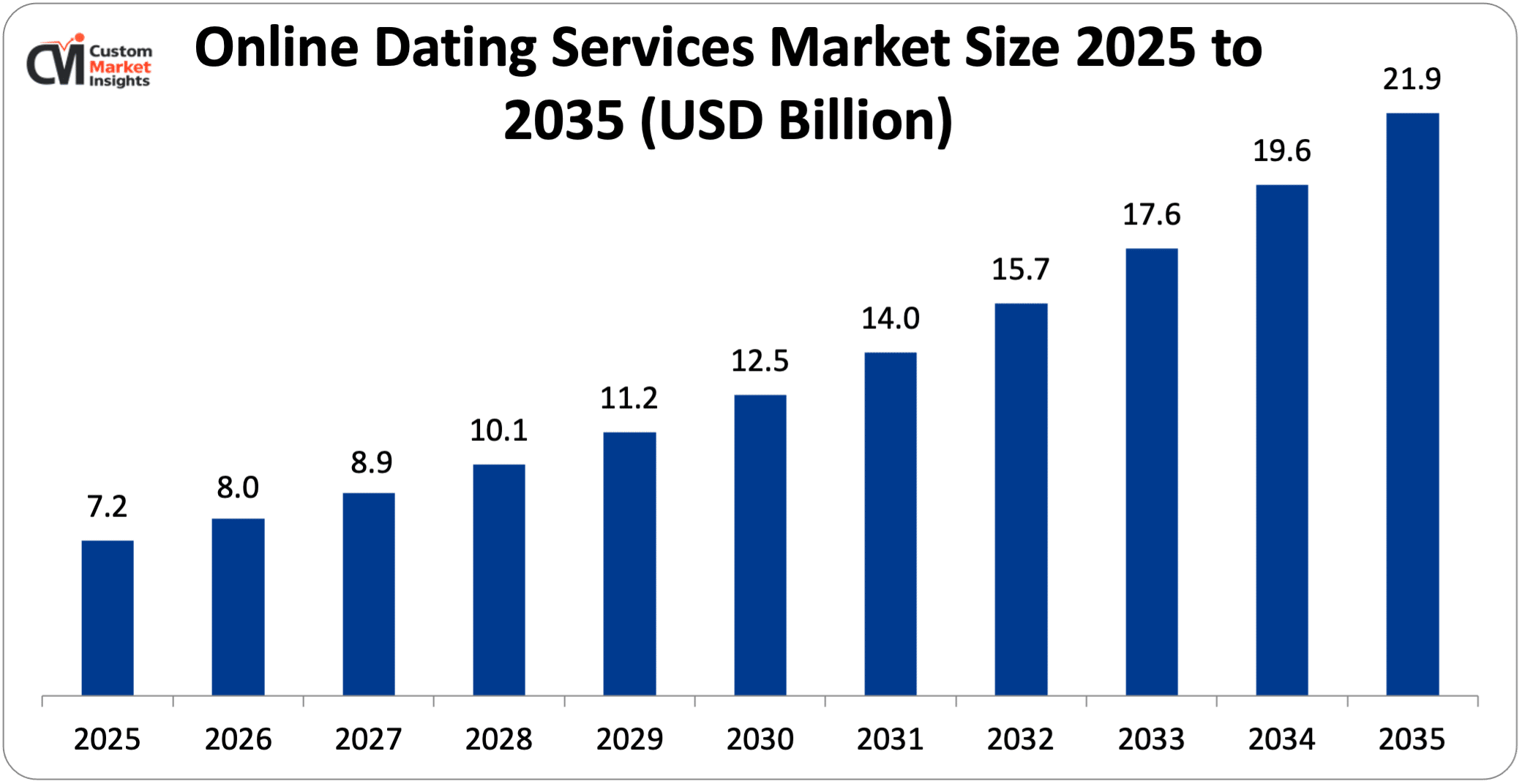
Valued at USD 8 Bn in 2026, the market is projected to reach USD 21.9 Bn by 2035, growing at a 11.8% CAGR. North America holds the largest share, while Asia Pacific grows fastest. The report profiles 14 companies including Tinder and Happn.
The global online dating services market was valued at USD 8 Bn in 2026 and is projected to reach USD 21.9 Bn by 2035, growing at a CAGR of 11.8%. North America is the largest regional market and Asia Pacific is growing fastest.
The market size of global online dating services will be estimated at USD 7.2 billion in 2025 and is expected to grow to between USD 8 billion in 2026 and about USD 21.9 billion by 2035, with a current CAGR (compound annual growth rate) of 11.8% during the period of 2026 to 2035. Online dating services allow people to meet, communicate, and build relationships on the web. This can be in the form of websites or apps and is mostly through mobile devices.
This online dating system is meant to be convenient and easy so couples can connect and interact over the internet. They introduce algorithms or artificial intelligence to form matches based on profile characteristics, interests, location, and also human preferences. Dating apps like Tinder, Bumble, and OkCupid provide free or basic research options with additional subscriptions and in-app purchases involved. Online dating services have developed from simply helping couples find a partner to also assisting with friendship seekers.
The exponential growth in smartphone and internet penetration is one of the key factors contributing to growth in the online dating services market, as it effectively increases the number of potential customers and allows ease of access to dating sites anywhere, at any time. The data published by the Government in this regard is very conclusive, with the most recent section on emerging markets like India revealing that the Government of India reports a steep rise in internet reach, as total internet subscribers increased from 88.1 crore (8.81 billion) in March 2023 to 95.4 crore (9.54 billion) by March 2024, showing a CAGR of 8.3%. The telecom density is already as high as 85.69%, which shows the presence of mobile/handheld device access across the population.
The above-noted growth is exclusively driven by Mobile based internet, with the percentage of users accessing the internet via wireless networks (smartphones) exceeding 95–96%, highlighting that the dominant device for accessing the internet is hand-held smartphones. As can be seen, which has been announced in a survey conducted by the government (National Sample Survey/PIB), as of date, 85.5% of Indian households have at least 1 smartphone, and 86.3% of households even have access to the internet from their homes. Furthermore, India’s population of internet users is already over one billion, with ~ ~70% penetration by 2025 thus becoming one of the world’s largest digitally connected countries. This summarizes the growth of online dating services, as the abundance of affordable data (which has been dropping drastically over the years) and availability of 4G/5G coverage (and increasing connectivity in rural India) mean millions of new internet users, many of them first-time, are coming online for the first time via their smartphones. Therefore, dating apps are consistently operating within a large target audience that not only continues to grow but also can be reached easily, often via less traditional means of marketing and user acquisition, or at least to much higher levels of engagement within significantly shorter periods of time.
AI & Algorithm-based Matchmaking: AI and algorithm-based matching have been the biggest product drivers in this industry, as they allow for more compatible matches, increased engagement, and a more engaged, richer experience for users. Where a swipe-based system is often showing users the most compatible profile from a very general set of variables, AI, because of the nature of the large amount of available data (preferences, behavior, style of communication, and goals of relationship), can produce a complex bouquet of compatible matches. An example here is Bumble, who chose to use product innovation as the strategy driver in 2026 for the first time. They entered a whole new space with an AI powered matching assistant, Bee, but to set it apart, they introduced a new feature called 'Dates,' which would hold detailed conversations with users in order to understand what morals and goals they pursue in life and who they want to find a partner for and then identify the compatible matches and guide them to the specific profile matching their own values. This is a massive departure from their original, superficial swipe-based product to now relying on intelligent, intent-driven matching. Similar innovations can be seen in the launch of the AI function ‘compatibility scores’ on Tinder to help remove overwhelming swiping from the process and produce more relevant, higher-quality matches to users. Hinge also adopted machine learning to make more reliable predictions of successful matches with fewer, higher-quality options. All of these innovations have been implemented to tackle the fatigue associated with the multiple qualities of dating apps by decreasing the number of incompatible matches and increasing the quality of matches and the overall experience to drive revenue.
What are the Major Advances Changing the Online Dating Services Market Today?
Rise of Niche & Community-based Platforms: The exploding niche and community-centric dating sites and apps are one of the main innovations transforming the online dating industry. This trend moves away from a blanket-based and generic matching engine approach to much more tailored and contextualized niche and community-based connecting platforms. While a broad-based application such as Tinder or Bumble screens a wide population of possible investors, niche dating apps can focus on a subgroup whose identity, lifestyle, job, belief system, or other persona may figure heavily into tangible matches. For example, niche dating apps such as Dil Mil only screen South Asian candidates, Grindr allows for the LGBTQ+ community to meet, or the League intends to cater to the career-oriented clientele. Not only does this narrow specialization bring about greater affinity between matches, but it also caters to the specific cultural, religious, or dating needs of a subgroup. Consumers expect this ease of tailored adjusting for people's busy lives and want a shorter time spent on trolling through hefty numbers of unwanted profiles. This also explains the greater punch-through ratio leading to more matches converting into sessions or long-term engagement and creating the community feel needed for a niche group. From a business perspective, exclusive and more easily profit-generating applications are also becoming more ubiquitous, and more lucrative and profitable users are stickier and more loyal. This partially explains why new entrants and existing players are trying to segment into various receptive subgroups.
Mobile-first & Location-based Matching: Mobile-first & location-based matching will arguably be the most important innovation to drive the evolution of the online dating services industry. Since most users access the world wide web over a mobile device, making services mobile-centric is vital. Mobile-first is a design philosophy where all services are primarily designed for mobile interfaces, exceeding desktop capabilities, and providing users with a better experience with simple but elegant interfaces, clean notifications, and mobility. Most top dating applications, such as Tinder, Bumble, and Hinge, are designed following the new mobile ergonomics, including swipe-gesture-powered interfaces, push notifications, and profile updating on the go. Due to this feature, engagement has led the online dating industry because users are always connected, chatting and dating everywhere. In addition to this feature, the use of GPS and geolocation tools allows location-based matching of making connections with people who are close by, optimizing the chance of an actual meeting and creating opportunities for many matchups due to the high chances of getting to meet a real match without even a Google search. Considering most users access the web solely through mobile in many emerging countries such as India, the feature is invaluable in bringing growth to this industry.
Category Wise Insights
By Platforms
Why Application Hold a Prominent Position in the Market?
The application segment dominated the industry in 2025. This segment has soared significantly in recent years thanks to the convenience and ease enabled by these apps as well as the tremendous adoption of these apps by their users. Dating apps like Tinder, Bumble, and Hinge have pioneered the ‘mobile-first’ dating experience by allowing users to connect and stay connected on their phones all the time with a low-cost, low-barrier user interface, immediate alerts/notifications, matching via location data, etc. Also, the adoption of this segment has resulted in an exponential increase in monthly active users and daily active users, which translates directly into increased monetization. Further, the growth of the revenue in this segment is also encouraged by adopting a freemium business model and providing value-added services to consumers such as unlimited swipes, enhanced filter settings, profile boosts, and more visibility and exposure.
The web portals segment is growing at a steady rate during the forecast period. The portal section of web-based dating services is still a significant source of revenue for some dating sites—in particular for sites attractive to users wishing to fill out relatively long profiles and looking for other forms of commitment, even if the pace of growth is lower than that of the mobile apps. Established incumbents (originally successful) such as Match.Com and OkCupid attracted their user base through long questionnaires, compatibility scores, the proliferation of options for customizing profiles, a wide scope of information attractive to long-term relationship seekers, and revenue derived by giving paying customers access to premium communications, visibility, and matching.
By Revenue Generation
Why Subscription Capture the Highest Market Share in the Online Dating Services Market?
The subscription segment captures the largest market share in 2025. This leads the platform to be able to create consistent, sustainable revenues while also providing an experience for the user that is much better than what could be achieved without using the platform. Many of the most heavily used dating apps (such as tinder, bumble and hinge) all use this freemium subscription model where customers pay for premium packages that include more filters, unlimited profiles to view, read receipts, boosts, and the ability to see when someone has liked you.
Online dating industry is experiencing strong lead increases in revenue because users are willing to pay higher prices for premium packages that lead to better match quality and more match visibility. In the long run, the initial strong revenue growth is largely because of larger amounts of users willing to pay for better matches, more visibility, and time saved (which ironically has increased among those seeking serious relationships because they want more premium features to give them better matching results with the help of AI recommendations and personalized features). Although with more competition, as it becomes more popular, onboarding users onto tiered subscription prices and relating exciting features more often to their search criteria, ARPU (average revenue per user) will grow even more. Subscription based model will continue to be a key contributor to the online dating industry's growth.
The advertisement segment is growing at a rapid rate over the projected period. This segment of growth will continue to be pushed by the enormous, highly interactive user base within this category, as many users are very young and spend more time on these screens than on anything else in their daily routine. Potential advertisers are increasingly taking note of dating apps due to the abundance of information associated with users, as well as the ability to target advertisements to specific groups according to age, gender, location, behavior, user preferences, or specific ads that may be more suited to certain users—resulting in higher click-through rates that improve monetization and provide increased revenues. Coupled with the growth in mobile usage as well as advances in programmatic advertising technology (allowing for even higher levels of optimal ad focus and revenues), this should positively drive monetization and continue substantially to the subscription revenues worldwide in time.
By Demographics
Why Adult Capture the Highest Market Share in the Online Dating Services Market?
The adult segment is expected to capture the largest market share over the projected period. Adult (30 years and above) online dating services account for the larger portion of user base as well as the larger percentage of revenue generated. Widespread indications of an inclination towards serious relationships and a higher willingness to subscribe to premium services have been prevalent in adult online dating services. Thus, online dating services such as Match.com and eHarmony focus more on providing adult user profiles in detail, comparisons based on compatibility, and long-term relationship guidance. Compared to the teenage/early adult dating segment, who for the most part attend to free services, adult users are more likely to pay for online dating service subscriptions because they are more interested in getting quality matches, seeking safety, and getting a higher number of matches within a shorter period of time. The increasing divorce rates, delay in marriages, and increasing working professionals all within the adult age bracket (upwards of 30 years) generate a constantly expanding user demographic, as do the large disposable income levels of the adult users.
The baby boomer segment is growing at a rapid rate over the projected period. This segment is growing due to the rising adoption of digital technology and the “boomers” craving companionship in older age. Seeking Arrangement focuses on this segment by providing an easier-to-navigate website, safety features, and a compatibility-based matchmaking system, all designed for a mature audience. The revenues from this segment are mainly supported by the relatively high willingness to spend on premium subscription plans, as baby boomers put more emphasis on trust, placing less value on casual “dates” and regarding a girlfriend or boyfriend as a “relationship” and not just a network versus the “sex” websites. This segment also benefits from a longer life expectancy, a lower percentage of widowhood and divorce, and a higher comfort and reliance on the internet and mobile products. Many of these older users have more stable money and spend it on premium services and subscription plans.
By Service
Why Adult Dating Capture the Highest Market Share in the Online Dating Services Market?
The adult dating segment is expected to capture the largest market share over the projected period. Shifting social attitudes and a greater digital acceptance of alternative relationship types will drive growth. Sites like Tinder and Adult Friend Finder are attracting this cohort by streamlining the interaction process through fast match algorithms, location-based discovery, and a minimum of interaction. Revenue growth in this space will be driven by high user engagement and frequent app use as the users interact more consistently than they would on a pure match site. Monetization will come from a combination of subscriptions, in-app purchases (like boosts and increased visibility), and advertising, as users are happy to pay for increased exposure and more rapid matches. Changing social attitudes towards casual dating and the growing mobile culture are expanding this user pool.
The matchmaking segment is growing at a rapid rate over the projected period. Today, consumers are demanding serious and long-term relationships and compatibility-based matches rather than simple “meet market” encounters. Players like eHarmony and Hinge essentially employ a “matchmaker” by offering sophisticated structuring methods using dossiers, personality inventories, and algorithms to suggest users’ most compatible matches. The segment is growing most significantly because consumers are willing to pay a premium to avoid wasted time on “missed” matches and maximize the quality, compatibility, and success of matches. Incorporating AI and data analytics will add to the accuracy of matching and the overall customer experience and thereby increase paid memberships. Social trends like later-life marriage, more singles and divorced individuals, and less casual dating are also among key drivers.
Report Scope
Feature of the Report
Details
Market Size in 2026
USD 8 billion
Projected Market Size in 2035
USD 21.9 billion
Market Size in 2025
USD 7.2 billion
CAGR Growth Rate
11.8% CAGR
Base Year
2025
Forecast Period
2026-2035
Key Segment
By Platforms, Revenue Generation, Demographics, Service and Region
Report Coverage
Revenue Estimation and Forecast, Company Profile, Competitive Landscape, Growth Factors and Recent Trends
Regional Scope
North America, Europe, Asia Pacific, Middle East & Africa, and South & Central America
Buying Options
Request tailored purchasing options to fulfil your requirements for research.
Regional Analysis
How Big is North America Online Dating Services Market Size?
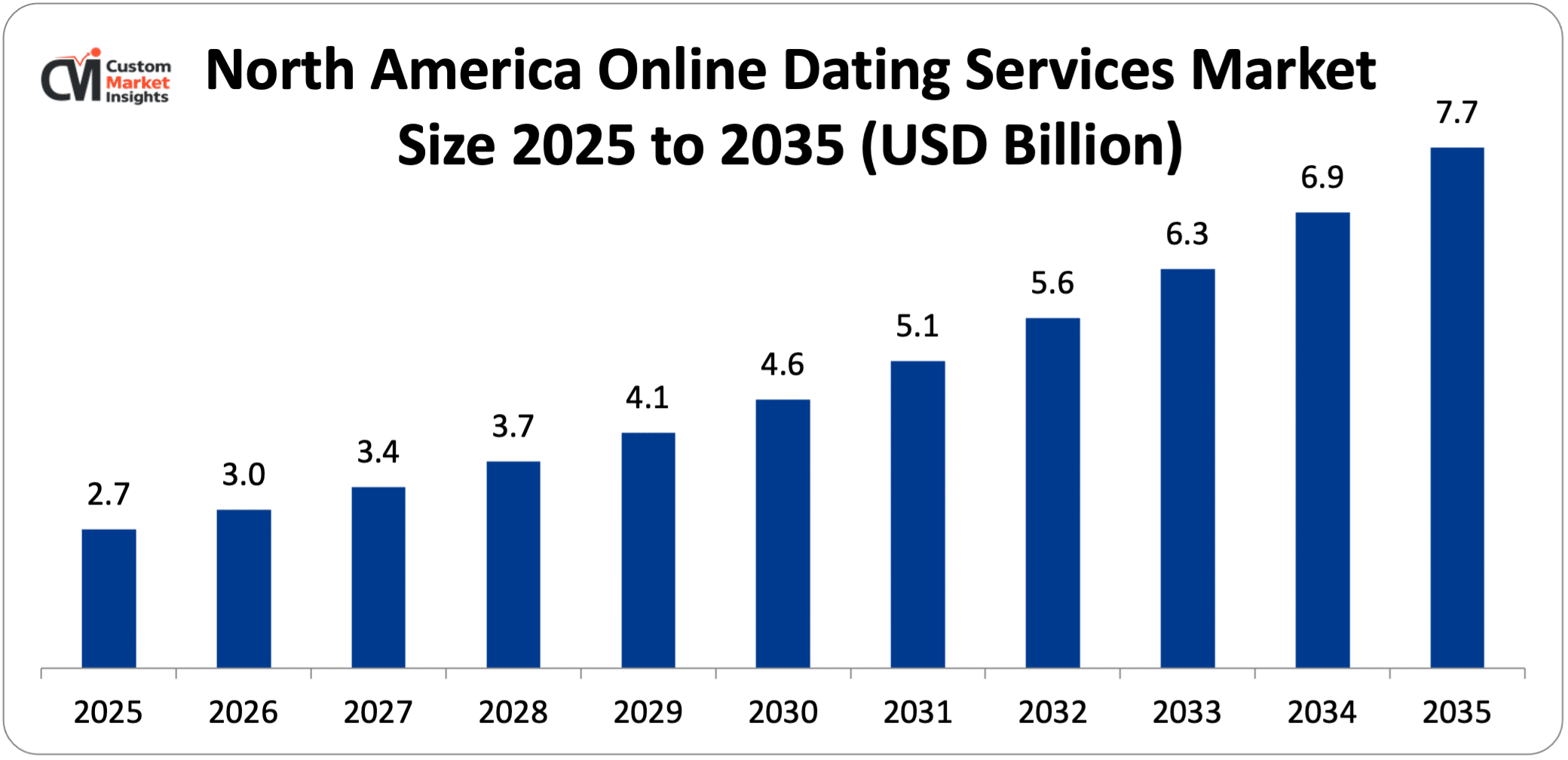
Its market size, in terms of North America online dating services, is projected to be USD 2.7 billion in 2025 with a growth of about USD 7.7 billion in 2035 with a CAGR of 10.9% between 2026 and 2035.
Why did North America Dominate the Online Dating Services Market in 2025?
In 2025, North America will dominate the global market with an estimated market share of 38%. The high adoption of digital platforms, widespread smartphone penetration, and a mature online dating market primarily drive this trend. This market has a significant mass of mature users in the US who are constantly adopting new platforms like Tinder, Bumble, and Hinge. Revenue growth has been driven by the monetization preferences shown by users on this high-engagement platform, who are willing to pay for key features like better matching algorithms, profile and presence boosts, privacy controls, etc. Additionally, the high penetration of prominent players, product innovation and diversification, monetization fit, and multiple other social factors (like postponement of marriages, high number of single households & changing relationship preferences, etc.) contribute to the market expansion. Furthermore, the high disposable income of end consumers, high smartphone penetration in the developed world, tech-savviness of the population, etc. help us generate a higher average revenue per user (ARPU).
US Online Dating Services Market Trends
In North America region, US leads the industry expansion over the projected period. In the US, revenue growth is mainly due to the moderate penetration of paid services, which require a small fee from users in return for more swipes, better- performing filters, and featured profiles in the search for more accurate match quality and visibility. Also, the constant innovations such as AI dating, video dating, and leveling-up services set the users apart, which generates more cash flow. The social trends such as late marriage, soaring single numbers, and digital dating adoption also promote the user penetration.
Why is Europe Experiencing Significant Growth in the Online Dating Services Market?
Europe holds a significant market share in 2025. The growth is driven by an increase in digital connectivity, changing social interaction, and acceptance of online dating in countries such as the United Kingdom, Germany, and France. A wide and diverse user base keeps the market growing. European revenue growth is driven by an increasing number of subscription packages subscribed to and paid by the user for additional features such as better matching, more privacy, and no ads.
Germany Online Dating Services Market Trends
Germany held the dominant position in the market in 2025. Established local platforms and innovative new features like AI match-ups and enhanced safety measures increase confidence and attractiveness. Other demographics such as later marriages, higher single-income households, and work-life balance improve the usage rates.
Why is the Asia Pacific Growing at a Highest rate in the Online Dating Services Market?
The Asia Pacific is expected to grow at a highest rate over the projected period. The Asia Pacific contains a huge and rapidly expanding digital population, with increasing smartphone penetration and social acceptance of online dating markets like India, China, and Japan. The platform is effectively sitting atop a mobile-first user base—millions of digital natives migrating to digital dating through Tinder, Bumble, and Tantan. Revenue is powering upwards due to a growth in the uptake of freemium + subscription tiered models that continue to increase matching success rate and visibility in search results and filters.
India Online Dating Services Market Trends
India holds the prominent market share in the industry. Smartphones, affordable internet, and changing social perspectives on digitalized love lives have contributed to this growth. The large youth demographic adopting mobile applications has resulted in Tinder, Bumble, and TrulyMadly becoming a runaway success in urban, tier-2, and tier-3 cities. Upward trend in revenues can be attributed to the freemium model, with a large base of free users converting into subscriptions to get advanced features like profile boosts, better filters, and visibility.
Why is the Middle East & Africa Region is growing rapidly in the Online Dating Services?
The MEA region is growing at a steady rate over the projected period. This growth is being fueled by penetration of the internet, increasing smartphone adoption, and young populations adopting digital social platforms. The leading countries in this growth are the United Arab Emirates, Saudi Arabia, and South Africa. On the other hand, revenue growth is being fueled by the increase in mobile-first users on dating apps, leading to easier access to dating services for the millennials.
UAE Online Dating Services Market Trends
The UAE is growing at the highest CAGR during the forecast period. The increasing investment in advanced technology drives the market growth.
Top Players in the Online Dating Services Market and Their Offerings
Tinder
Happn
Match Group
Zoosk
Tantan
Coffee Meets Bagel
OkCupid
Hinge
Grindr
Badoo
Plenty of Fish
eHarmony
Pure
Bumbl
Others
Key Developments
Online dating services market has experienced considerable changes in the last two years as the market players are trying to diversify their technological aspects and develop product portfolios using strategic approaches.
In June 2025, Pairs partnered with Omikare to merge online matching and offline meetups, creating blended ecosystems for authentic interactions.
These strategic measures have enabled the companies to reinforce their competitive positions, increase the product line, boost their technological competencies, and also seize growth opportunities in the fast-growing online dating services market.
The Online Dating Services Market is segmented as follows:
Who are the key players in the Online Dating Services market?
The key players in the market are Tinder, Happn, Match Group, Zoosk, Tantan, Coffee Meets Bagel, OkCupid, Hinge, Grindr, Badoo, Plenty of Fish, eHarmony, Pure, Bumble, and Others.
What role do government regulations play in shaping this market's development?
The price point significantly impacts market growth and adoption in the online dating services market, as lower entry costs (free or freemium models) attract a large user base and drive mass adoption, while competitively priced premium subscriptions encourage conversions by offering enhanced features such as better matchmaking, visibility, and security, thereby increasing user engagement and overall revenue growth.
How does the price point impact market growth and adoption?
The price point significantly impacts market growth and adoption in the online dating services market, as lower entry costs (free or freemium models) attract a large user base and drive mass adoption, while competitively priced premium subscriptions encourage conversions by offering enhanced features such as better matchmaking, visibility, and security, thereby increasing user engagement and overall revenue growth.
What is the projected market size by the end of the forecast period?
According to the present analysis and forecast modeling, the market of online dating services will witness a significant growth of about USD 21.9 billion in the year 2035 with the growing innovative product launch, increasing collaboration, growing single population & delayed marriages, and a CAGR of 11.8% between the years 2026 and 2035.
Which region is anticipated to dominate the market during the forecast period?
It is projected that North America will hold the largest market share in the online dating services market in the forecast period, with a share of about 38% of the global market share, which is attributed to the region's busy urban lifestyles.
Which region is expected to grow at the fastest CAGR in this market?
The Asia Pacific is expected to grow at the highest rate during the forecast period. The growth in the region is owing to the presence of major players and increasing penetration of smartphones.
What are the key driving factors influencing the growth of the Online Dating Services market?
The growth of the online dating services market is primarily driven by rising smartphone and internet penetration, increasing social acceptance of digital relationships, advancements in AI-based matchmaking, growing single populations with delayed marriages, and the widespread adoption of freemium models that encourage user engagement and monetization.
Ayush Kadam is a Senior Market Research Analyst at Custom Market Insights, with over seven years of experience in syndicated and custom market research. He specializes in market sizing, competitive intelligence, industry trends, forecasting, and strategic insights, helping clients turn complex data into actionable business decisions.